1.3 Kinetic and gravitational potential energy
Calculating kinetic energy (Ek = ½mv²) and gravitational potential energy (Ep = mgh), rearranging the equations, and energy changes for falling objects and rollercoasters.
Kinetic energy
Key terms
- Kinetic energy: the energy an object has because it is moving.
- Gravitational potential energy: the energy an object has because of its height above the ground in a gravitational field.
- Gravitational field strength: the force on each kilogram of mass in a gravitational field. On the surface of the Earth it is about 9.8 N/kg.
The kinetic energy of a moving object depends on its mass and its speed. The speed is squared, so doubling the speed makes the kinetic energy four times bigger.
- E_k = kinetic energy in joules (J)
- m = mass in kilograms (kg)
- v = speed in metres per second (m/s)
Example. A cyclist and bike have a combined mass of 80 kg and travel at 6 m/s.
E_k = \frac{1}{2} \times 80 \times 6^2 = 40 \times 36 = 1440 J
Remember to square the speed first, then multiply.
Gravitational potential energy
When you lift an object, you do work against gravity and transfer energy to its gravitational potential store. The higher it is, and the more massive it is, the more energy it has.
- E_p = gravitational potential energy in joules (J)
- m = mass in kilograms (kg)
- g = gravitational field strength in newtons per kilogram (N/kg), 9.8 N/kg on Earth
- h = height in metres (m)
Example. A 2.0 kg book is lifted onto a shelf 1.5 m high.
E_p = 2.0 \times 9.8 \times 1.5 = 29.4 J
Rearranging the equations
You may be asked to find the mass, the speed or the height. Rearrange first, then substitute.
- h = \frac{E_p}{m g}
- v^2 = \frac{2 E_k}{m}, so v = \sqrt{\frac{2 E_k}{m}}
Example. A ball of mass 0.50 kg has 25 J of kinetic energy. Its speed is v = \sqrt{\frac{2 \times 25}{0.50}} = \sqrt{100} = 10 m/s.
Energy changes in falling objects
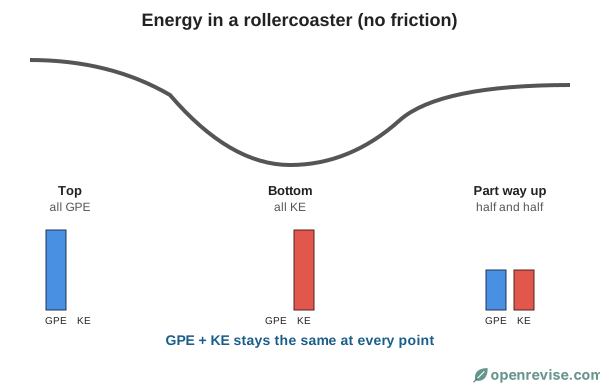
When an object falls, energy is transferred from its gravitational potential store to its kinetic store. If we ignore air resistance and friction, all the gravitational potential energy lost becomes kinetic energy:
\text{loss in } E_p = \text{gain in } E_k
A rollercoaster is a good example. At the top of the first hill the carriages have lots of gravitational potential energy and very little kinetic energy. At the bottom they have the least gravitational potential energy and the most kinetic energy, so they move fastest there. A pendulum swings in the same way, with the most kinetic energy at the lowest point.
In real life some energy is transferred to the thermal store by friction and air resistance, so the kinetic energy at the bottom is a little less than the potential energy lost.
Finding the speed from the energy transferred
If an object falls or slides without friction or air resistance, all of its gravitational potential energy is transferred to kinetic energy: m g h = \frac{1}{2} m v^2. The mass is on both sides, so it cancels:
v = \sqrt{2 g h}
Example 1. A ball falls from rest through a height of 10 m. Ignore air resistance.
v = \sqrt{2 \times 9.8 \times 10} = \sqrt{196} = 14 \text{ m/s}
Because the mass cancels, all objects fall at the same rate if there is no air resistance. A heavy and a light object dropped together reach the ground together.
Example 2: a skier. A skier of mass 60 kg starts from rest at the top of a slope that is 25 m higher than the bottom. Ignore friction.
- Gravitational potential energy lost = 60 \times 9.8 \times 25 = 14\,700 J
- This is the kinetic energy gained, so v = \sqrt{\frac{2 \times 14\,700}{60}} = \sqrt{490} = 22 \text{ m/s}
Only the vertical height matters in E_p = m g h. The length of the slope does not.
Kinetic energy and road safety
The speed in the kinetic energy equation is squared. A car of mass 1000 kg travelling at 15 m/s has E_k = \frac{1}{2} \times 1000 \times 15^2 = 112\,500 J. At 30 m/s, which is twice the speed, E_k = \frac{1}{2} \times 1000 \times 30^2 = 450\,000 J. That is four times as much. The brakes must transfer all of this energy to thermal energy to bring the car to a stop, which is why the braking distance goes up so quickly with speed, and why a small reduction in speed is important in built-up areas.
Estimating energies
You can estimate energies using g \approx 10 N/kg. An apple of mass 0.1 kg lifted by 1 m gains about 0.1 \times 10 \times 1 = 1 J. A person of mass 70 kg climbing a flight of stairs that is 3 m high gains about 70 \times 10 \times 3 = 2100 J.
Common mistakes
- Using the mass in grams. It must be in kilograms.
- Forgetting to square the speed, or squaring the \frac{1}{2} m as well.
- Using the length of a slope instead of the vertical height in m g h.
- Writing the answer without a unit. The unit is the joule (J).
Test yourself on this lesson
9 exam questions · 23 marks · with mark schemes and model answers
Found a mistake?