5.12 Speed and velocity
Speed and velocity, the equation distance = speed x time, typical speeds, average and instantaneous speed, and measuring speed with light gates.
Speed
Key terms
- Speed: how fast an object is moving, or the distance it travels per unit of time. It is a scalar.
- Velocity: the speed of an object in a particular direction. It is a vector.
- Average speed: the total distance travelled divided by the total time taken.
- Instantaneous speed: the speed of an object at a particular moment.
Speed tells you how quickly an object covers a distance. It is measured in metres per second (m/s). The speed of a real object is hardly ever constant: a car speeds up, slows down and stops. So when we calculate speed from the distance and time of a whole journey, we get the average speed.
s = v t
- s is distance in metres (m)
- v is speed in metres per second (m/s)
- t is time in seconds (s)
Rearranged: v = \frac{s}{t} and t = \frac{s}{v}.
Worked example 1. A sprinter runs 100 m in 12.5 s. Calculate her average speed.
v = \frac{s}{t} = \frac{100}{12.5} = 8.0 \text{ m/s}
Worked example 2. A cyclist travels at an average speed of 6.0 m/s for 20 minutes. How far does she travel?
Time = 20 × 60 = 1200 s, so s = v t = 6.0 \times 1200 = 7200 \text{ m} = 7.2 \text{ km}.
Worked example 3. A train at 50 m/s travels 12.5 km. How long does it take?
t = \frac{s}{v} = \frac{12\,500}{50} = 250 \text{ s} (about 4 minutes).
Converting units
Speeds in everyday life are given in km/h or miles per hour. In physics we use m/s.
- To convert from km/h to m/s: divide by 3.6. For example, 72 km/h = 20 m/s.
- To convert from m/s to km/h: multiply by 3.6.
Typical speeds
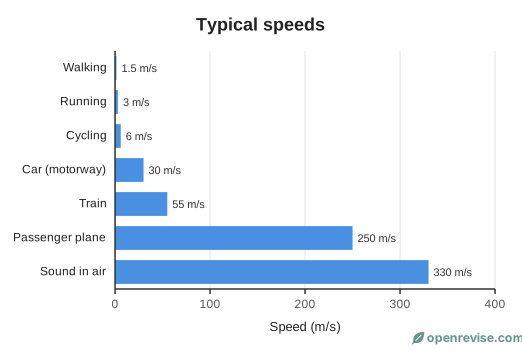
It is useful to know the approximate speeds of everyday things. These are only typical values:
- walking: about 1.5 m/s
- running: about 3 m/s
- cycling: about 6 m/s
- a car on a motorway: about 30 m/s (70 mph)
- a passenger plane: about 250 m/s
- sound in air: about 330 m/s
Wind speed varies a lot, from a light breeze of 1-2 m/s to a hurricane of more than 30 m/s. Because of this, the speed of an object in the wind can be different from its speed in still air.
Worked example 4: using the speed of sound. A student claps their hands near a large wall and hears the echo 1.0 s later. The sound has travelled to the wall and back, a distance of 330 \times 1.0 = 330 \text{ m}. So the wall is 165 m away.
Velocity
Velocity is speed with a direction. A car travelling at 20 m/s east has a velocity of 20 m/s east. Two objects can have the same speed but a different velocity, if they are going in different directions. When you use a positive and negative direction, a velocity of −5 m/s means 5 m/s in the opposite direction.
Measuring speed
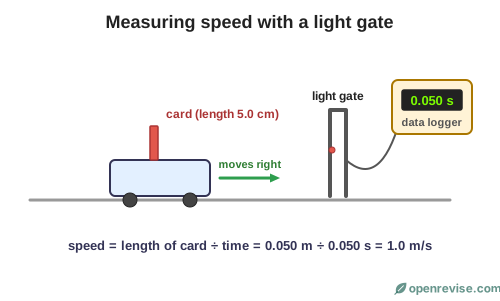
To find the speed of a trolley accurately, a light gate is used. A card of known length is fixed to the trolley. As the card passes through the gate it blocks a beam of light, and a data logger records the time for which the beam was blocked. Then the speed = length of card ÷ time. This gives the speed at that instant, which is better than using a stopwatch because it avoids human reaction time errors. Other methods use a ruler and a stopwatch (the speed is a mean over the distance measured) or video analysis.
Test yourself on this lesson
9 exam questions · 21 marks · with mark schemes and model answers
Found a mistake?