5.11 Atmospheric pressure
The atmosphere as a thin layer of air, how atmospheric pressure is caused by air molecules colliding with surfaces, and why it decreases with height. For Separate Science.
The atmosphere
Key terms
- Atmosphere: the layer of gases that surrounds the Earth, held in place by gravity.
- Atmospheric pressure: the pressure caused by the weight of the air above, due to air molecules colliding with surfaces.
- Altitude: the height above sea level.
- Barometer: an instrument used to measure atmospheric pressure.
The Earth is surrounded by a layer of gas called the atmosphere. It is made mostly of nitrogen (about 78%) and oxygen (about 21%). Compared with the size of the Earth, the atmosphere is a very thin layer: the Earth has a radius of about 6400 km, but most of the air is within about 10 km of the surface. If the Earth were the size of an apple, the atmosphere would be about as thick as the apple's skin.
The atmosphere gets thinner (less dense) with height, and gradually fades out into space. There is no sharp edge at the top.
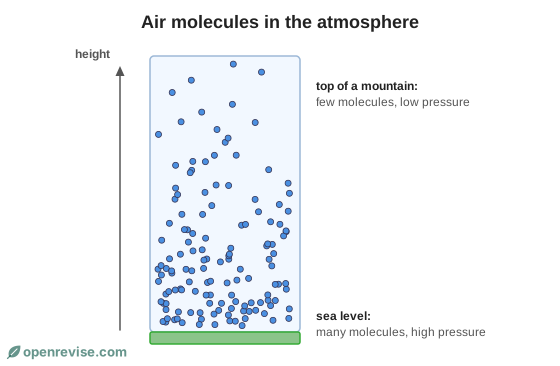
What causes atmospheric pressure?
Air is a fluid, so the particles move around randomly and collide with every surface they meet, including you. Each collision exerts a tiny force. The very large number of collisions each second adds up to a force on the surface, and so to a pressure. Because the particles bounce off in all directions, the pressure acts in all directions and at right angles to the surface. At the same time, the atmospheric pressure at any point is related to the weight of the air above that point.
At sea level, atmospheric pressure is about 100 000 Pa (100 kPa), which is the same as the weight of about a thousand kilograms on every square metre. We do not feel it, because the pressure inside our bodies is the same, so the forces are balanced. Windows do not break for the same reason: the pressure on both sides is equal.
Worked example. Calculate the force on a table of area 1.5 m² caused by atmospheric pressure of 100 kPa.
F = p A = 100\,000 \times 1.5 = 150\,000 \text{ N}
This is a huge force, but there is an equal force of air pushing up on the underside of the table, so the table is not crushed.
Atmospheric pressure and height
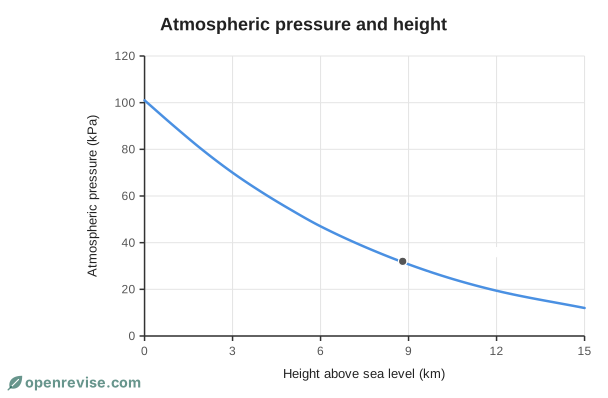
As you go higher in the atmosphere, the atmospheric pressure decreases. There are two linked reasons:
- There is less air above you, so the weight of the air pressing down is smaller.
- The air is less dense at higher altitude: there are fewer air molecules in a given volume, so there are fewer collisions with a surface each second, and the pressure is lower.
The graph shows the pressure falling by about a half for every 5.5 km of height. At the top of Mount Everest (about 8.8 km), the pressure is only about one-third of that at sea level.
Effects of changes in atmospheric pressure
- Popping ears: when you go up in an aircraft or a lift, the pressure outside falls. The higher pressure in your middle ear pushes air out through the Eustachian tube, which makes your ears pop.
- Breathing at altitude: there are fewer oxygen molecules in each breath of air, so mountaineers breathe harder, and may need extra oxygen.
- Sealed packets (such as crisp packets) swell up as they are taken up a mountain, because the air pressure outside decreases while the pressure inside stays the same.
- Drinking through a straw: sucking reduces the pressure inside the straw. The higher atmospheric pressure on the surface of the drink then pushes the liquid up the straw.
- Suction cups stick because the air is pushed out, and the atmospheric pressure outside holds them against the surface.
Weather
Atmospheric pressure at a place changes slightly from day to day, as the weather changes. A barometer measures it. Falling pressure often means that rain or storms are on the way, and rising pressure is usually linked with settled, dry weather.
Test yourself on this lesson
9 exam questions · 20 marks · with mark schemes and model answers
Found a mistake?