5.23 Changes in momentum and car safety
Higher tier: force as the rate of change of momentum, F = change in momentum / time, and how crumple zones, seat belts, airbags and helmets reduce the force in a collision.
Force and change of momentum
Key terms
- Change in momentum: the final momentum minus the initial momentum.
- Crumple zone: a part of a car that is designed to collapse in a crash, so that the car takes longer to stop.
- Impact time: the time over which a collision takes place.
Newton's second law can be written in a different form that links force to momentum. Starting from F = m a and a = \frac{v - u}{t}:
F = \frac{m (v - u)}{t} = \frac{m v - m u}{t}
Since m v - m u is the change in momentum:
F = \frac{\Delta p}{\Delta t} = \frac{m \Delta v}{\Delta t}
So the resultant force on an object is the rate of change of its momentum. The same change in momentum can be caused by a large force acting for a short time or by a smaller force acting for a longer time.
Worked example 1. A 1000 kg car travelling at 20 m/s hits a wall and stops. Compare the force if the car stops in 0.10 s with the force if it stops in 0.50 s.
- Change in momentum = 1000 \times 20 = 20\,000 \text{ kg m/s}
- Stopping in 0.10 s: F = \frac{20\,000}{0.10} = 200\,000 \text{ N}
- Stopping in 0.50 s: F = \frac{20\,000}{0.50} = 40\,000 \text{ N}
A five times longer impact gives a five times smaller force. This is the basis of almost all safety design.
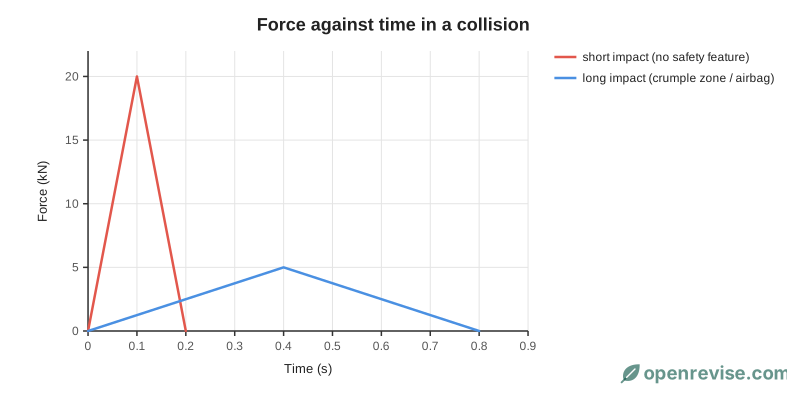
The two curves represent the same change in momentum (the area under each graph is the same). The short impact has a very high peak force, and the longer one has a smaller peak force.
Reducing the force in a collision
To reduce the force on a person, we increase the time over which they stop, or the distance in which they stop.
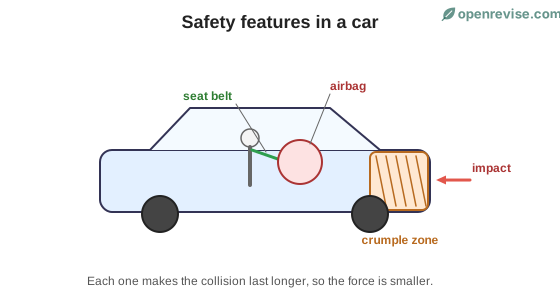
- Crumple zones at the front and back of a car are designed to crumple in a collision. This makes the collision last longer, so the force on the passengers is smaller. The kinetic energy is transferred to the car's deformation, rather than to the occupants.
- Seat belts stretch slightly in a collision. They stop the passenger hitting the windscreen, and increase the time it takes to slow the passenger, which reduces the force. They also spread the force over the strong parts of the body.
- Airbags inflate and provide a soft cushion. The passenger's head and chest take longer to stop, and the force is spread over a larger area, which reduces the pressure on the body.
- Crash helmets have a layer of soft foam that crushes in a collision, increasing the time that the head takes to stop.
Worked example 2. A passenger of mass 70 kg is travelling at 15 m/s when the car hits a wall. Compare the force if the passenger stops in 0.05 s, with the force when an airbag makes the stopping time 0.20 s.
- Change in momentum = 70 \times 15 = 1050 \text{ kg m/s}
- Without an airbag: F = \frac{1050}{0.05} = 21\,000 \text{ N}
- With an airbag: F = \frac{1050}{0.20} = 5250 \text{ N}
Other examples
- Catching a fast cricket ball: you move your hands backwards as you catch it. This increases the time over which the ball stops, so the force on your hands is smaller and it hurts less.
- Gym mats and playground surfaces: these are soft, so a falling person takes longer to stop and experiences a smaller force.
- Bending your knees when landing: this increases the time over which you stop.
- Packaging for delicate things uses foam to increase the stopping time.
Common errors
- Safety features do not reduce the change in momentum. The change in momentum when a passenger stops is the same. They reduce the force by increasing the time.
- Do not say that crumple zones "absorb the force". They increase the time of the collision, and absorb the energy.
Test yourself on this lesson
9 exam questions · 27 marks · with mark schemes and model answers
Found a mistake?