5.22 Momentum and its conservation
Higher tier: momentum as mass times velocity, the principle of conservation of momentum in collisions and explosions, and how to use it in calculations.
Momentum
Key terms
- Momentum: a measure of how hard it is to stop a moving object. It is the product of mass and velocity, and is a vector.
- Conservation of momentum: in a closed system, the total momentum before an event is equal to the total momentum after the event.
- Closed system: a system in which no external forces act.
- Recoil: the backward movement of a gun, or similar object, when it fires something forward.
A lorry moving at 5 m/s is much harder to stop than a bicycle moving at 5 m/s. A fast ball is harder to stop than a slow one of the same mass. Both the mass and the velocity matter. Momentum takes both into account.
p = m v
- p is momentum in kilogram metres per second (kg m/s)
- m is mass in kilograms (kg)
- v is velocity in metres per second (m/s)
Momentum is a vector, so it has a direction, which is the same as the direction of the velocity. One direction is chosen as positive, and the opposite as negative.
Worked example 1. Calculate the momentum of a 1200 kg car travelling at 15 m/s east.
p = m v = 1200 \times 15 = 18\,000 \text{ kg m/s} east
Worked example 2. A 0.060 kg tennis ball moves at 40 m/s to the right. Then it is hit back at 30 m/s to the left. The momentum is 0.060 \times 40 = +2.4 \text{ kg m/s} before, and 0.060 \times (-30) = -1.8 \text{ kg m/s} after.
Conservation of momentum
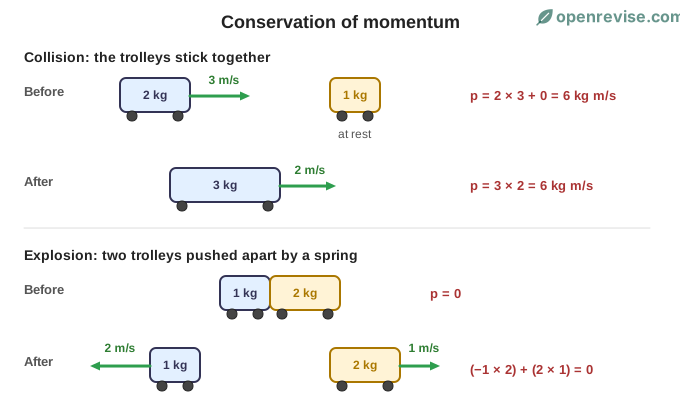
In a closed system, the total momentum before an event is equal to the total momentum after, whatever happens. This is the principle of conservation of momentum. Individual objects can gain or lose momentum, but the total is constant.
\text{total momentum before} = \text{total momentum after}
Collisions
Worked example 3: trolleys that stick together. A 2.0 kg trolley moves at 3.0 m/s and hits a stationary 1.0 kg trolley. They stick together. Calculate their speed after the collision.
- Momentum before = (2.0 \times 3.0) + (1.0 \times 0) = 6.0 \text{ kg m/s}
- Momentum after = (2.0 + 1.0) \times v = 3.0 v
- 3.0 v = 6.0, so v = 2.0 \text{ m/s}
The total momentum is the same, 6.0 kg m/s, but the speed has decreased because the mass has increased.
Worked example 4: bouncing apart. A 1.0 kg trolley moves at 2.0 m/s to the right and hits a stationary 1.0 kg trolley. After the collision, the first stops, and the second moves off. Using momentum: 1.0 \times 2.0 = 0 + 1.0 \times v, so v = 2.0 \text{ m/s}.
Explosions and recoil
In an explosion, objects that are at rest start to move apart. The total momentum before is zero, so the total after must also be zero. This means that the momenta of the parts are equal in size and opposite in direction.
Worked example 5: a trolley explosion. Two trolleys, of mass 1.0 kg and 2.0 kg, are at rest, pushed apart by a spring. The 1.0 kg trolley moves to the left at 2.0 m/s. Calculate the velocity of the other trolley.
- Total momentum after = 0
- (1.0 \times -2.0) + (2.0 \times v) = 0
- v = +1.0 \text{ m/s} to the right
Worked example 6: a gun recoiling. A gun of mass 2.0 kg fires a bullet of mass 0.010 kg at 400 m/s. Before firing, the total momentum is zero.
- 0 = (0.010 \times 400) + (2.0 \times v)
- v = -2.0 \text{ m/s}
The gun recoils backwards at 2.0 m/s. It moves much more slowly than the bullet because it has a much larger mass.
Using the principle in calculations
- Choose a positive direction (usually right).
- Write down the mass and the velocity (with sign) of each object, before and after.
- Write: total momentum before = total momentum after.
- Solve for the unknown.
Test yourself on this lesson
9 exam questions · 25 marks · with mark schemes and model answers
Found a mistake?