6.1 Transverse and longitudinal waves
Waves transfer energy without transferring matter; transverse and longitudinal waves, compressions and rarefactions, and evidence that the medium does not travel with the wave.
What is a wave?
Key terms
- Wave: a disturbance that transfers energy (and information) from one place to another, without transferring matter.
- Oscillation: a repeated back-and-forth or up-and-down movement.
- Medium: the substance (solid, liquid or gas) that a wave travels through.
- Transverse wave: a wave in which the oscillations are at right angles to the direction of energy transfer.
- Longitudinal wave: a wave in which the oscillations are parallel to the direction of energy transfer.
Waves are all around you. You hear sound waves, see light waves, and feel the warmth of infrared waves from the Sun. Ripples spread out on a pond and waves crash onto a beach. All waves have one important thing in common: they transfer energy from a source to somewhere else, without carrying the material of the medium with them.
Waves transfer energy, not matter
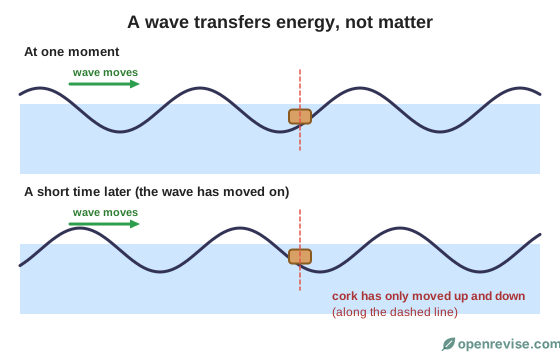
Imagine a cork floating on a pond. When a ripple passes, the cork bobs up and down but it does not travel along with the wave. The water particles also just move up and down (and a little back and forth) about a fixed position. The wave is the pattern of disturbance that moves across, and it carries energy, which is why it can make the cork move.
Other evidence:
- A Mexican wave in a stadium moves round the crowd, but each person just stands up and sits down in the same place.
- When a loudspeaker plays, sound travels to your ear, but the air is not blown from the speaker to your ear (a candle flame next to the speaker flickers, but is not blown out).
- A wave sent down a long rope moves along it, but the rope does not move away from its place.
Transverse waves
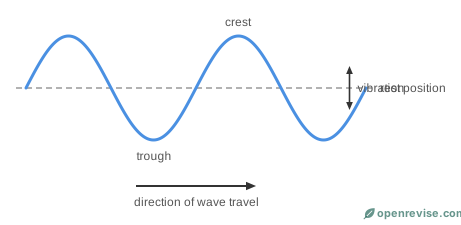
In a transverse wave, the particles of the medium (or the field) vibrate at right angles to the direction the wave is travelling.
- The top of the wave is a crest and the bottom is a trough.
- Examples: ripples on water, waves on a rope or a string, all electromagnetic waves (including light, radio waves and X-rays) and S-waves (a type of seismic wave).
Longitudinal waves
In a longitudinal wave, the particles vibrate parallel to the direction of the wave's travel (backwards and forwards along the same line).
- The wave is made of regions where the particles are squashed together, called compressions, and regions where they are spread out, called rarefactions.
- Examples: sound waves, ultrasound, and P-waves (a type of seismic wave).
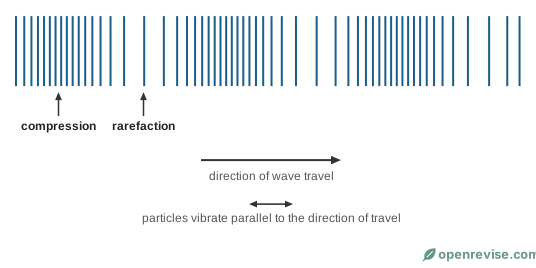
You can show both types with a slinky spring. If you flick one end up and down, a transverse wave travels along it. If you push and pull the end along the spring's length, a longitudinal wave of compressions and rarefactions travels along it.
| Feature | Transverse wave | Longitudinal wave |
|---|---|---|
| Direction of oscillation | At right angles to the direction of travel | Parallel to the direction of travel |
| Parts of the wave | Crests and troughs | Compressions and rarefactions |
| Examples | Light and other electromagnetic waves, ripples on water, S-waves | Sound, ultrasound, P-waves |
| Can travel through a vacuum? | Electromagnetic waves can | No: needs a medium to travel through |
Mechanical and electromagnetic waves
Mechanical waves (sound, water waves, seismic waves) need a medium because they are made by particles passing on the vibration to their neighbours. They cannot travel through a vacuum, which is why there is no sound in space. Electromagnetic waves are different: they are vibrations of electric and magnetic fields, so they can travel through a vacuum. That is how light reaches the Earth from the Sun.
Describing waves
When you describe how a wave moves, always say what is moving (the energy or the pattern) and what is not moving (the material). A good answer would be: "the particles oscillate about a fixed position, and energy is transferred in the direction of the wave".
Test yourself on this lesson
9 exam questions · 18 marks · with mark schemes and model answers
Found a mistake?