7.3 The motor effect and Fleming's left-hand rule
Higher tier: the force on a current-carrying wire in a magnetic field (the motor effect), Fleming's left-hand rule, and the equation F = BIl with magnetic flux density in tesla.
The motor effect
Key terms
- Motor effect: when a wire carrying a current is placed in a magnetic field, it experiences a force.
- Magnetic flux density (B): a measure of the strength of a magnetic field. It is measured in tesla (T).
- Fleming's left-hand rule: a rule for finding the direction of the force on a current-carrying wire in a magnetic field.
When a wire carries a current, it has its own magnetic field around it. If the wire is placed in the field of a permanent magnet (or another current), the two magnetic fields interact, and the wire feels a force. This is called the motor effect, because it is the principle behind the electric motor.
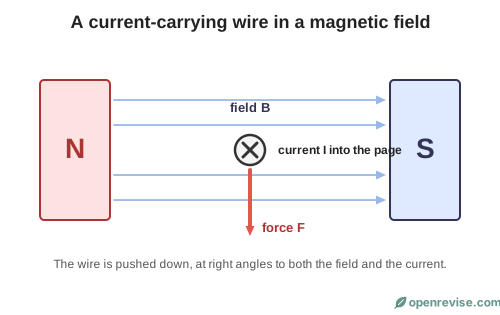
In the diagram, the field goes from the north pole to the south pole, from left to right. The current goes into the page. The wire is pushed downwards.
- The force is biggest when the wire is at right angles to the field.
- The force is zero when the wire is parallel to the field.
- If the wire is at an angle in between, there is a force, but it is smaller.
Fleming's left-hand rule
The force on the wire is at right angles to both the field and the current. You can find its direction using Fleming's left-hand rule.
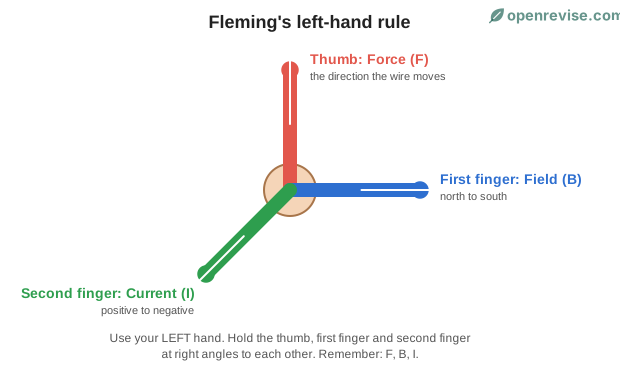
Hold the thumb, the first finger and the second finger of your left hand at right angles to each other.
- Thumb: the direction of the force (or motion).
- First finger: the direction of the magnetic field (north to south).
- Second finger: the direction of the current (positive to negative, the conventional current).
A useful memory aid is F-B-I (Force, magnetic field B, Current I), in the order thumb, first finger, second finger.
If the current is reversed, or the field is reversed, the force is reversed. If both are reversed, the force is in the same direction.
The size of the force
For a wire at right angles to a magnetic field:
F = B I l
- F is the force in newtons (N)
- B is the magnetic flux density in tesla (T)
- I is the current in amperes (A)
- l is the length of the wire that is in the field in metres (m)
The tesla is the unit of magnetic flux density. A strong fridge magnet has about 0.01 T, and the field in an MRI scanner is about 1.5 T to 3 T. The Earth's field is about 0.00005 T.
Worked example 1. A wire of length 0.10 m in a field of 0.20 T carries a current of 5.0 A. Calculate the force.
F = B I l = 0.20 \times 5.0 \times 0.10 = 0.10 \text{ N}
Worked example 2. A wire experiences a force of 0.60 N when 0.40 m of it is in a field of 0.30 T. Calculate the current.
I = \frac{F}{B l} = \frac{0.60}{0.30 \times 0.40} = 5.0 \text{ A}
Worked example 3. A force of 0.15 N acts on a 0.050 m length of wire carrying 3.0 A. Calculate the magnetic flux density.
B = \frac{F}{I l} = \frac{0.15}{3.0 \times 0.050} = 1.0 \text{ T}
Making the force bigger
The force on the wire increases if you:
- use a stronger magnet (increase the flux density B);
- increase the current;
- use a longer length of wire in the field (for example, by using a coil with many turns).
Demonstrations
In a simple demonstration, a metal rod lies on two rails between the poles of a magnet. When a current is passed through the rod, it is pushed along the rails by the motor effect, and rolls. If the current or the magnet is reversed, the rod rolls the other way. This demonstrates the motor effect, which is used in the electric motor, the loudspeaker and the moving-coil meter.
Test yourself on this lesson
10 exam questions · 24 marks · with mark schemes and model answers
Found a mistake?