3.3 Changes of state and internal energy
Changes of state as physical changes in which mass is conserved, and internal energy as the total kinetic and potential energy of the particles in a system.
Changes of state
Key terms
- Change of state: a change between solid, liquid and gas, such as melting, freezing, boiling and condensing.
- Physical change: a change that can be reversed, in which no new substances are made.
- Internal energy: the total kinetic energy and potential energy of all the particles that make up a system.
- Conservation of mass: the mass of a substance stays the same after a change of state.
The five changes of state are melting (solid to liquid), freezing (liquid to solid), boiling or evaporating (liquid to gas), condensing (gas to liquid) and sublimation (solid directly to gas).
Mass is conserved
When a substance changes state, the number of particles stays the same, so the mass stays the same. For example, 0.5 kg of ice melts into 0.5 kg of water. Only the arrangement and the movement of the particles change.
A change of state is a physical change, not a chemical change, because no new substance is made. If you cool the substance, it returns to its original state, so the change is reversible.
Internal energy
The particles in a substance have two kinds of energy:
- Kinetic energy: the particles are moving or vibrating.
- Potential energy: the particles are held together by attractive forces. This store is higher when the particles are further apart.
The internal energy of a substance is the sum of these two for all its particles.
Heating a substance increases its internal energy. This can have two different effects:
- The temperature rises, because the particles gain kinetic energy.
- The substance changes state, because the particles gain potential energy as they are pulled apart. The temperature does not change while this happens.
A heating curve
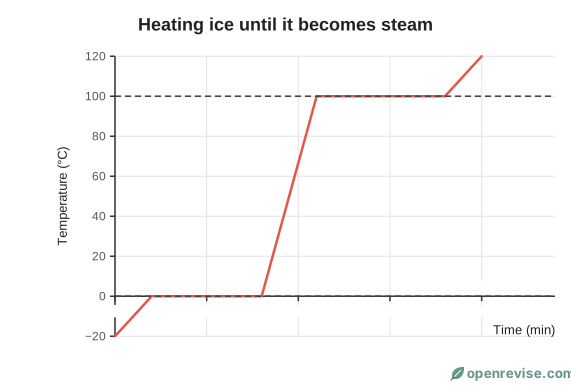
The curve above shows ice being heated steadily.
- The temperature rises as the ice warms (kinetic energy rises).
- At 0 °C the temperature stays constant while the ice melts. The energy supplied increases the potential energy of the particles.
- The temperature of the water rises again until it reaches 100 °C.
- At 100 °C the temperature stays constant while the water boils.
- Once all of the water is steam, the temperature of the steam rises.
When a substance is cooled, the same stages happen in reverse: energy is transferred out, and at the melting and boiling points the temperature stays constant as the particles come together.
The particle model of solids, liquids and gases
| Property | Solid | Liquid | Gas |
|---|---|---|---|
| Arrangement of particles | Regular, close together | Close together, random | Far apart, random |
| Movement of particles | Vibrate about fixed positions | Move around each other | Move quickly in all directions |
| Forces between particles | Strong | Weaker | Almost none |
| Density | High | High (usually slightly lower than the solid) | Very low |
| Shape and volume | Fixed shape and volume | Takes the shape of its container; fixed volume | Fills its container; can be compressed |
Evaporation and boiling
Evaporation happens at the surface of a liquid, at any temperature. The fastest particles have enough energy to escape from the liquid. Since the fastest particles escape, the average kinetic energy of the remaining particles falls, so the liquid cools. This is how sweating cools you down.
Boiling happens throughout the liquid, at its boiling point, when bubbles of vapour form all through it.
Sublimation is when a solid changes straight to a gas, without becoming a liquid first. Solid carbon dioxide (dry ice) does this.
Internal energy and temperature
The temperature of a substance is related to the average kinetic energy of its particles. The internal energy is the total kinetic and potential energy of all the particles. So two objects at the same temperature can have different internal energies. A bath of water at 30 °C has far more internal energy than a cup of water at 30 °C, since it has many more particles. Doubling the mass of a substance at the same temperature doubles its internal energy.
Pure and impure substances
A pure substance melts and boils at a sharp temperature, which is why the heating curve has flat sections. An impure substance melts over a range of temperatures, and the melting point is lowered. Salt added to ice lowers its melting point, which is why salt is spread on roads in winter.
Mass and volume
When a substance changes state, its mass stays the same, but its volume can change. For example, 250 g of ice melts to make 250 g of water, but the volume gets smaller, since ice takes up more space. When water boils to make steam, the volume increases by around 1600 times.
Test yourself on this lesson
9 exam questions · 21 marks · with mark schemes and model answers
Found a mistake?