3.4 Specific heat capacity
Specific heat capacity, the equation change in thermal energy = mass x specific heat capacity x temperature change, and why water takes so much energy to heat.
Specific heat capacity
Key terms
- Specific heat capacity: the energy needed to raise the temperature of 1 kg of a substance by 1 °C.
- Temperature change: the final temperature minus the starting temperature, in °C.
Different materials need different amounts of energy to warm up. A saucepan made of metal heats up in seconds, but the water in it takes much longer. This is because the specific heat capacity of water is much bigger than that of metal.
- A material with a high specific heat capacity needs a lot of energy to warm up, and it also releases a lot of energy when it cools.
- A material with a low specific heat capacity warms up and cools down quickly.
| Material | Specific heat capacity (J/kg °C) |
|---|---|
| Water | 4200 |
| Aluminium | 900 |
| Iron | 450 |
| Copper | 390 |
The equation
\Delta E = m c \Delta \theta
- \Delta E is the change in thermal energy in joules (J)
- m is the mass in kilograms (kg)
- c is the specific heat capacity in joules per kilogram per degree Celsius (J/kg °C)
- \Delta \theta is the temperature change in degrees Celsius (°C)
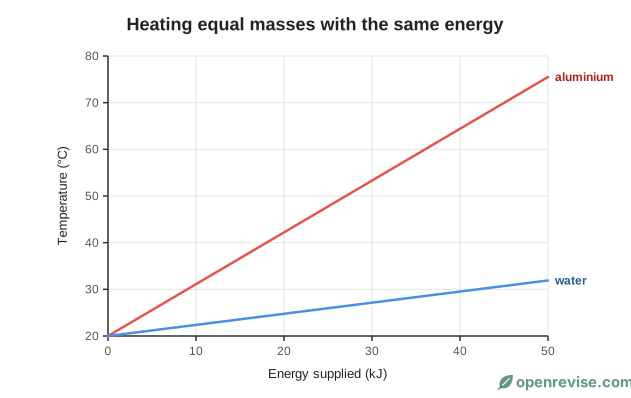
The graph shows that when the same energy is supplied to equal masses, aluminium warms up much faster than water, because it has a much lower specific heat capacity.
Worked example 1. Calculate the energy needed to heat 2.0 kg of water from 20 °C to 60 °C. (c = 4200 \text{ J/kg °C})
\Delta \theta = 60 - 20 = 40 \text{ °C}
\Delta E = m c \Delta \theta = 2.0 \times 4200 \times 40 = 336\,000 \text{ J}
Worked example 2. 18 000 J is supplied to 2.0 kg of a metal, and its temperature rises by 10 °C. Calculate its specific heat capacity.
c = \frac{\Delta E}{m \Delta \theta} = \frac{18\,000}{2.0 \times 10} = 900 \text{ J/kg °C}
Why water is useful
Water has a very high specific heat capacity, so a small mass of water can store a lot of energy and releases it slowly as it cools. That is why water is used in central heating systems and as a coolant in car engines.
Finding the final temperature
The equation gives the change in temperature. To find the final temperature, add the change to the starting temperature.
Example 1. A 0.50 kg block of copper at 20 °C is supplied with 1950 J of energy. The specific heat capacity of copper is 390 J/kg °C.
\Delta \theta = \frac{\Delta E}{m c} = \frac{1950}{0.50 \times 390} = 10 \text{ °C}
The final temperature is 20 + 10 = 30 °C.
Example 2. How much energy is needed to heat a 250 g aluminium pan from 20 °C to 100 °C? (c = 900 J/kg °C)
m = 0.250 kg and \Delta \theta = 100 - 20 = 80 °C.
\Delta E = m c \Delta \theta = 0.250 \times 900 \times 80 = 18\,000 J (18 kJ)
Heating a bath
Example 3. A bath contains 100 kg of water at 20 °C. How much energy is needed to heat it to 40 °C?
\Delta E = 100 \times 4200 \times 20 = 8\,400\,000 J, which is 8.4 MJ.
To change joules to kilowatt-hours, divide by 3 600 000: \frac{8\,400\,000}{3\,600\,000} = 2.3 kWh. At 30p per kWh, the energy costs about 70p.
Why does water's high specific heat capacity matter?
- Central heating and hot-water bottles: water stores a lot of energy for each kilogram, and releases it slowly as it cools.
- Cooling engines: water in a car's radiator takes in a lot of energy from the hot engine without a large rise in its own temperature.
- Coastal climates: the sea warms up and cools down much more slowly than the land. Places near the sea therefore have milder weather, cooler summers and warmer winters, than places far inland.
A checklist for these calculations
- Write down m, c, \Delta E or \Delta \theta with units.
- Convert the mass to kilograms and the energy to joules.
- Rearrange the equation for the quantity you need.
- If you are asked for the final temperature, add the change to the starting temperature.
- Check that the answer is sensible.
Test yourself on this lesson
9 exam questions · 23 marks · with mark schemes and model answers
Found a mistake?