3.2 Required practical: density
Required practical: measure the density of a regular solid, an irregular solid and a liquid using a ruler, a eureka can, a measuring cylinder and a balance.
Aim
To find the density of regular solids, irregular solids and liquids by measuring their mass and volume.
Key terms
- Displacement: when an object is placed in water it pushes out (displaces) a volume of water equal to its own volume.
- Eureka can: a container with a spout, used to measure the volume of an irregular object by displacement.
- Meniscus: the curved surface of a liquid in a narrow tube.
The density of each substance is found using
\rho = \frac{m}{V}
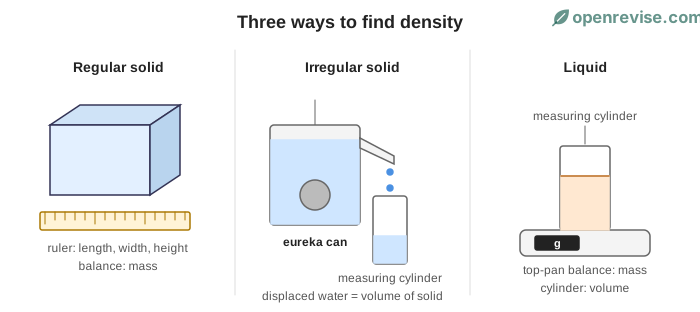
Method 1: a regular solid
- Measure the mass of the object on a top-pan balance.
- Measure the length, width and height with a ruler (or the diameter and length for a cylinder).
- Calculate the volume: for a cuboid, volume = length × width × height.
- Calculate the density using \rho = \frac{m}{V}.
Method 2: an irregular solid
- Measure the mass of the object on a balance.
- Fill a eureka can with water until it just starts to overflow from the spout, and wait until the dripping stops.
- Place a measuring cylinder under the spout.
- Lower the object gently into the can using a thread. It must be fully submerged.
- Collect all of the water that flows out. The volume of this water equals the volume of the object.
- Calculate the density.
Method 3: a liquid
- Place an empty measuring cylinder on the balance and record its mass (or press the tare button to reset the balance to zero).
- Pour in some of the liquid, and read the volume at eye level from the bottom of the meniscus.
- Measure the mass of the cylinder and liquid together.
- The mass of the liquid is the difference between the two readings.
- Calculate the density.
Precautions and sources of error
- Read the balance when the reading is steady, and check it reads zero before you start.
- Read the measuring cylinder at eye level, so the reading is not affected by parallax.
- In the eureka can, wait for dripping to stop, and make sure no water is left behind in the spout or lost when the object is lowered in.
- Take several measurements of each length with a ruler and find a mean. Use the smallest measuring cylinder that holds the water, so the scale gives the most precise reading.
Example results
Regular solid. A metal cuboid has a mass of 135.0 g. Its dimensions are 5.0 cm, 2.0 cm and 5.0 cm.
- Volume = 5.0 \times 2.0 \times 5.0 = 50 cm³
- Density = \frac{135.0}{50} = 2.7 g/cm³
Irregular solid. A stone has a mass of 81 g and displaces 30 cm³ of water.
- Density = \frac{81}{30} = 2.7 g/cm³
Liquid. An empty measuring cylinder has a mass of 85 g. With 40 cm³ of a liquid in it, the mass is 117 g.
- Mass of the liquid = 117 - 85 = 32 g
- Density = \frac{32}{40} = 0.80 g/cm³
You can check your answer by comparing it with the known values of the density of common materials. Both solids above have a density of 2.7 g/cm³, which is the density of aluminium.
Reducing the uncertainty
Every measurement has an uncertainty. A ruler with 1 mm divisions can be read to about ± 0.5 mm. The percentage uncertainty is the uncertainty divided by the measurement, multiplied by 100.
- For a length of 10 mm: \frac{0.5}{10} \times 100 = 5\%
- For a length of 50 mm: \frac{0.5}{50} \times 100 = 1\%
The volume of a cuboid is found from three lengths, so these percentages add up: about 15% for a small cube, and about 3% for a large one. To get the best result, use the largest object that you can, or a more precise instrument, such as a micrometer or vernier callipers, for small objects.
Other tips
- Objects that float: an object such as a piece of wood floats, so you cannot use a eureka can to find its volume. You can tie a heavy object (a sinker) to it, to hold it under the water, and subtract the volume of the sinker.
- Using a measuring cylinder for an irregular solid: record the volume of water before, put in the object, and record the volume after. The difference is the volume of the object.
- Take readings of mass using a balance with a reading of 0.1 g, and make sure it is zeroed first.
- Repeat the measurements and take a mean, to reduce the effect of random errors.
Test yourself on this lesson
9 exam questions · 22 marks · with mark schemes and model answers
Found a mistake?