3.7 Particle motion and gas pressure
The random motion of gas particles, how collisions with the walls cause pressure, how temperature affects pressure at constant volume, and the kelvin scale and absolute zero.
Gas particles and pressure
Key terms
- Gas pressure: the force that the gas particles exert on the walls of their container, for each unit of area.
- Absolute zero: the lowest possible temperature, 0 K (−273 °C), at which the particles have the least possible kinetic energy.
- Kelvin scale: a temperature scale that starts at absolute zero. One kelvin is the same size as one degree Celsius.
The particles in a gas move around randomly at high speeds. They travel in straight lines until they collide with another particle or with the walls of their container, and then they change direction.
When a particle hits a wall it bounces off. This changes its momentum, so the wall exerts a force on the particle, and the particle exerts an equal force on the wall. The very large number of collisions each second adds up to a steady force on the wall. The pressure of the gas is this force per unit area.
Temperature and the motion of particles
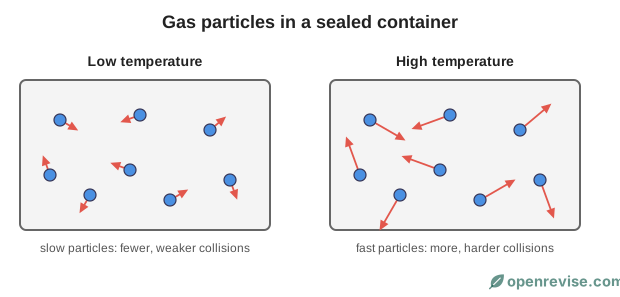
The temperature of a gas is related to the average kinetic energy of its particles. When the temperature increases:
- the particles move faster;
- they hit the walls more often;
- each collision is harder, so the force is larger.
So for a gas at a constant volume, increasing the temperature increases the pressure.
The kelvin scale and absolute zero
As a gas is cooled, its particles move more slowly and the pressure falls. At absolute zero the particles would have no (or the lowest possible) kinetic energy. This temperature is −273 °C, which is 0 kelvin (0 K).
To convert between the two scales:
\text{temperature in K} = \text{temperature in °C} + 273
\text{temperature in °C} = \text{temperature in K} - 273

For gases at constant volume, the pressure is directly proportional to the temperature in kelvin. Doubling the temperature in kelvin doubles the pressure.
Evidence that the particles are moving
When you look at smoke particles in air through a microscope, you can see them jiggling about at random. This is called Brownian motion. The smoke particles are big enough to see, but the air particles are far too small to see. The smoke particles are moving because they are being hit by the tiny, fast-moving air particles from all sides, and the hits are not quite balanced. It is good evidence that the particles in a gas move randomly.
Pressure and temperature: some numbers
At a constant volume, the pressure of a gas is directly proportional to its temperature in kelvin.
Example 1. A sealed container holds gas at 300 K and a pressure of 100 kPa. It is heated to 600 K. The temperature in kelvin has doubled, so the pressure doubles to 200 kPa.
Example 2. The same gas is heated from 20 °C to 40 °C. In kelvin, these are 293 K and 313 K. The pressure changes by \frac{313}{293} = 1.07, an increase of only 7%. The temperature in degrees Celsius has doubled, but the pressure has not, which is why you must always use kelvin.
Converting temperatures
| Temperature | In °C | In K |
|---|---|---|
| Absolute zero | −273 | 0 |
| Liquid nitrogen boils | −196 | 77 |
| Water freezes | 0 | 273 |
| Room temperature | 25 | 298 |
| Water boils | 100 | 373 |
A change of 1 °C is the same as a change of 1 K. So a temperature rise of 30 °C is also a rise of 30 K.
Examples in everyday life
- Pumping up a tyre: the pump puts more particles into the same volume, so there are more collisions with the walls every second, and the pressure rises.
- Tyres on a long journey: friction warms the tyre and the air inside it, so the particles move faster, and the pressure rises. Pressures should be checked when the tyres are cold.
- Aerosol cans carry a warning not to heat them. If the can gets hot, the pressure inside rises and the can may burst.
- A sealed bag at altitude swells because the pressure outside falls.
Test yourself on this lesson
9 exam questions · 21 marks · with mark schemes and model answers
Found a mistake?