3.6 Specific latent heat
Specific latent heat of fusion and of vaporisation, the equation E = mL, and why the temperature stays constant during a change of state.
Latent heat
Key terms
- Specific latent heat: the energy needed to change the state of 1 kg of a substance without changing its temperature.
- Specific latent heat of fusion: the energy needed to melt 1 kg of a solid (or released when 1 kg of liquid freezes).
- Specific latent heat of vaporisation: the energy needed to boil 1 kg of a liquid (or released when 1 kg of gas condenses).
When a substance is heated at its melting point or boiling point, its temperature does not change. The energy supplied is used to change the state, not the temperature. This energy is called latent heat.
Where does the energy go?
During a change of state the energy increases the potential energy of the particles as they are pulled further apart (internal energy increases). The kinetic energy of the particles does not change, so the temperature stays the same.
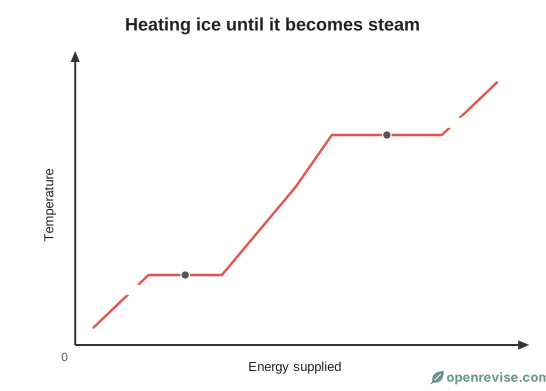
- Melting and freezing use the specific latent heat of fusion.
- Boiling and condensing use the specific latent heat of vaporisation.
The latent heat of vaporisation is much larger than the latent heat of fusion for the same substance, because the particles have to be completely separated from each other, and the gas does work against the atmosphere as it expands.
The equation
E = m L
- E is energy in joules (J)
- m is mass in kilograms (kg)
- L is specific latent heat in joules per kilogram (J/kg)
| Quantity | Value (J/kg) |
|---|---|
| Specific latent heat of fusion | 334 000 |
| Specific latent heat of vaporisation | 2 260 000 |
Worked example 1. Calculate the energy needed to melt 0.50 kg of ice at 0 °C.
E = m L = 0.50 \times 334\,000 = 167\,000 \text{ J}
Worked example 2. Calculate the energy needed to boil 0.20 kg of water at 100 °C into steam.
E = m L = 0.20 \times 2\,260\,000 = 452\,000 \text{ J}
When a substance freezes or condenses, the same amount of energy is released to the surroundings.
Combining the two equations
Many problems have more than one stage. Treat each stage separately, and then add the energies.
Example 1. Calculate the energy needed to change 0.20 kg of ice at 0 °C into water at 20 °C. (L_f = 334\,000 J/kg, c = 4200 J/kg °C)
- Stage 1, melting the ice at 0 °C: E = m L = 0.20 \times 334\,000 = 66\,800 J
- Stage 2, warming the water from 0 °C to 20 °C: \Delta E = m c \Delta \theta = 0.20 \times 4200 \times 20 = 16\,800 J
- Total = 66\,800 + 16\,800 = 83\,600 J
Why do steam burns hurt more?
When steam condenses on your skin, it releases its latent heat. For 0.010 kg of steam at 100 °C, this is 0.010 \times 2\,260\,000 = 22\,600 J. The same mass of boiling water cooling from 100 °C to 40 °C releases only 0.010 \times 4200 \times 60 = 2520 J. Steam carries about nine times as much energy, so it causes a much worse burn.
Why does ice cool a drink so well?
Ice at 0 °C needs 334 000 J of energy for each kilogram that melts. It takes this energy from the drink, which cools the drink, without the ice getting any warmer at the time. A same-sized lump of cold water at 0 °C would take in much less energy.
Measuring the specific latent heat of vaporisation
One way is to boil water with an electric heater, and measure the mass of water that has boiled away, using a balance. The energy supplied can be found from E = P t, or from a joulemeter.
Example 2. A 2.0 kW heater is on for 5.0 minutes, and 0.26 kg of boiling water is turned into steam. The energy supplied is 2000 \times 300 = 600\,000 J.
L = \frac{E}{m} = \frac{600\,000}{0.26} = 2.3 \times 10^6 \text{ J/kg}
This is close to the accepted value of 2.26 \times 10^6 J/kg. Some energy is wasted, so the result is likely to be a little too high.
Energy during cooling
When a substance freezes or condenses, the same amount of energy is released. A cooling curve has the same flat sections as the heating curve, at the melting point and the boiling point, because the particles are losing potential energy and not kinetic energy. This is why water in a puddle stays at 0 °C while it freezes.
Test yourself on this lesson
9 exam questions · 24 marks · with mark schemes and model answers
Found a mistake?