3.5 Required practical: specific heat capacity
Required practical: find the specific heat capacity of a metal block using an immersion heater, a joulemeter or meters, and a thermometer, and reduce heat loss with insulation.
Aim
To find the specific heat capacity of a material by heating a block of it with an electric heater and measuring how its temperature rises.
Key terms
- Immersion heater: an electric heating element placed in a block or a liquid to heat it.
- Joulemeter: an instrument that measures the energy transferred electrically, in joules.
- Insulation: material wrapped around an object to reduce the energy transferred to the surroundings.
Apparatus
- block of metal (for example aluminium) with holes for a heater and a thermometer
- immersion heater and power supply (or a joulemeter)
- thermometer, stopwatch, balance
- insulation to wrap around the block (such as a thick layer of felt or foam)
- a little oil for the thermometer hole
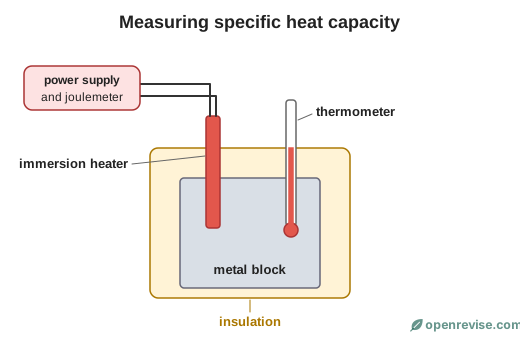
Method
- Measure the mass of the block on a balance.
- Place the heater and the thermometer in the holes in the block. Put a little oil in the thermometer hole so that the thermometer is in good thermal contact with the block.
- Wrap the block in insulation.
- Record the starting temperature, and the joulemeter reading (or set the meters so you can calculate the energy).
- Switch on the heater and start the stopwatch. Record the temperature every minute for 10 minutes.
- Switch off the heater, but keep reading the thermometer. The temperature will keep rising for a short time and then fall; record the highest temperature reached.
- Work out the energy supplied. If you do not use a joulemeter, use the potential difference V, the current I and the time t:
E = V I t
Results
Plot a graph of temperature against energy supplied. The graph is a straight line, and its gradient is \frac{\Delta \theta}{\Delta E}. Since \Delta E = m c \Delta \theta, you can work out the specific heat capacity from either:
c = \frac{\Delta E}{m \Delta \theta} \qquad \text{or} \qquad c = \frac{1}{m \times \text{gradient}}
Sources of error
- Some energy is transferred to the surroundings (thermal energy is dissipated), so not all of the energy from the heater warms the block. This makes the calculated value of c too high. Insulation reduces this.
- The thermometer may not read the true temperature of the whole block, especially if it is not in good contact. Oil helps.
- The heater may keep transferring energy to the block after it is switched off, so use the highest temperature reached.
Using the results
You can find the specific heat capacity from a graph of temperature against energy supplied. It is a straight line, and the gradient is \frac{\Delta \theta}{\Delta E} = \frac{1}{m c}, so
c = \frac{1}{m \times \text{gradient}}
| Energy supplied (kJ) | Temperature (°C) |
|---|---|
| 0 | 20.0 |
| 9 | 30.3 |
| 18 | 40.4 |
| 27 | 50.5 |
| 36 | 60.2 |
| 45 | 70.6 |
- Temperature change = 70.6 - 20.0 = 50.6 °C for 45 kJ, so the gradient = \frac{50.6}{45\,000} = 1.12 \times 10^{-3} °C/J.
- c = \frac{1}{1.0 \times 1.12 \times 10^{-3}} = 890 J/kg °C
The accepted value for aluminium is about 900 J/kg °C. The percentage difference is \frac{900 - 890}{900} \times 100 = 1.1\%, so the experiment is quite accurate.
Why might the result be too high?
Some of the energy supplied from the heater is transferred to the surroundings, and not to the block. The temperature rise is therefore smaller than it should be for the energy supplied, so the calculated value of c is too high. To reduce this:
- wrap the block in insulation (such as thick felt or foam) and put a lid or insulation on the top;
- put a little oil in the thermometer hole so the thermometer is in good contact with the block;
- make sure that the heater is fully inserted in the block and the thermometer is not touching the heater;
- record the highest temperature after the heater has been switched off, since the energy carries on spreading through the block.
Doing the experiment with water
You can find the specific heat capacity of water with an immersion heater in a polystyrene cup with a lid. Measure the mass of the water, stir gently so that the temperature is even, and use the same method. Polystyrene is a good insulator, so less energy is wasted. A typical result is close to the accepted value of 4200 J/kg °C, but it is often a little too high because of the energy wasted.
Calculating the energy
If you do not have a joulemeter, you can find the energy from the readings of the ammeter and voltmeter: E = V I t. For example, 12 V and 3.0 A for 5.0 minutes (300 s) gives 12 \times 3.0 \times 300 = 10\,800 J.
Test yourself on this lesson
9 exam questions · 22 marks · with mark schemes and model answers
Found a mistake?