6.4 Reflection, refraction and wavefronts
What happens when waves meet a boundary: reflection, absorption and transmission, the law of reflection, refraction as a change in speed, and wavefronts (Higher), with total internal reflection for Edexcel.
Waves at a boundary
Key terms
- Boundary: the surface between two different materials, such as air and glass.
- Reflection: when a wave bounces off a boundary.
- Absorption: when the energy of a wave is transferred to the material it meets.
- Transmission: when a wave passes through a boundary and carries on through the second material.
- Refraction: the change in direction of a wave as it passes a boundary between two materials in which it travels at different speeds.
- Normal: an imaginary line drawn at right angles to a boundary, used for measuring angles.
When a wave meets a boundary between two materials, three things can happen, and often all three at the same time:
- the wave is reflected (it bounces back);
- the wave is absorbed (its energy is transferred to the material, which heats it up);
- the wave is transmitted (it carries on through the second material, which may change its direction: refraction).
What happens depends on the wavelength of the wave and the properties of the materials. For example, a mirror reflects light, a black surface absorbs most of it, and glass transmits it.
Reflection

All angles for waves are measured from the normal, not from the surface. The law of reflection says:
\text{angle of incidence} = \text{angle of reflection}
The incident ray, the reflected ray and the normal are all in the same plane. A smooth, flat surface such as a mirror gives a clear reflection. Water waves reflect from a barrier in the same way, and sound is reflected as echoes.
Refraction
When a wave moves from one material into another, its speed changes. If the wave meets the boundary at an angle, this causes the wave to change direction. This is refraction.
- When light goes from air into glass (or water), it slows down and bends towards the normal.
- When light goes from glass into air, it speeds up and bends away from the normal.
- If the wave travels along the normal (at 90° to the boundary), the speed changes but the direction does not.
The frequency of the wave does not change. Since v = f \lambda, if the speed decreases, the wavelength decreases too. So in glass, light has a shorter wavelength than in air.
Explaining refraction with wavefronts (Higher tier)
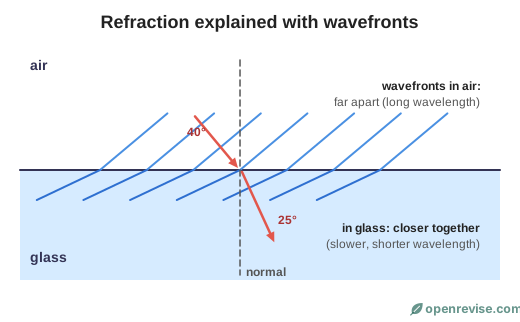
A wavefront is a line joining points on a wave that are in step (for example, all the crests). The rays are drawn at right angles to the wavefronts. Look at what happens as a wave reaches the glass at an angle:
- The end of the wavefront that arrives at the glass first slows down first, while the other end is still travelling at the higher speed in air.
- The slower end falls behind, so the wavefront swivels, and its direction changes.
- Inside the glass, the wavefronts are closer together, since the speed (and the wavelength) is smaller, but the frequency is the same.
- When the wave leaves the glass, the reverse happens, and the wave goes back to its original direction (if the sides of the block are parallel).
Total internal reflection (Edexcel)
When light inside glass hits the boundary with air at a large angle, it can be reflected back completely. This is total internal reflection. It happens when the angle of incidence is bigger than the critical angle. It is used in optical fibres and in the prisms in binoculars and periscopes.
Examples of refraction
- A straw in a glass of water seems to bend at the surface of the water.
- A swimming pool looks shallower than it really is.
- Water waves in a ripple tank slow down when they pass over a shallower area, and the wavefronts bend.
- Lenses (covered later) use refraction to focus light.
Test yourself on this lesson
9 exam questions · 19 marks · with mark schemes and model answers
Found a mistake?