6.5 Required practical: reflection and refraction of light
Required practical: investigate the reflection of light by a mirror and the refraction of light through a rectangular glass block by tracing rays and measuring angles.
Aim
To investigate reflection and refraction of light, by tracing the path of a ray of light through a rectangular glass block and by measuring the angles of incidence and refraction.
Key terms
- Ray box: a lamp with a slit that gives a narrow beam of light.
- Angle of incidence (i): the angle between the incident ray and the normal.
- Angle of refraction (r): the angle between the refracted ray and the normal.
- Emergent ray: the ray of light that comes out of the other side of a block.
Apparatus
- a ray box with a single slit
- a rectangular glass block (or a Perspex block), and a plane mirror
- a sheet of plain paper, a sharp pencil and a ruler
- a protractor (with a resolution of 1°)
Method: refraction in a glass block
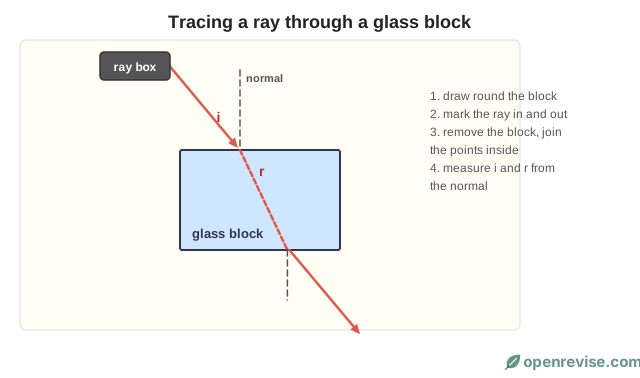
- Place the glass block on the paper and draw around it. Remove the block and mark a point O on the long side of the block's outline.
- Draw a normal at O at 90° to the side. Using a protractor, draw lines from O at angles of incidence of 10°, 20°, 30°, 40°, 50° and 60° from the normal.
- Put the block back. Direct the ray from the ray box along the first line, so it hits the block at O.
- Mark the point where the emergent ray leaves the block, with a cross, and mark a second cross on the ray some way beyond the block.
- Remove the block. Join the crosses to draw the emergent ray. Join the point where the emergent ray leaves the block to O to draw the ray inside the block.
- Draw the normal at the point where the light comes out. Measure the angle of refraction, r, between the ray inside the block and the normal at O.
- Repeat for the other angles of incidence.
Results
| Angle of incidence i (°) | Angle of refraction r (°) |
|---|---|
| 10 | 7 |
| 20 | 13 |
| 30 | 19 |
| 40 | 26 |
| 50 | 31 |
| 60 | 35 |
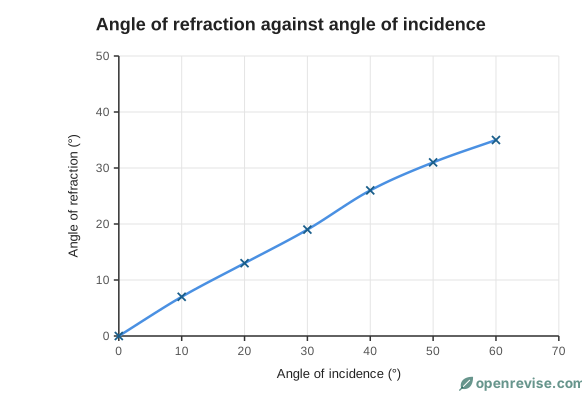
Conclusions from the experiment:
- When light goes into the block (from air to glass), the ray bends towards the normal: the angle of refraction is smaller than the angle of incidence.
- When light goes out of the block, it bends away from the normal.
- The emergent ray is parallel to the incident ray, but is shifted sideways. This is because the two sides of the block are parallel, so the bending out cancels the bending in.
- A ray that travels along the normal (i = 0°) goes straight through without bending.
Method: reflection
- Draw a straight line on the paper and place a plane mirror along it. Draw a normal at 90° to the mirror.
- Direct a ray from the ray box at an angle of incidence i and mark the incident and reflected rays with crosses.
- Remove the mirror and join the points, then measure the angle of reflection with a protractor.
- Repeat for at least five angles. The results should show that the angle of incidence equals the angle of reflection.
Investigating different materials and surfaces
The experiment can also be done with different materials (Perspex, or water in a transparent tank), to see how much the light bends: a larger change of speed gives a bigger change of direction. A dull black surface compared with a polished mirror shows how different surfaces reflect and absorb light.
Errors and precautions
- Use a narrow ray, and mark points on the ray as accurately as possible, since a wide beam makes it hard to place the crosses accurately.
- Place the protractor carefully, with the centre on the point and the zero line on the normal. The resolution of a protractor is 1°, which limits the accuracy.
- Do the experiment in a darkened room so that the ray is easy to see.
- The ray box gets hot: do not touch the lamp, and do not look directly into the beam.
- Repeat the measurements and calculate a mean to reduce random errors.
Test yourself on this lesson
9 exam questions · 25 marks · with mark schemes and model answers
Found a mistake?