6.3 Required practical: measuring waves
Required practical: measure the speed of waves using a ripple tank and a vibrating string, and calculate speed from frequency and wavelength.
Aim
To investigate the speed, frequency and wavelength of waves, in a ripple tank and on a vibrating string, and to show that v = f \lambda.
Key terms
- Ripple tank: a shallow tank of water used to make and study water waves.
- Stroboscope: a light that flashes at a known frequency. If its frequency matches that of the waves, the waves appear to stand still.
- Standing wave: a wave pattern on a string that appears to stay in one place, with nodes and antinodes.
- Node: a point on a standing wave with no movement. An antinode is a point of maximum movement.
Part A: waves in a ripple tank
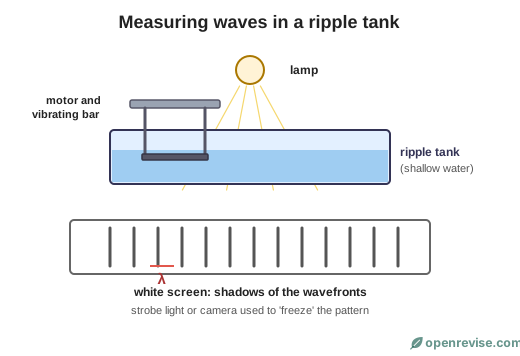
Apparatus: ripple tank with shallow water, a motor with a vibrating bar (or a dipper), a lamp above, a white screen below, a stroboscope (or a camera), and a metre ruler.
Method
- Fill the ripple tank so the water is about 5 mm deep. Switch on the lamp: the waves cast bright and dark lines on the white screen. The lamp must be above the tank and the screen underneath.
- Switch on the motor to make straight waves. Adjust the speed so that the waves are clear.
- Use the stroboscope (adjusted to match the frequency of the waves) or take a photograph or video with a camera, to make the waves appear to stand still.
- Place a ruler on the screen, and measure the distance across several waves, for example 10 wavelengths. Divide by the number of waves to get the wavelength. Measuring many waves gives a smaller percentage uncertainty.
- The frequency is the frequency of the motor (or stroboscope). Alternatively, count the number of waves passing a mark in a fixed time.
- Calculate the speed: v = f \lambda.
Worked example. The motor frequency is 12 Hz. 10 wavelengths measure 0.30 m. The wavelength is \frac{0.30}{10} = 0.030 \text{ m}.
v = f \lambda = 12 \times 0.030 = 0.36 \text{ m/s}
Part B: waves on a string
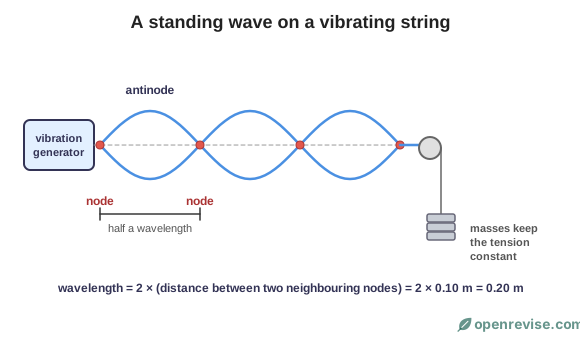
Apparatus: a vibration generator connected to a signal generator, a string over a pulley with slotted masses to keep the tension constant, a metre ruler.
Method
- Set up the string so that one end is attached to the vibration generator and the other passes over a pulley with a hanging mass.
- Switch on the signal generator and slowly increase the frequency, until the string forms a clear standing wave with large vibrations (nodes and antinodes).
- Read the frequency from the signal generator.
- Measure the distance between several nodes. The wavelength is twice the distance between two neighbouring nodes (or between two antinodes).
- Calculate v = f \lambda.
- Repeat at different frequencies (higher frequencies give more loops). The speed should be the same, since it depends on the string and its tension.
| Frequency (Hz) | Wavelength (m) | Speed = f × λ (m/s) |
|---|---|---|
| 20 | 0.80 | 16 |
| 40 | 0.40 | 16 |
| 60 | 0.27 | 16 |
| 80 | 0.20 | 16 |
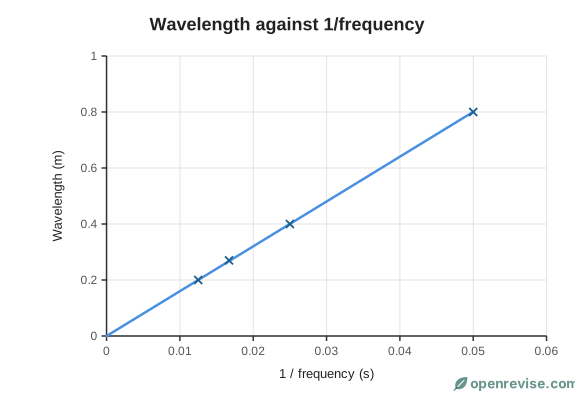
A graph of wavelength against \frac{1}{f} is a straight line through the origin, and its gradient is the wave speed, 16 m/s.
Part C: the speed of sound (Edexcel)
- Echo method: stand at a measured distance d (e.g. 100 m) from a large wall and make a sharp sound. Use a stopwatch to time the interval t between the sound and its echo. The sound travels 2d, so v = \frac{2d}{t}.
- Two microphones: place two microphones a known distance apart, connected to an oscilloscope or data logger. Measure the time delay between the sound reaching the first and second microphones. v = \frac{\text{distance}}{\text{time}}.
Errors and precautions
- The ripple pattern should be observed with the stroboscope frequency matched, or the wave appears blurred.
- Measure across many waves, to reduce the percentage uncertainty in the wavelength.
- Keep the depth of the water and the string tension constant, because they change the wave speed.
- Safety: mop up spills and keep electrical equipment away from the water. Dry your hands.
Test yourself on this lesson
9 exam questions · 23 marks · with mark schemes and model answers
Found a mistake?