6.2 Wave properties and the wave equation
Amplitude, wavelength, frequency and period of a wave, the wave equation v = f x wavelength, and T = 1/f, with typical wave speeds.
Describing a wave
Key terms
- Amplitude: the maximum displacement of a point on a wave from its rest (undisturbed) position.
- Wavelength: the distance from a point on one wave to the equivalent point on the next wave, for example crest to crest.
- Frequency: the number of waves passing a point each second. It is measured in hertz (Hz).
- Period: the time taken for one complete wave to pass a point, measured in seconds (s).
- Wave speed: the speed at which energy is transferred by the wave, measured in metres per second (m/s).
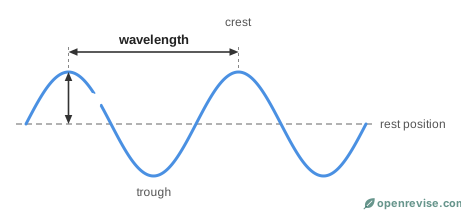
- The amplitude (A) is measured from the rest position (the middle line) to a crest or a trough. A bigger amplitude means a wave carrying more energy. For a sound wave, a bigger amplitude means a louder sound; for light, a brighter light.
- The wavelength (\lambda, the Greek letter "lambda") is the length of one complete wave. It is measured in metres (m).
- The frequency (f) is the number of complete waves that pass a point each second. 1 hertz (1 Hz) is 1 wave per second. Frequencies are often large: 1 kHz = 1000 Hz and 1 MHz = 1 000 000 Hz. For sound, a higher frequency is a higher pitch.
- The period (T) is the time for one complete wave.
Frequency and period
Frequency and period are linked by:
T = \frac{1}{f}
A wave with a frequency of 2 Hz has a period of \frac{1}{2} = 0.5 \text{ s}.
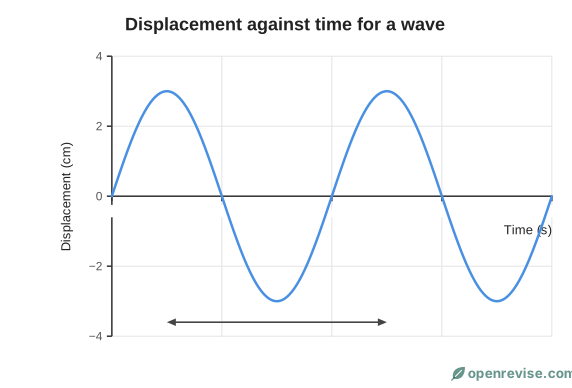
On a displacement-time graph, the period is the time between two equivalent points, such as two peaks. In the graph, the period is 0.5 s, so the frequency is \frac{1}{0.5} = 2 \text{ Hz}.
The wave equation
The speed of a wave depends on its frequency and wavelength. In one second, f waves pass a point, each of length \lambda, so the wave travels a distance of f \times \lambda in one second. This gives the wave equation:
v = f \lambda
- v is wave speed in metres per second (m/s)
- f is frequency in hertz (Hz)
- \lambda is wavelength in metres (m)
Wave speed can also be found using v = \frac{\text{distance}}{\text{time}}, the same as for any moving object.
Worked example 1. A wave has a frequency of 50 Hz and a wavelength of 6.0 m. Calculate its speed.
v = f \lambda = 50 \times 6.0 = 300 \text{ m/s}
Worked example 2. A sound wave of frequency 440 Hz travels at 330 m/s in air. Calculate its wavelength.
\lambda = \frac{v}{f} = \frac{330}{440} = 0.75 \text{ m}
Worked example 3. Waves on the sea have a wavelength of 20 m and a period of 8.0 s. Calculate the wave speed.
f = \frac{1}{T} = \frac{1}{8.0} = 0.125 \text{ Hz}, so v = f \lambda = 0.125 \times 20 = 2.5 \text{ m/s}
Worked example 4. A radio station broadcasts at 100 MHz. Radio waves travel at 3.0 \times 10^8 \text{ m/s}. Calculate the wavelength.
f = 100 \times 10^6 = 1.0 \times 10^8 \text{ Hz}, so \lambda = \frac{3.0 \times 10^8}{1.0 \times 10^8} = 3.0 \text{ m}
What decides the wave speed?
- The frequency is set by the source: the wave has the same frequency as the thing that makes it.
- The speed is set by the medium. For example, sound travels at about 330 m/s in air, 1500 m/s in water and 5000 m/s in steel.
- When a wave moves from one medium to another, its frequency stays the same but its speed and wavelength change. If the speed is lower, the wavelength is shorter (since v = f \lambda, and f is constant).
- All electromagnetic waves travel at the same speed in a vacuum, 3.0 \times 10^8 \text{ m/s}.
Test yourself on this lesson
9 exam questions · 22 marks · with mark schemes and model answers
Found a mistake?