Viewing as
Teacher view: planning notes, the answers to every question, and the teacher copies of the files.
History · Crime and punishment in Britain, c1700-c1900
The Metropolitan Police, 1829
From watchmen and the Bow Street Runners to Robert Peel's Metropolitan Police - why Britain created its first professional police force, and how it spread.
Teacher resources
The teacher copies: slides with the questions built in, the answers, and anything else attached to this lesson for whoever is teaching it.
- The Metropolitan Police 1829 - Teacher Slides.pptx Teacher The lesson slides with the teacher's notes on each slide, and every question and mark scheme built in. Built from the lesson script on 23 September 2026. View
- The Metropolitan Police 1829 - Teacher Notes.docx Teacher The complete notes with the teacher's notes and every model answer in full. Built from the lesson script on 23 September 2026. View
Student handouts
The same files the students see, to print or hand out.
- The Metropolitan Police 1829.pptx Built from the lesson script on 23 September 2026. View
- The Metropolitan Police 1829 - Completed Notes.docx The full notes for the lesson, every gap filled in - to check against, or to revise from. Built from the lesson script on 23 September 2026. View
- The Metropolitan Police 1829 - Exam Questions.docx Built from the lesson script on 23 September 2026. View
Learning Objectives
- 1Describe law enforcement before 1829, including watchmen and the Bow Street Runners.
- 2Explain why the Metropolitan Police was set up in 1829.
- 3Explain how policing developed after 1829, and why the police were at first unpopular.
Setting the Scene
In 1700 there was still no professional police force. Towns relied on unpaid parish constables and night watchmen, who were often old, poorly paid and easily bribed. As London grew into the largest city in the world, it became clear that this system could not cope.
- 1749 Henry Fielding sets up the Bow Street Runners in London.
- 1805 The Bow Street Horse Patrol guards the roads around London.
- 1829 Robert Peel's Metropolitan Police Act creates the Metropolitan Police.
- 1842 The Metropolitan Police sets up a Detective Department.
- 1856 The County and Borough Police Act makes every area have a police force.
- 1878 The Criminal Investigation Department (CID) is formed.
Law Enforcement Before 1829
A patchy system that relied on individuals rather than an organised force.
-
Watchmen
Night watchmen patrolled towns, but were often old, badly paid and mocked as "Charleys".
-
Constables
Parish constables were ordinary men who served for a year, usually unpaid and untrained.
-
Thief-takers
Private individuals who caught criminals for rewards - some, like Jonathan Wild, were criminals themselves.
-
Bow Street Runners
Set up in 1749 by magistrate Henry Fielding and his half-brother John: a small, paid team who investigated crimes and caught criminals.
Why Was the Metropolitan Police Set Up?
Several pressures came together in the 1820s.
-
A growing city
London's population had grown enormously, and the old system could not cope.
-
Rising crime
Crime appeared to be rising, and the Bloody Code was not stopping it.
-
Fear of unrest
Riots and protests made the government want better control of the streets.
-
Bow Street's success
The Runners showed that a paid, organised force could work.
-
Robert Peel
As Home Secretary, Peel persuaded Parliament to act.
-
Prevention
Peel wanted to prevent crime by having police visible on the streets.
The First Police Officers
The Metropolitan Police began in 1829 with around 3,200 constables. They were deliberately made to look different from soldiers, to reassure a public that feared a military-style force.
The first "Peelers"
- Uniform A blue tailcoat and top hat, not a red army coat.
- Equipment A wooden truncheon and a rattle to call for help.
- Beats Constables walked set routes, or beats, around the clock.
- Discipline Strict rules - many early recruits were sacked for drunkenness.
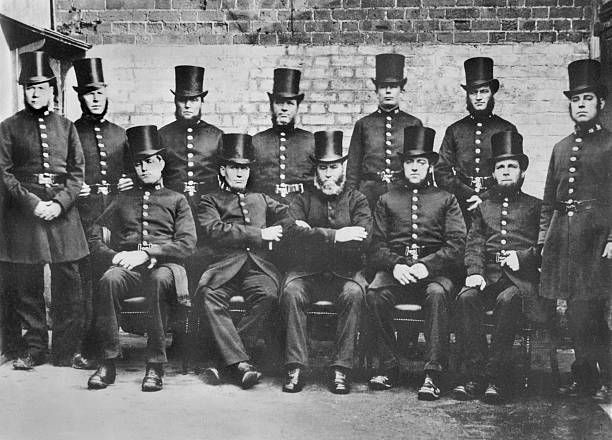
A "Peeler" of the 1830s.
Opposition to the New Police
Not everyone welcomed the "Peelers" or "Bobbies".
-
Cost
People resented paying for the police through local taxes.
-
Liberty
Many feared the police would be used to spy on people, like the police in France.
-
Early problems
Many early recruits were dismissed, often for drunkenness.
-
Gaining trust
Over time, the police's focus on preventing crime and keeping order helped them gain acceptance.
How Policing Spread
The Metropolitan Police became a model for the whole country.
-
1
1829
Metropolitan Police set up in London.
-
2
1839
Counties were allowed, but not forced, to set up police forces.
-
3
1842
The Met set up a Detective Department to investigate crimes.
-
4
1856
The County and Borough Police Act made police forces compulsory across the country.
-
5
1878
The Criminal Investigation Department (CID) was formed.
Summary & Exam Focus
- Before 1829, law enforcement relied on watchmen, constables and thief-takers.
- The Bow Street Runners (1749) showed that paid officers could work.
- Robert Peel created the Metropolitan Police in 1829 to prevent crime.
- By 1856 every area had to have a police force.
Exam focus
Explain why the Metropolitan Police was set up in 1829. (12 marks) (12 marks)
Explain several factors - London's growth, crime, fear of unrest, Peel - and link each one to the decision.
Key terms
The vocabulary this lesson expects you to use. Each one is linked from the first place it appears above.
- Watchman
- A man paid to patrol a town at night, often old and ineffective.
- Parish constable
- An unpaid local man who kept order for a year.
- Thief-taker
- A private individual who caught criminals for rewards.
- Bow Street Runners
- A small paid force set up by Henry Fielding in London in 1749.
- Metropolitan Police
- London's professional police force, set up by Robert Peel in 1829.
- Peelers / Bobbies
- Nicknames for the first police officers, after Robert Peel.
- CID
- The Criminal Investigation Department, formed in 1878.
Questions and answers
9 questions set on this lesson, with the mark schemes and model answers open.
Explain one way in which law enforcement in the eighteenth century was different from law enforcement in the late nineteenth century.
Mark scheme — 4 marks available
- A valid difference identified — 1-2 marks
- Supported with specific knowledge of both periods — 3-4 marks
Model answer
In the eighteenth century there was no professional police force: law enforcement relied on unpaid parish constables, night watchmen and thief-takers who worked for rewards, although the Bow Street Runners were set up in London in 1749. By the late nineteenth century every area had a professional, paid police force - the Metropolitan Police was created in 1829 and the County and Borough Police Act of 1856 made forces compulsory. So the difference is that law enforcement changed from amateur and local to professional and organised.
Explain why the Metropolitan Police was set up in 1829. You may use the following in your answer: the growth of London; Robert Peel. You must also use information of your own.
Mark scheme — 12 marks available
- Level 1 (1-3) — A simple or general answer
- Level 2 (4-6) — Some explanation of one or more reasons, with some knowledge
- Level 3 (7-9) — A developed explanation linked to the question, with accurate knowledge
- Level 4 (10-12) — An analytical explanation of several reasons, with knowledge that goes beyond the stimulus points
Model answer
One reason was the growth of London. By the 1820s London was the largest city in the world, and its crowded streets and slums made it impossible for unpaid parish constables and old night watchmen to keep order. Crime appeared to be rising, and the old system was clearly failing. A second reason was the role of Robert Peel. As Home Secretary in the 1820s he was already reforming the Bloody Code and prisons, and he believed crime should be prevented by having police visible on the streets. He persuaded Parliament to pass the Metropolitan Police Act of 1829, creating a force of around 3,200 constables. A third reason, beyond the stimulus, was the success of earlier experiments and the fear of unrest. The Bow Street Runners, set up by Henry Fielding in 1749, and the Bow Street Horse Patrol of 1805 had shown that paid, organised officers could catch criminals. At the same time, riots and protests made the government want a force that could control the streets without using the army.
"Robert Peel was the main reason for changes in law enforcement in the period c1700-c1900." How far do you agree? Explain your answer. You may use the following in your answer: the Metropolitan Police Act (1829); the Bow Street Runners. You must also use information of your own. (16 marks, plus 4 for spelling, punctuation, grammar and specialist terminology)
Mark scheme — 16 marks available
- Level 1 (1-4) — A simple or generalised answer
- Level 2 (5-8) — Some analysis, with a judgement that is asserted
- Level 3 (9-12) — Analysis of both sides with accurate knowledge and a supported judgement
- Level 4 (13-16) — Sustained analysis, knowledge beyond the stimulus, and a clear, justified judgement
- SPaG (4) — Accurate spelling, punctuation and grammar, with specialist terms such as constable and Metropolitan Police
Model answer
On the one hand, Peel was very important. As Home Secretary he persuaded Parliament to pass the Metropolitan Police Act of 1829, creating the first professional police force with around 3,200 constables. He shaped how it worked: officers wore blue uniforms rather than army red, walked set beats, and focused on preventing crime. The Met became the model for police forces across the country. On the other hand, other factors were also important. Henry and John Fielding's Bow Street Runners, set up in 1749, had already shown that paid, organised officers could work, decades before Peel. The growth of London and industrial towns made the old system of watchmen and constables unworkable, and fear of riots made the government want better control. Later changes came after Peel: the County and Borough Police Act of 1856 made forces compulsory everywhere, and the CID was set up in 1878. Overall, Peel was the most important individual because he turned earlier ideas into a permanent professional force. But the need for change came from the growth of towns and rising crime, and the idea had already been tested by the Fieldings, so he was a key factor rather than the only one.
Who set up the Bow Street Runners in 1749?
Why: Henry Fielding, a magistrate and novelist, with his half-brother John.
Why were the first police given blue uniforms?
Why: To make them look different from the army's red coats, reassuring people who feared a military force.
What did the County and Borough Police Act of 1856 do?
Why: It made every area of the country have a police force.
About how many constables did the Metropolitan Police start with in 1829?
Why: Around 3,200 constables patrolled London's streets.
What nickname was given to the first police officers?
Why: "Peelers" or "Bobbies", after Robert Peel.
When was the Criminal Investigation Department (CID) formed?
Why: The CID was formed in 1878, building on the Detective Department of 1842.