Maths · Circle Theorems
Viewing as
Teaching this? The teacher view opens every answer and mark scheme.
Circle Theorem Proofs and Problems
Proving circle theorems, solving multi-step problems, and finding the equation of a tangent.
Learning Objectives
- 1Prove the main circle theorems using isosceles triangles.
- 2Choose and combine circle theorems in multi-step problems.
- 3Find the equation of a tangent to a circle at a point.
- 4Write clear, complete reasons.
Proving and combining theorems
Higher tier questions can ask you to prove a circle theorem, or to combine several of them in one diagram. Proofs follow the same pattern each time: draw radii, which make isosceles triangles, then use the fact that the angles of a triangle add up to \(180^\circ\) and that an exterior angle equals the sum of the two opposite interior angles. In a multi-step problem, work out one angle at a time and write its reason, because each reason earns a mark.
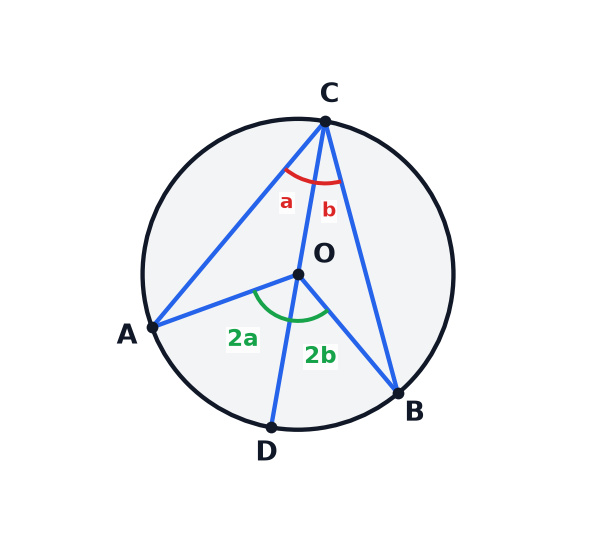
Proof: the angle at the centre
The angle at the centre is twice the angle at the circumference. Radii give isosceles triangles.
-
Set up
\(A\), \(B\) and \(C\) are on a circle with centre \(O\). Join \(CO\) and extend it to \(D\) on the circle.
-
Isosceles
\(OA = OC\), so triangle \(OAC\) is isosceles, and angle \(OCA = a\) means angle \(OAC = a\).
-
Exterior angle
Angle \(AOD = a + a = 2a\), because an exterior angle equals the sum of the two opposite interior angles.
-
The other side
In the same way, if angle \(OCB = b\), angle \(BOD = 2b\).
-
Conclusion
Angle \(AOB = 2a + 2b = 2(a + b) = 2 \times\) angle \(ACB\).
Proof of the angle at the centre
The angle at \(C\) is split into \(a\) and \(b\) by the line \(CD\). The angles at the centre are \(2a\) and \(2b\), because each is the exterior angle of an isosceles triangle. So angle \(AOB\) is twice angle \(ACB\).
Checking the proof
- Radii \(OA\), \(OB\) and \(OC\) are all equal.
- Isosceles Triangles \(OAC\) and \(OBC\) are isosceles.
- Exterior angle Each angle at \(O\) is the sum of two equal base angles.
- Reasons Each step needs a reason in a proof.
Proofs for the other theorems
The other circle theorems follow from the angle at the centre.
-
Semicircle
If \(AB\) is a diameter, the angle at the centre is \(180^\circ\), so the angle at the circumference is \(90^\circ\).
-
Same segment
Two angles at the circumference on the same chord are each half the same angle at the centre, so they are equal.
-
Cyclic quadrilateral
The angles at the centre are \(2x\) and \(2y\) with \(2x + 2y = 360^\circ\), so \(x + y = 180^\circ\).
-
Alternate segment
The tangent-radius right angle and an isosceles triangle give the angle in the alternate segment.
A multi-step problem
\(A\), \(B\), \(C\) and \(D\) are points on a circle with centre \(O\). Angle \(AOC = 140^\circ\), where \(B\) is on the major arc \(AC\). Work out angle \(ABC\) and angle \(ADC\), where \(D\) is on the minor arc \(AC\). Give reasons.
Show the solutionHide the solution
- 1 Centre and circumference Angle \(ABC = 140 \div 2 = 70^\circ\), because the angle at the centre is twice the angle at the circumference.
- 2 Cyclic quadrilateral \(ABCD\) has all four points on the circle.
- 3 Opposite angles Angle \(ADC = 180 - 70 = 110^\circ\).
- 4 Reason "Opposite angles of a cyclic quadrilateral add up to \(180^\circ\)."
AnswerAngle \(ABC = 70^\circ\) and angle \(ADC = 110^\circ\)
The tangent to a circle on a grid
A tangent is perpendicular to the radius, so the gradient of the tangent is linked to the gradient of the radius.
-
Gradient of the radius
Work out the gradient from the centre to the point of contact.
-
Perpendicular gradient
Turn the fraction upside down and change the sign: if \(m = \frac{3}{4}\), the tangent has gradient \(-\frac{4}{3}\).
-
Equation
Use \(y - y_1 = m(x - x_1)\) with the point of contact.
-
Circle centred at the origin
For \(x^2 + y^2 = r^2\), the radius to \((a, b)\) has gradient \(\frac{b}{a}\).
The equation of a tangent
The point \(P(3, 4)\) is on the circle \(x^2 + y^2 = 25\). Find the equation of the tangent to the circle at \(P\).
Show the solutionHide the solution
- 1 Gradient of the radius The centre is \((0, 0)\), so the radius \(OP\) has gradient \(\frac{4}{3}\).
- 2 Perpendicular The tangent is perpendicular to the radius, so its gradient is \(-\frac{3}{4}\).
- 3 Equation \(y - 4 = -\frac{3}{4}(x - 3)\).
- 4 Rearrange \(y = -\frac{3}{4}x + \frac{9}{4} + 4 = -\frac{3}{4}x + \frac{25}{4}\).
Answer\(y = -\frac{3}{4}x + \frac{25}{4}\)
Test yourself
-
1
Why is a triangle with two radii isosceles?
Show answerHide answer
Two of its sides are radii, so they are equal.
-
2
What is the angle at the centre in terms of the angle at the circumference?
Show answerHide answer
Twice as big.
-
3
What is the gradient of a tangent in terms of the gradient of the radius?
Show answerHide answer
The negative reciprocal.
-
4
What does an exterior angle of a triangle equal?
Show answerHide answer
The sum of the two opposite interior angles.
-
5
What is the first step in a proof?
Show answerHide answer
Draw in the radii and mark the equal angles.
Exam technique: proof questions
Each line of a proof needs a reason, and the reasons are the marks.
-
Use letters
Call unknown angles \(a\) and \(b\) to prove a general result.
-
Say why
Write the reason after each step.
-
Finish
State what you have proved, linking back to the question.
-
Do not use numbers
A proof must work for any angle, so do not measure or use values from the diagram.
Summary and exam focus
- Proofs use radii to make isosceles triangles.
- The angle at the centre is twice the angle at the circumference.
- Combine theorems one step at a time, with a reason for each angle.
- The tangent at a point has the negative reciprocal gradient of the radius.
Exam focus
The point \(P(3, 4)\) is on the circle \(x^2 + y^2 = 25\). Find the equation of the tangent at \(P\). (3 marks) (3 marks)
The radius has gradient \(\frac{4}{3}\), so the tangent has gradient \(-\frac{3}{4}\). Then use \(y - 4 = -\frac{3}{4}(x - 3)\).
Key terms
The words this lesson expects you to use. Each one is linked from the first place it appears above.
- Proof
- A series of steps, with reasons, that shows a result is always true.
- Theorem
- A result that has been proved.
- Exterior angle
- An angle between a side extended and the next side.
- Radius
- The distance from the centre to the circle.
- Isosceles triangle
- A triangle with two equal sides.
- Negative reciprocal
- The number found by turning a fraction upside down and changing its sign.
- Gradient
- A measure of the steepness of a line.
- Tangent
- A straight line that touches a circle at one point.
- Major arc
- The longer arc between two points on a circle.
You've finished the notes
Check your understanding
Test yourself while it is fresh. Start with the flashcards, then try the exam questions.
Something here looks wrong?
Tell us what and we will go and look. It goes to whoever writes these pages, nobody else, and we do not ask who you are — so there is nothing to sign and nothing comes back to you.