Maths · Further Trigonometry
Viewing as
Teaching this? The teacher view opens every answer and mark scheme.
Trigonometric Graphs and Exact Values
Sketching and using the sine, cosine and tangent graphs, and solving equations between 0 and 360 degrees using exact values.
Learning Objectives
- 1Sketch and recognise the graphs of \(y = \sin x\), \(y = \cos x\) and \(y = \tan x\).
- 2State the key values of each graph, including where each crosses the axis and its maximum and minimum.
- 3Use the symmetry of the graphs to find more than one angle with the same sine or cosine.
- 4Solve equations such as \(\sin x = \dfrac{1}{2}\) between \(0^\circ\) and \(360^\circ\), using exact values.
Trigonometry beyond right-angled triangles
In a right-angled triangle the angle is always below \(90^\circ\), but the sine, cosine and tangent functions are defined for any angle. Their graphs repeat, and have a shape that you should know well. The graphs show why an equation such as \(\sin x = \dfrac{1}{2}\) has more than one solution between \(0^\circ\) and \(360^\circ\). On a non-calculator paper, the values come from the exact values table that you met in right-angled trigonometry, and the symmetry of the graph gives the other solutions.
The sine and cosine graphs
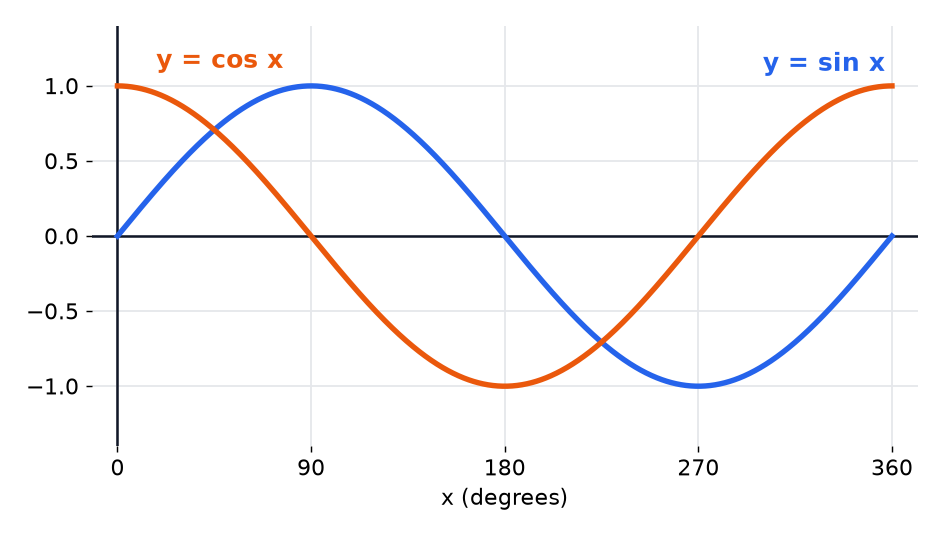
Both graphs are smooth waves that repeat every \(360^\circ\) and stay between \(-1\) and \(1\).
-
\(y = \sin x\)
Starts at 0 when \(x = 0^\circ\), reaches a maximum of 1 at \(90^\circ\), crosses zero at \(180^\circ\), has a minimum of \(-1\) at \(270^\circ\) and returns to 0 at \(360^\circ\).
-
\(y = \cos x\)
Starts at 1 when \(x = 0^\circ\), crosses zero at \(90^\circ\), has a minimum of \(-1\) at \(180^\circ\), crosses zero at \(270^\circ\) and returns to 1 at \(360^\circ\).
-
The shape
The cosine graph is the sine graph moved \(90^\circ\) to the left.
-
Range
The values of sine and cosine are never greater than 1 or less than \(-1\).
The sine and cosine graphs
Both curves have a maximum of 1 and a minimum of \(-1\). Sine passes through the origin, and cosine starts at its maximum value of 1.
Key points
- Sine \((0, 0)\), \((90, 1)\), \((180, 0)\), \((270, -1)\), \((360, 0)\).
- Cosine \((0, 1)\), \((90, 0)\), \((180, -1)\), \((270, 0)\), \((360, 1)\).
- Meeting point The curves cross at \(45^\circ\) and \(225^\circ\), where sine and cosine are equal.
- Period Both repeat every \(360^\circ\).
The tangent graph
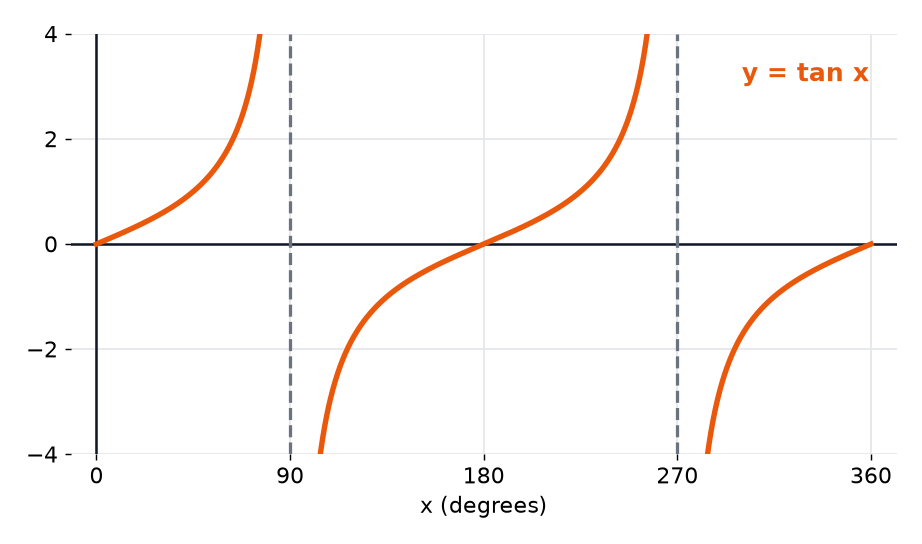
The tangent graph is different. It has no maximum or minimum, and it has gaps where the function is undefined.
-
\(y = \tan x\)
Starts at 0 when \(x = 0^\circ\), rises towards infinity as \(x\) approaches \(90^\circ\), then comes up from minus infinity after \(90^\circ\).
-
Asymptotes
The lines \(x = 90^\circ\) and \(x = 270^\circ\) are asymptotes, which the graph approaches but never touches.
-
Zeros
The graph crosses the axis at \(0^\circ\), \(180^\circ\) and \(360^\circ\).
-
Period
The tangent graph repeats every \(180^\circ\), and its values can be any number.
The tangent graph
Each branch rises from the left to the right. The graph passes through 0 at \(0^\circ\), \(180^\circ\) and \(360^\circ\), and \(\tan 45^\circ = 1\).
Features to remember
- Asymptotes At \(90^\circ\) and \(270^\circ\).
- Zeros At \(0^\circ\), \(180^\circ\) and \(360^\circ\).
- Value at \(45^\circ\) \(\tan 45^\circ = 1\).
- Period \(180^\circ\), which is half that of sine and cosine.
Reading a value from the graph
Use the graph of \(y = \cos x\) to write down the value of \(\cos 180^\circ\) and the values of \(x\) between \(0^\circ\) and \(360^\circ\) where \(\cos x = 0\).
Show the solutionHide the solution
- 1 Find 180 The cosine graph reaches its minimum at \(x = 180^\circ\), so \(\cos 180^\circ = -1\).
- 2 Find the zeros The curve crosses the \(x\)-axis where \(y = 0\).
- 3 Read the values It crosses at \(90^\circ\) and \(270^\circ\).
Answer\(\cos 180^\circ = -1\), and \(\cos x = 0\) when \(x = 90^\circ\) and \(x = 270^\circ\)
Solving \(\sin x = k\) and \(\cos x = k\)
An equation has more than one solution because the graph reaches the same height more than once.
-
Step 1
Find the first angle from the exact values table, for example \(\sin 30^\circ = \dfrac{1}{2}\).
-
Sine
The graph is symmetrical about \(90^\circ\), so the second solution is \(180^\circ - x\).
-
Cosine
The graph is symmetrical about \(180^\circ\), so the second solution is \(360^\circ - x\).
-
Check
Look at the graph to see how many solutions to expect between \(0^\circ\) and \(360^\circ\).
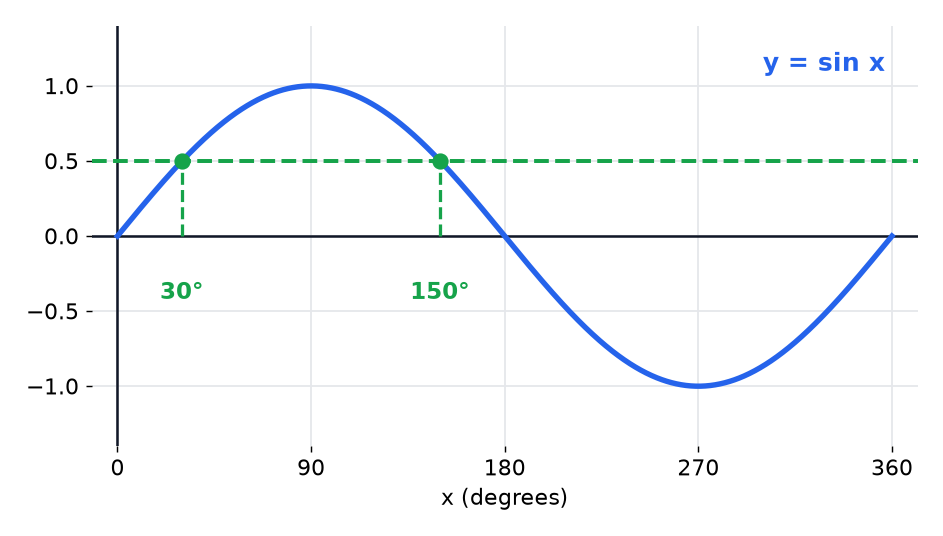
Solving \(\sin x = 0.5\)
The horizontal line \(y = 0.5\) crosses the sine curve twice between \(0^\circ\) and \(360^\circ\). The first solution is \(30^\circ\), and the second is \(180^\circ - 30^\circ = 150^\circ\).
Reading the graph
- First solution \(x = 30^\circ\), from \(\sin 30^\circ = \dfrac{1}{2}\).
- Second solution \(x = 180^\circ - 30^\circ = 150^\circ\), from the symmetry about \(90^\circ\).
- Check \(\sin 150^\circ = \dfrac{1}{2}\) as well.
- Negative values If \(\sin x = -\dfrac{1}{2}\) the solutions are \(210^\circ\) and \(330^\circ\).
Solving a cosine equation
Solve \(\cos x = -\dfrac{1}{2}\) for \(0^\circ \le x \le 360^\circ\).
Show the solutionHide the solution
- 1 Use the positive value \(\cos 60^\circ = \dfrac{1}{2}\), so the related acute angle is \(60^\circ\).
- 2 Negative cosine Cosine is negative between \(90^\circ\) and \(270^\circ\).
- 3 First solution \(180^\circ - 60^\circ = 120^\circ\).
- 4 Second solution \(180^\circ + 60^\circ = 240^\circ\).
Answer\(x = 120^\circ\) and \(x = 240^\circ\)
Test yourself
-
1
What are the maximum and minimum values of \(\sin x\)?
Show answerHide answer
1 and \(-1\).
-
2
Where does the cosine graph start?
Show answerHide answer
At 1, when \(x = 0^\circ\).
-
3
Where are the asymptotes of the tangent graph?
Show answerHide answer
At \(90^\circ\) and \(270^\circ\).
-
4
What is the period of the tangent graph?
Show answerHide answer
\(180^\circ\).
-
5
If \(\sin 30^\circ = \dfrac{1}{2}\), what is the other solution of \(\sin x = \dfrac{1}{2}\)?
Show answerHide answer
\(150^\circ\).
Exam technique: trigonometric graphs
Most marks come from knowing the shapes and the values.
-
Sketching
Label the axes with \(90\), \(180\), \(270\) and \(360\), and mark the maximum and minimum.
-
Find all the solutions
Use the graph to find out how many solutions there are, then use symmetry to find them.
-
Exact values
Without a calculator, the numbers will be exact values, so learn the table.
-
The range
If a question gives \(\sin x = 2\), there is no solution, because sine is never above 1.
Summary and exam focus
- Sine and cosine are waves between \(-1\) and \(1\) that repeat every \(360^\circ\).
- Tangent has asymptotes at \(90^\circ\) and \(270^\circ\), and repeats every \(180^\circ\).
- For \(\sin x = k\), the second solution is \(180^\circ - x\). For \(\cos x = k\), it is \(360^\circ - x\).
- Use the exact values table to solve equations without a calculator.
Exam focus
Solve \(\sin x = \dfrac{\sqrt{3}}{2}\) for \(0^\circ \le x \le 360^\circ\). (3 marks) (3 marks)
\(\sin 60^\circ = \dfrac{\sqrt{3}}{2}\), so \(x = 60^\circ\) is one solution. The second is \(180^\circ - 60^\circ = 120^\circ\). Check that you have found both.
Key terms
The words this lesson expects you to use. Each one is linked from the first place it appears above.
- Sine
- The ratio of the opposite side to the hypotenuse.
- Cosine
- The ratio of the adjacent side to the hypotenuse.
- Tangent
- The ratio of the opposite side to the adjacent side.
- Period
- The distance after which a graph repeats.
- Asymptote
- A line that a graph approaches but never touches.
- Amplitude
- Half the distance between the maximum and minimum values.
- Exact value
- A value written with fractions and surds, not as a decimal.
- Symmetry
- A balance in a graph, so that values are repeated.
- Periodic
- Repeating at regular intervals.
You've finished the notes
Check your understanding
Test yourself while it is fresh. Start with the flashcards, then try the exam questions.
Something here looks wrong?
Tell us what and we will go and look. It goes to whoever writes these pages, nobody else, and we do not ask who you are — so there is nothing to sign and nothing comes back to you.