Viewing as
Teaching this? The teacher view adds 2 files, the mark schemes and the model answers.
Maths · Algebra
Algebraic indices
The index laws work just as well with letters as with numbers. Deal with the numbers first, then each letter in turn, and even a long expression simplifies in a few lines.
From the Number Chapter
Answer each one, then check.
-
1
Write \(2^5 \times 2^3\) as a single power of 2.
Show answerHide answer
\(2^8\)
-
2
Write \((3^2)^4\) as a single power of 3.
Show answerHide answer
\(3^8\)
-
3
What is \(5^0\)?
Show answerHide answer
\(1\)
-
4
What is \(3^{-2}\)?
Show answerHide answer
\(\frac{1}{9}\)
-
5
Simplify \(3a \times 4b\).
Show answerHide answer
\(12ab\)
Learning Objectives
- 1Use the index laws with letters.
- 2Simplify expressions with numbers and several letters.
- 3Raise a bracket to a power, such as \((2x^3)^4\).
- 4Use negative and fractional indices in algebra. (Higher)
- 5Solve equations with unknown powers, such as \(9^x = 27^{x-1}\). (Higher)
The Index Laws with Letters
Exactly the laws from the Number chapter - the base is now a letter.
-
Multiplying
In words: Add the indices. Example: \(x^5 \times x^2 = x^7\)
-
Dividing
In words: Subtract the indices. Example: \(y^8 \div y^2 = y^6\)
-
Power of a power
In words: Multiply the indices. Example: \((z^3)^5 = z^{15}\)
-
Zero index
In words: Anything (except 0) to the power 0 is 1. Example: \(x^0 = 1\)
-
A letter on its own
In words: Has an index of 1. Example: \(x \times x^4 = x^1 \times x^4 = x^5\)
Multiplying Terms
Simplify \(3x^2y^4 \times 5x^3y\)
Show the solutionHide the solution
- 1 Multiply the numbers \(3 \times 5 = 15\)
- 2 Multiply the \(x\) terms: add the indices \(x^2 \times x^3 = x^5\)
- 3 Multiply the \(y\) terms: \(y\) is \(y^1\) \(y^4 \times y^1 = y^5\)
- 4 Put them together \(15x^5y^5\)
Answer\(15x^5y^5\)
Dividing Terms
Simplify \(24a^7b^3 \div 8a^2b^3\)
Show the solutionHide the solution
- 1 Divide the numbers \(24 \div 8 = 3\)
- 2 Divide the \(a\) terms: subtract the indices \(a^7 \div a^2 = a^5\)
- 3 Divide the \(b\) terms \(b^3 \div b^3 = b^0 = 1\)
- 4 Put them together \(3 \times a^5 \times 1\)
Answer\(3a^5\)
A Bracket to a Power
Simplify \((3x^2y^5)^3\)
Show the solutionHide the solution
- 1 Everything inside the bracket is raised to the power 3 \(3^3 \times (x^2)^3 \times (y^5)^3\)
- 2 The number \(3^3 = 27\)
- 3 Power of a power: multiply the indices \((x^2)^3 = x^6\) and \((y^5)^3 = y^{15}\)
Answer\(27x^6y^{15}\)
Why a Bracket Cubed Cubes the Number Too
The power on a bracket applies to everything inside it - the number as well as the letter. A cube with edges of \(2x\) has a volume of \(2x \times 2x \times 2x = 8x^3\). Writing \(2x^3\) would mean only the \(x\) was cubed.
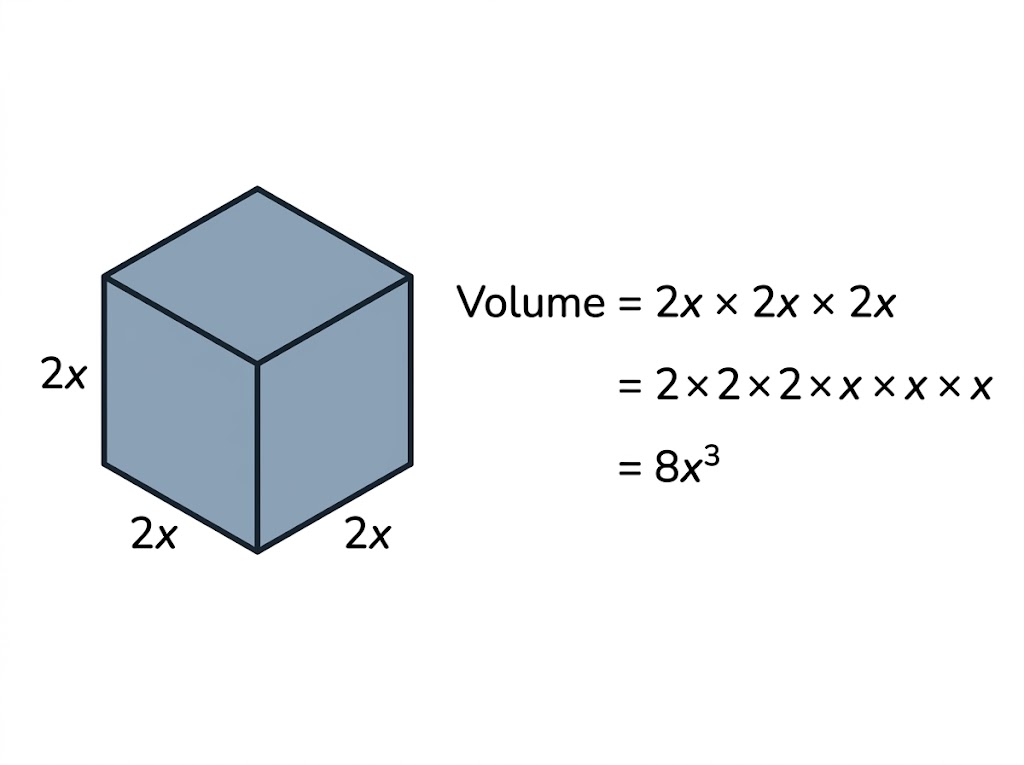
\((2x)^3 = 2x \times 2x \times 2x = 8x^3\), not \(2x^3\).
Mistakes to Avoid
Wrong
- \((2x)^3 = 2x^3\)
- \(3x^2 \times 2x = 6x^2\)
- \(x^2 + x^3 = x^5\)
- \((x^3)^2 = x^5\)
- \(12x^6 \div 4x^2 = 3x^3\)
Right
- \((2x)^3 = 8x^3\) - cube the 2 as well.
- \(3x^2 \times 2x = 6x^3\) - \(x\) is \(x^1\).
- \(x^2 + x^3\) cannot be simplified: they are not like terms.
- \((x^3)^2 = x^6\) - multiply the indices.
- \(12x^6 \div 4x^2 = 3x^4\) - subtract the indices.
Negative and Fractional Powers of Letters
The meanings are the same as for numbers.
-
Negative powers
\(x^{-1} = \dfrac{1}{x}\) and \(x^{-3} = \dfrac{1}{x^3}\). So \(\dfrac{1}{x^4}\) can be written as \(x^{-4}\).
-
Fractional powers
\(x^{\frac{1}{2}} = \sqrt{x}\) and \(x^{\frac{1}{3}} = \sqrt[3]{x}\). So \(\dfrac{1}{\sqrt{x}} = x^{-\frac{1}{2}}\).
-
"Write in the form \(x^n\)"
Turn roots and fractions into single powers: \(\dfrac{1}{x^2} = x^{-2}\), \(\sqrt{x^3} = x^{\frac{3}{2}}\).
-
Brackets
Raise each part inside the bracket to the power: \((16x^8)^{\frac{1}{2}} = 16^{\frac{1}{2}} \times x^4 = 4x^4\).
A Negative Fractional Power
Simplify \((27x^6y^{-3})^{-\frac{1}{3}}\)
Show the solutionHide the solution
- 1 Raise each part to the power \(-\frac{1}{3}\) \(27^{-\frac{1}{3}} \times (x^6)^{-\frac{1}{3}} \times (y^{-3})^{-\frac{1}{3}}\)
- 2 The number: flip and cube root \(27^{-\frac{1}{3}} = \dfrac{1}{3}\)
- 3 The \(x\): multiply the indices \(6 \times \left(-\frac{1}{3}\right) = -2\), so \(x^{-2} = \dfrac{1}{x^2}\)
- 4 The \(y\): multiply the indices \(-3 \times \left(-\frac{1}{3}\right) = 1\), so \(y^1 = y\)
- 5 Put them together \(\dfrac{1}{3} \times \dfrac{1}{x^2} \times y\)
Answer\(\dfrac{y}{3x^2}\)
Solving an Equation with Powers
Solve \(2^{x+1} = 8^x\)
Show the solutionHide the solution
- 1 Write both sides with the same base \(8 = 2^3\), so \(8^x = 2^{3x}\)
- 2 So \(2^{x+1} = 2^{3x}\)
- 3 Same base, so the indices are equal \(x + 1 = 3x\)
- 4 Solve \(1 = 2x\)
Answer\(x = \dfrac{1}{2}\)
Index Pyramids
Simplify each. (a) \(a^4 \times a^6\) (b) \(6m^5 \times 2m\) (c) \(18p^8q^3 \div 6p^2q\) (d) \((4x^3)^2\) (e) \((2a^2b)^3 \times 3ab^4\) (f) \(\dfrac{x^7 \times x^2}{x^5}\). Higher: (g) \((9x^4)^{\frac{1}{2}}\) (h) \((8y^6)^{-\frac{1}{3}}\) (i) solve \(4^x = 2^{x+3}\).
1. Numbers first.
2. Then each letter in turn.
3. Check every bracket's power applies to everything inside.
A good answer shows: (a) \(a^{10}\) (b) \(12m^6\) (c) \(3p^6q^2\) (d) \(16x^6\) (e) \(8a^6b^3 \times 3ab^4 = 24a^7b^7\) (f) \(x^4\) (g) \(3x^2\) (h) \(\dfrac{1}{2y^2}\) (i) \(2^{2x} = 2^{x+3}\), so \(x = 3\).
Can I...?
- 1Multiply terms using the index laws.
- 2Divide terms using the index laws.
- 3Raise a power to a power.
- 4Raise a bracket to a power.
- 5Use \(x^0 = 1\).
- 6Use negative powers of letters. (Higher)
- 7Use fractional powers of letters. (Higher)
- 8Solve equations with unknown powers. (Higher)
Summary & Exam Focus
- Multiply: add indices. Divide: subtract indices. Power of a power: multiply indices.
- A power on a bracket applies to everything inside, including the number.
- Only like terms can be added; \(x^2 + x^3\) does not simplify.
- (Higher) \(x^{-n} = \dfrac{1}{x^n}\) and \(x^{\frac{1}{n}} = \sqrt[n]{x}\).
Exam focus
Simplify \((2a^3b)^5\) (2 marks) (2 marks)
Work through the numbers first, then each letter in alphabetical order. The two marks are usually one for the number and one for the letters.
Key terms
The vocabulary this lesson expects you to use. Each one is linked from the first place it appears above.
- Index (power)
- The small number showing how many times the base is multiplied by itself.
- Coefficient
- The number in front of a letter, e.g. 5 in \(5x^3\).
- Like terms
- Terms with exactly the same letters and powers, e.g. \(3x^2\) and \(7x^2\).
- Simplify
- Write an expression in its shortest form.
- Negative index (Higher)
- \(x^{-n} = \dfrac{1}{x^n}\).
- Fractional index (Higher)
- \(x^{\frac{1}{n}} = \sqrt[n]{x}\).
Practice questions
Have a go at each one before you open its answer.
-
Question 1 Non-calculator 1 mark
Simplify \(m^5 \times m^3\)
Show answerHide answer
Model answer
\(m^8\)
Mark scheme
- \(m^8\) — B1
-
Question 2 Non-calculator 1 mark
Simplify \((p^4)^3\)
Show answerHide answer
Model answer
\(p^{12}\)
Mark scheme
- \(p^{12}\) — B1
-
Question 3 Non-calculator 2 marks
Simplify \(4x^2y^3 \times 3x^5y\)
Show answerHide answer
Model answer
\(12x^7y^4\)
Mark scheme
- \(12x^7y^4\) — B2
- Two of \(12\), \(x^7\) and \(y^4\) in a single term — B1
-
Question 4 Non-calculator 2 marks
Simplify \((2a^3b)^5\)
Show answerHide answer
Model answer
\(32a^{15}b^5\)
Mark scheme
- \(32a^{15}b^5\) — B2
- Two of \(32\), \(a^{15}\) and \(b^5\) in a single term — B1
-
Question 5 Non-calculator · Higher 2 marks
Simplify \((64x^6)^{\frac{2}{3}}\)
Show answerHide answer
Model answer
\(64^{\frac{2}{3}} = \left(\sqrt[3]{64}\right)^2 = 4^2 = 16\) and \((x^6)^{\frac{2}{3}} = x^4\), so \(16x^4\).
Mark scheme
- \(16x^4\) — B2
- \(16\) or \(x^4\) in a single term — B1
-
Question 6 Non-calculator · Higher 3 marks
Solve \(9^x = 27^{x-1}\)
Show answerHide answer
Model answer
\(9 = 3^2\) and \(27 = 3^3\), so \(3^{2x} = 3^{3x-3}\). Then \(2x = 3x - 3\), so \(x = 3\).
Mark scheme
- Both sides written as powers of 3 — M1
- \(2x = 3x - 3\) — M1
- \(x = 3\) — A1
Quick check
-
Simplify \(x^3 \times x^4\)
Show answerHide answer
A: \(x^7\)
Multiplying: add the indices, \(3 + 4 = 7\).
-
Simplify \((3x)^2\)
Show answerHide answer
C: \(9x^2\)
Everything in the bracket is squared: \(3^2 \times x^2 = 9x^2\).
-
(Higher) Write \(\dfrac{1}{\sqrt{x}}\) as a power of \(x\).
Show answerHide answer
D: \(x^{-\frac{1}{2}}\)
\(\sqrt{x} = x^{\frac{1}{2}}\), and one over it is \(x^{-\frac{1}{2}}\).
Downloads
Free to keep, print and annotate.
- Algebraic indices.pptx Built from the lesson script on 28 September 2026. View
- Algebraic indices - Completed Notes.docx The full notes for the lesson, to revise from. Built from the lesson script on 28 September 2026. View
- Algebraic indices - Exam Questions.docx Built from the lesson script on 28 September 2026. View
Something here looks wrong?
Tell us what and we will go and look. It goes to whoever writes these pages, nobody else, and we do not ask who you are — so there is nothing to sign and nothing comes back to you.