Viewing as
Teacher view: planning notes, the answers to every question, and the teacher copies of the files.
Maths · Algebra
Equations
An equation is a balance: whatever you do to one side, you do to the other. With that one rule you can solve equations with the unknown on both sides, inside brackets or on the bottom of a fraction - and turn word problems into equations too.
Teacher resources
The teacher copies: slides with the questions built in, the answers, and anything else attached to this lesson for whoever is teaching it.
- Equations - Teacher Slides.pptx Teacher The lesson slides with the teacher's notes on each slide, and every question and mark scheme built in. Built from the lesson script on 28 September 2026. View
- Equations - Teacher Notes.docx Teacher The complete notes with the teacher's notes and every model answer in full. Built from the lesson script on 28 September 2026. View
Student handouts
The same files the students see, to print or hand out.
Last Lesson and Before
Answer each one, then check.
-
1
Solve \(x + 7 = 12\).
Show answerHide answer
\(x = 5\)
-
2
What is the inverse of "multiply by 4"?
Show answerHide answer
Divide by 4.
-
3
Work out \(-6 \div 2\).
Show answerHide answer
\(-3\)
-
4
Last lesson: expand \(3(x - 2)\).
Show answerHide answer
\(3x - 6\)
-
5
Last lesson: factorise \(6x + 9\).
Show answerHide answer
\(3(2x + 3)\)
Learning Objectives
- 1Solve linear equations with the unknown on both sides.
- 2Solve equations with brackets.
- 3Solve equations with fractions.
- 4Form equations from words and diagrams.
- 5Solve problems by forming and solving an equation.
Keeping the Balance
An equation says two things are equal. Solving it means finding the value of the letter that makes it true.
-
Same on both sides
Add, subtract, multiply or divide both sides by the same thing, and the equation stays true.
-
Inverse operations
Undo \(+\) with \(-\), and \(\times\) with \(\div\).
-
One step at a time
Write each step on a new line, with the \(=\) signs lined up.
-
Check
Put your answer back into the original equation. Both sides should give the same number.
An Equation Is a Balance
The scales stay level as long as you do the same thing to both pans. Take 2 counters off each side and 3 bags balance 9 counters; share them out and each bag must hold 3. That is exactly how you solve \(3x + 2 = 11\).
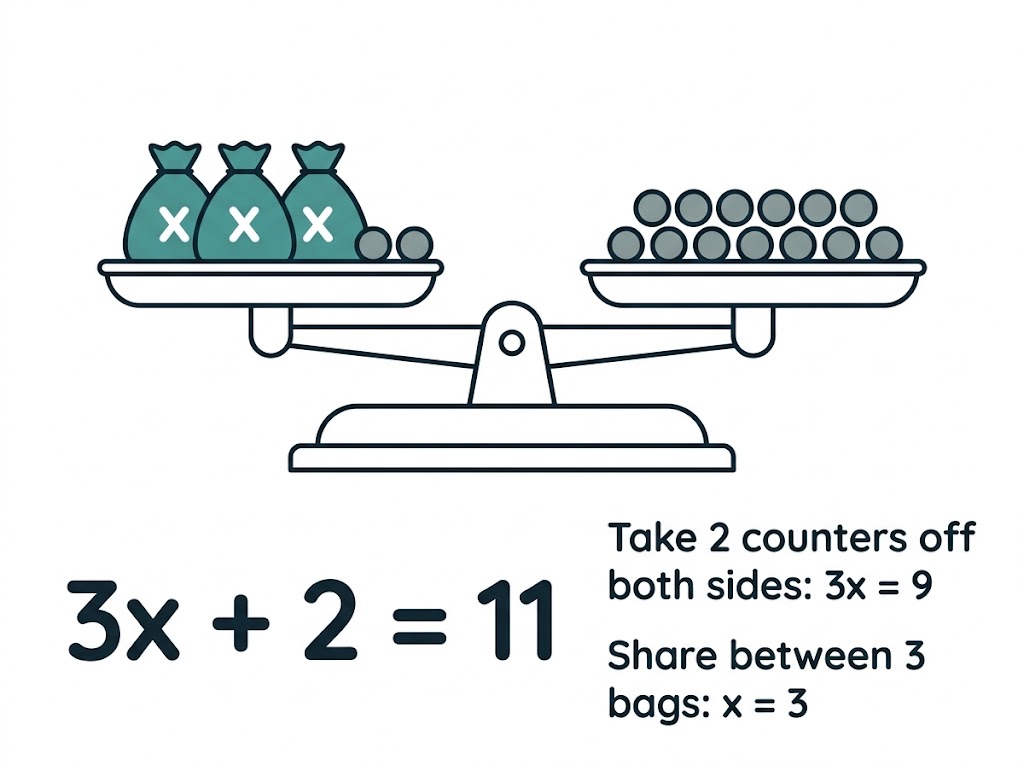
\(3x + 2 = 11\): take 2 from both sides, then divide by 3.
A Method for Any Linear Equation
Not every equation needs every step - skip the ones that do not apply.
-
1
Brackets
Expand any brackets.
-
2
Fractions
Multiply both sides to clear any fractions.
-
3
Letters
Collect the letter terms on the side with more of them.
-
4
Numbers
Collect the numbers on the other side.
-
5
Divide
Divide by the number in front of the letter.
The Unknown on Both Sides
Solve \(5x - 7 = 2x + 11\)
Show the solutionHide the solution
- 1 Subtract \(2x\) from both sides (there are more \(x\)s on the left) \(3x - 7 = 11\)
- 2 Add 7 to both sides \(3x = 18\)
- 3 Divide both sides by 3 \(x = 6\)
- 4 Check: both sides give 23 \(5(6) - 7 = 23\) and \(2(6) + 11 = 23\)
Answer\(x = 6\)
Equations with Brackets
Solve \(3(2x - 1) = 4(x + 5)\)
Show the solutionHide the solution
- 1 Expand both brackets \(6x - 3 = 4x + 20\)
- 2 Subtract \(4x\) from both sides \(2x - 3 = 20\)
- 3 Add 3 to both sides \(2x = 23\)
- 4 Divide by 2 \(x = 11.5\)
Answer\(x = 11.5\) (or \(\dfrac{23}{2}\))
Equations with Fractions
Solve \(\dfrac{2x + 1}{3} = \dfrac{x - 2}{2}\)
Show the solutionHide the solution
- 1 Multiply both sides by 3 and by 2 (by 6) \(2(2x + 1) = 3(x - 2)\)
- 2 Expand \(4x + 2 = 3x - 6\)
- 3 Subtract \(3x\) \(x + 2 = -6\)
- 4 Subtract 2 \(x = -8\)
- 5 Check: both sides give \(-5\) \(\dfrac{-16 + 1}{3} = -5\) and \(\dfrac{-8 - 2}{2} = -5\)
Answer\(x = -8\)
Two Fractions on One Side
Solve \(\dfrac{x}{4} + \dfrac{x}{6} = 5\)
Show the solutionHide the solution
- 1 The lowest common multiple of 4 and 6 is 12: multiply every term by 12 \(3x + 2x = 60\)
- 2 Collect like terms \(5x = 60\)
- 3 Divide by 5 \(x = 12\)
Answer\(x = 12\)
From Words to an Equation
Four steps turn a problem into an equation you can solve.
-
Choose a letter
Let \(x\) be the thing you do not know - say exactly what it stands for.
-
Write expressions
Write everything else in terms of \(x\).
-
Make an equation
Use the fact the question gives you: a total, a perimeter, angles adding to \(180^\circ\).
-
Answer the question
Solve for \(x\), then use it to find what the question actually asked for.
A Perimeter Problem
A rectangle has length \((3x + 2)\) cm and width \((x - 1)\) cm. Its perimeter is 42 cm. Find the length and the width.
Show the solutionHide the solution
- 1 Perimeter = 2 lengths + 2 widths \(2(3x + 2) + 2(x - 1) = 42\)
- 2 Expand \(6x + 4 + 2x - 2 = 42\)
- 3 Simplify \(8x + 2 = 42\)
- 4 Solve \(8x = 40\), so \(x = 5\)
- 5 Answer the question Length \(= 3(5) + 2 = 17\), width \(= 5 - 1 = 4\)
AnswerLength 17 cm, width 4 cm (check: \(2 \times 17 + 2 \times 4 = 42\))
A Word Problem
An adult cinema ticket costs £4 more than a child ticket. Two adult tickets and three child tickets cost £38. Find the price of each ticket.
Show the solutionHide the solution
- 1 Let a child ticket cost £\(x\) An adult ticket costs £\((x + 4)\)
- 2 Write the equation \(2(x + 4) + 3x = 38\)
- 3 Expand and simplify \(2x + 8 + 3x = 38\), so \(5x + 8 = 38\)
- 4 Solve \(5x = 30\), so \(x = 6\)
AnswerChild £6, adult £10 (check: \(2 \times 10 + 3 \times 6 = 38\))
Equation Relay
Solve each equation; each answer is used in the next. (a) \(4x + 3 = 23\). (b) Let \(a\) be your answer to (a): solve \(2y - a = y + 1\). (c) Let \(b\) be your answer to (b): solve \(3(z - 2) = b + z\). (d) Let \(c\) be your answer to (c): solve \(\dfrac{w}{2} + \dfrac{w}{3} = c + 1\).
1. Solve each equation in turn.
2. Check each answer before passing it on.
3. The first team with a correct (d) wins.
A good answer shows: (a) \(x = 5\) (b) \(y = 6\) (c) \(3z - 6 = 6 + z\), so \(z = 6\) (d) \(\dfrac{5w}{6} = 7\), so \(w = 8.4\)
Can I...?
- 1Solve two-step equations.
- 2Solve equations with the unknown on both sides.
- 3Solve equations with brackets.
- 4Solve equations with one fraction.
- 5Solve equations with two fractions.
- 6Check a solution by substituting.
- 7Form an equation from words.
- 8Form an equation from a diagram.
Summary & Exam Focus
- Do the same to both sides to keep the equation balanced.
- Expand brackets, clear fractions, collect letters, collect numbers, divide.
- Clear fractions by multiplying every term by the LCM of the denominators.
- For word problems: choose a letter, write expressions, form an equation, then answer the question asked.
Exam focus
Solve \(4(3 - 2x) = 2(x + 11)\) (3 marks) (3 marks)
Write each step on a new line. If the final answer is wrong, the method marks for expanding and collecting terms are still there to win.
Key terms
The vocabulary this lesson expects you to use. Each one is linked from the first place it appears above.
- Equation
- A statement that two expressions are equal, true for particular values of the letter.
- Solve
- Find the value of the letter that makes the equation true.
- Solution
- The value that makes the equation true.
- Inverse operation
- The operation that undoes another: \(-\) undoes \(+\), \(\div\) undoes \(\times\).
- Linear equation
- An equation where the highest power of the letter is 1.
Questions and answers
8 questions set on this lesson, with the mark schemes and model answers open.
Solve \(7x + 4 = 3x - 12\)
Mark scheme — 2 marks available
- \(4x = -16\), or a correct first step collecting \(x\) terms or numbers — M1
- \(x = -4\) — A1
Model answer
\(4x = -16\), so \(x = -4\)
Solve \(4(3 - 2x) = 2(x + 11)\)
Mark scheme — 3 marks available
- Both brackets expanded correctly — M1
- Correctly collects \(x\) terms on one side and numbers on the other — M1
- \(x = -1\) — A1
Model answer
\(12 - 8x = 2x + 22\), so \(-10 = 10x\) and \(x = -1\).
Solve \(\dfrac{5x - 2}{3} = \dfrac{x + 4}{2}\)
Mark scheme — 3 marks available
- Multiplies both sides to clear the fractions, e.g. \(2(5x - 2) = 3(x + 4)\) — M1
- \(7x = 16\) — M1
- \(x = \frac{16}{7}\) (or \(2\frac{2}{7}\)) — A1
Model answer
\(2(5x - 2) = 3(x + 4)\), so \(10x - 4 = 3x + 12\), \(7x = 16\) and \(x = \dfrac{16}{7}\).
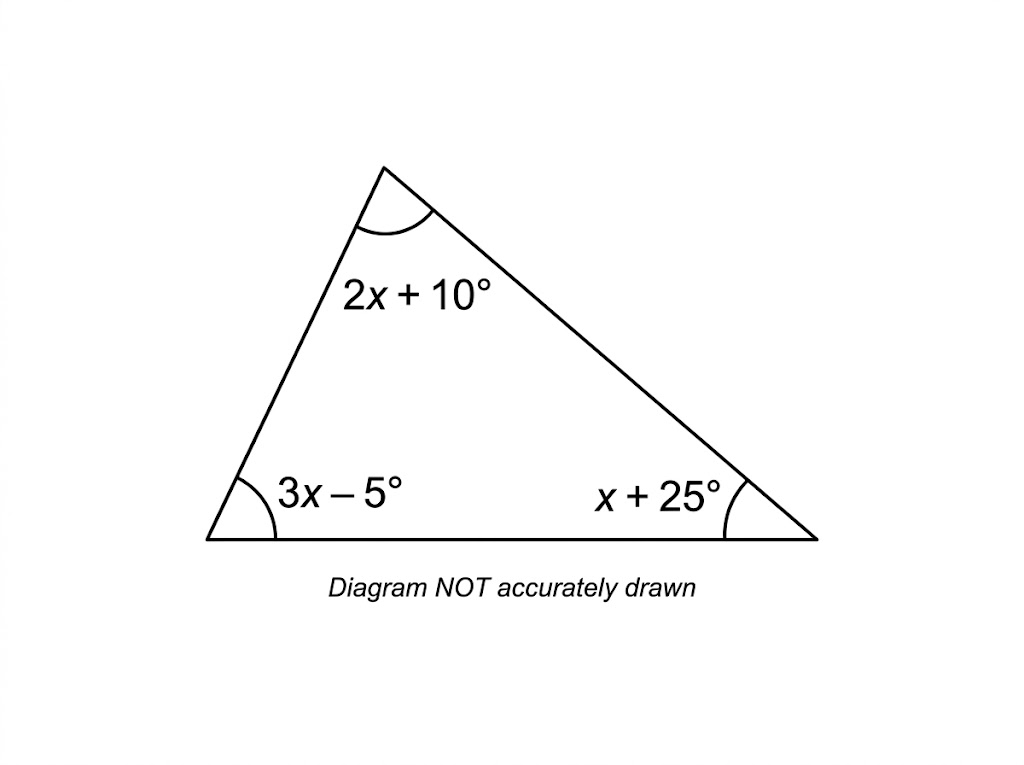
The diagram shows a triangle. The sizes of its angles, in degrees, are \(2x + 10\), \(3x - 5\) and \(x + 25\). Work out the size of the largest angle.
Mark scheme — 4 marks available
- Sets the sum of the angles equal to 180 — P1
- \(6x + 30 = 180\) — P1
- \(x = 25\) — P1
- \(70^\circ\) — A1
Model answer
\((2x + 10) + (3x - 5) + (x + 25) = 180\), so \(6x + 30 = 180\), \(6x = 150\) and \(x = 25\). The angles are \(60^\circ\), \(70^\circ\) and \(50^\circ\). The largest angle is \(70^\circ\).
Amy is 3 times as old as Ben. In 8 years' time, Amy will be twice as old as Ben. How old is Amy now?
Mark scheme — 4 marks available
- Ben \(= b\) and Amy \(= 3b\), or equivalent — P1
- \(3b + 8 = 2(b + 8)\) — P1
- \(b = 8\) — P1
- Amy is 24 — A1
Model answer
Let Ben be \(b\). Amy is \(3b\). In 8 years: \(3b + 8 = 2(b + 8)\), so \(3b + 8 = 2b + 16\) and \(b = 8\). Amy is 24.
Solve \(3x + 5 = 20\)
Why: Subtract 5: \(3x = 15\). Divide by 3: \(x = 5\).
Solve \(5x - 3 = 2x + 9\)
Why: Subtract \(2x\): \(3x - 3 = 9\). Add 3: \(3x = 12\). Divide by 3: \(x = 4\).
Solve \(\dfrac{x}{3} + 2 = 6\)
Why: Subtract 2: \(\dfrac{x}{3} = 4\). Multiply by 3: \(x = 12\).