Viewing as
Teaching this? The teacher view adds 2 files, the mark schemes and the model answers.
Maths · Angles and trigonometry
Angle properties of triangles and quadrilaterals
The angle facts for lines, triangles, quadrilaterals and parallel lines - and how to use them, with reasons, to find missing angles step by step.
Before We Start
Answer each one, then check.
-
1
How many degrees are there in a full turn?
Show answerHide answer
\(360^\circ\)
-
2
What is the name of an angle bigger than \(90^\circ\) but smaller than \(180^\circ\)?
Show answerHide answer
Obtuse
-
3
Solve \(3x + 30 = 180\).
Show answerHide answer
\(x = 50\)
-
4
How many lines of symmetry does a rhombus have?
Show answerHide answer
2
Learning Objectives
- 1Use the angle facts for lines, points and triangles.
- 2Use the angle sum of a quadrilateral and the properties of special quadrilaterals.
- 3Find angles made by parallel lines: alternate, corresponding and co-interior.
- 4Give a reason for every step of an angle calculation.
The Basic Angle Facts
Every angle problem is built from a handful of facts. Learn the exact wording - it is what earns the reason marks.
-
Angles on a straight line
Angles on a straight line add up to \(180^\circ\).
-
Angles around a point
Angles around a point add up to \(360^\circ\).
-
Vertically opposite angles
Where two straight lines cross, the opposite angles are equal.
-
Angles in a triangle
The angles in a triangle add up to \(180^\circ\).
Special Triangles
The sides tell you about the angles.
-
Equilateral
Three equal sides and three equal angles of \(60^\circ\).
-
Isosceles
Two equal sides, and the two base angles opposite them are equal.
-
Right-angled
One angle is \(90^\circ\), so the other two add up to \(90^\circ\).
-
Exterior angle of a triangle
The exterior angle equals the sum of the two interior opposite angles.
An Isosceles Triangle
In triangle ABC, AB = AC and angle BAC = \(40^\circ\). Work out angle ABC.
Show the solutionHide the solution
- 1 The triangle is isosceles, so the base angles are equal angle ABC = angle ACB
- 2 Angles in a triangle add up to \(180^\circ\) \(180 - 40 = 140\)
- 3 Share between the two equal base angles \(140 \div 2 = 70\)
Answerangle ABC = \(70^\circ\)
Quadrilaterals
A quadrilateral splits into two triangles, so its angles add up to \(2 \times 180^\circ = 360^\circ\).
-
Square and rectangle
Four right angles. Diagonals are equal and bisect each other.
-
Parallelogram
Opposite sides parallel and equal; opposite angles equal.
-
Rhombus
A parallelogram with four equal sides; the diagonals cross at right angles.
-
Kite and trapezium
A kite has one pair of equal opposite angles; a trapezium has one pair of parallel sides.
Angles in Algebra
The angles of a quadrilateral are \(x\), \(2x\), \(3x\) and \(4x\). Work out the size of the largest angle.
Show the solutionHide the solution
- 1 Angles in a quadrilateral add up to \(360^\circ\) \(x + 2x + 3x + 4x = 360\)
- 2 Collect like terms \(10x = 360\)
- 3 Solve \(x = 36\)
- 4 The largest angle is \(4x\) \(4 \times 36 = 144\)
Answer\(144^\circ\)
Alternate, Corresponding and Co-interior
Alternate angles are equal (a Z shape). Corresponding angles are equal (an F shape). Co-interior angles add up to \(180^\circ\) (a C shape). In the exam, write the proper name - "Z angles" does not earn the mark.
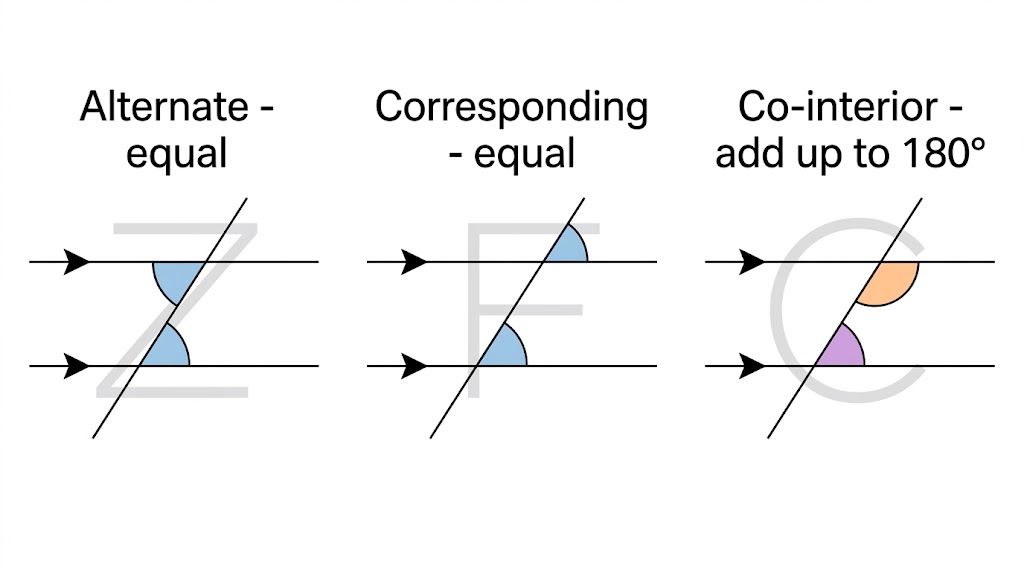
Z for alternate, F for corresponding, C for co-interior.
The Parallel Line Facts
-
Alternate
Shape: Z. Fact: Alternate angles are equal.
-
Corresponding
Shape: F. Fact: Corresponding angles are equal.
-
Co-interior (allied)
Shape: C. Fact: Co-interior angles add up to \(180^\circ\).
-
Vertically opposite
Shape: X. Fact: Vertically opposite angles are equal.
Parallel Lines with Reasons
Two parallel lines are crossed by a straight line. One of the angles is \(72^\circ\). Angle \(y\) is co-interior to it. Angle \(z\) is on a straight line with \(y\). Work out \(y\) and \(z\).
Show the solutionHide the solution
- 1 Co-interior angles add up to \(180^\circ\) \(y = 180 - 72 = 108\)
- 2 Angles on a straight line add up to \(180^\circ\) \(z = 180 - 108 = 72\)
- 3 Check: \(z\) is alternate (or corresponding) to the \(72^\circ\) angle, so equal to it \(z = 72\)
Answer\(y = 108^\circ\), \(z = 72^\circ\)
Reasons That Earn Marks
Loses the mark
- "Z angles"
- "Because it's a straight line"
- "Triangle = 180"
- "They're the same"
Earns the mark
- "Alternate angles are equal"
- "Angles on a straight line add up to \(180^\circ\)"
- "Angles in a triangle add up to \(180^\circ\)"
- "Base angles of an isosceles triangle are equal"
Angle Chase
Draw two parallel lines and two different transversals that cross each other between the parallel lines, making a triangle. Mark one angle at each crossing. Swap with a partner, who must find every other angle and give a reason for each.
1. Mark the parallel lines with arrows.
2. Find one angle at a time.
3. Write the reason next to each angle.
A good answer shows: Students use alternate and corresponding angles to find the triangle's angles, then check that they add up to \(180^\circ\) - which is in fact a proof that the angles in a triangle add up to \(180^\circ\).
Can I...?
- 1Use angles on a line and around a point.
- 2Use vertically opposite angles.
- 3Use angles in a triangle, including isosceles triangles.
- 4Use angles in a quadrilateral.
- 5Recall the properties of special quadrilaterals.
- 6Find alternate, corresponding and co-interior angles.
- 7Form and solve an equation from angle facts.
- 8Give a correct reason for each step.
Summary & Exam Focus
- Line \(180^\circ\), point \(360^\circ\), triangle \(180^\circ\), quadrilateral \(360^\circ\).
- Vertically opposite angles are equal.
- Alternate and corresponding angles are equal; co-interior angles add up to \(180^\circ\).
- Isosceles: the base angles are equal.
Exam focus
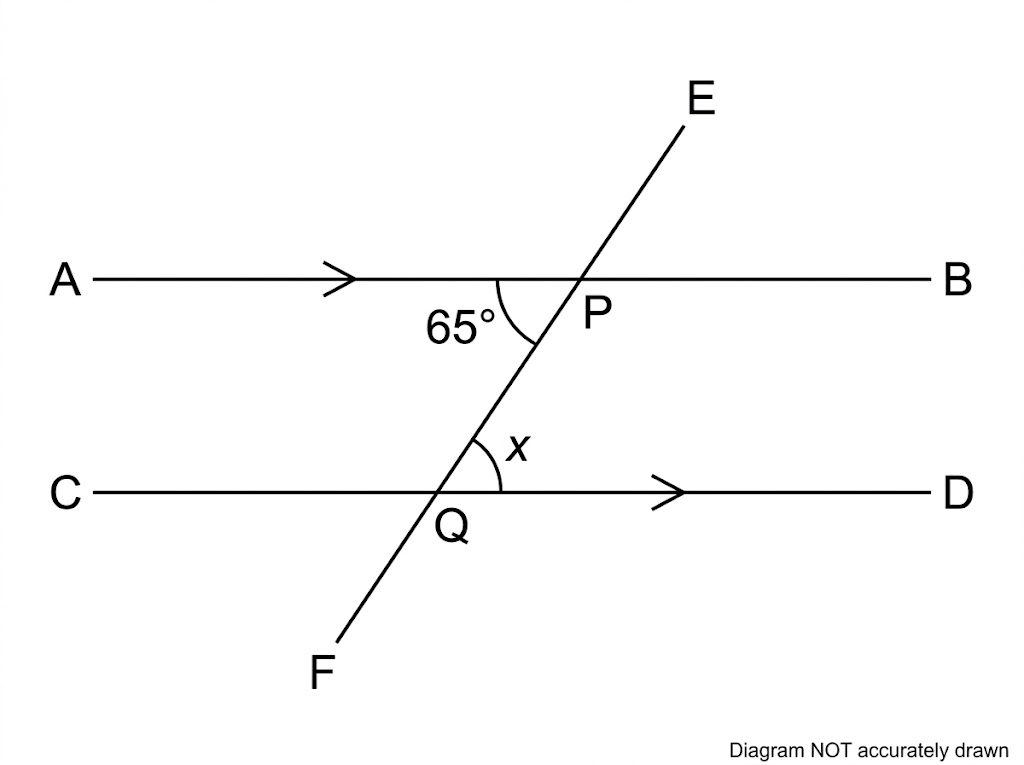
AB and CD are parallel lines. Angle APQ = \(65^\circ\). Work out the size of angle \(x\). Give a reason for each stage of your working. (3 marks) (3 marks)
"Give reasons" questions have marks for the reasons as well as the angles. Write each reason as a full sentence using the proper words: alternate, corresponding, co-interior, vertically opposite.
Key terms
The vocabulary this lesson expects you to use. Each one is linked from the first place it appears above.
- Vertically opposite
- The angles opposite each other where two lines cross; they are equal.
- Isosceles
- A triangle with two equal sides and two equal angles.
- Parallel
- Lines that are always the same distance apart and never meet.
- Transversal
- A line that crosses two or more other lines.
- Alternate angles
- Angles on opposite sides of a transversal, between parallel lines; they are equal.
- Co-interior angles
- Angles on the same side of a transversal, between parallel lines; they add up to \(180^\circ\).
Practice questions
Have a go at each one before you open its answer.
-
Question 1 Non-calculator 2 marks
In triangle PQR, PQ = PR and angle QPR = \(52^\circ\). Work out the size of angle PQR.
Show answerHide answer
Model answer
\(180 - 52 = 128\), \(128 \div 2 = 64\). Angle PQR = \(64^\circ\).
Mark scheme
- \(180 - 52\), or 128 — M1
- \(64^\circ\) — A1
-
Question 2 Non-calculator 3 marks
AB and CD are parallel lines. The line EF crosses AB at P and CD at Q. Angle APQ = \(65^\circ\). Work out the size of angle \(x\). Give a reason for each stage of your working.
Show answerHide answer
Model answer
Angle APQ and angle \(x\) (angle PQC) are co-interior, so \(x = 180 - 65 = 115^\circ\). (Or: angle PQD = \(65^\circ\) because alternate angles are equal, then \(x = 180 - 65 = 115^\circ\) because angles on a straight line add up to \(180^\circ\).)
Mark scheme
- \(x = 115\) — B1
- A correct reason, e.g. co-interior angles add up to \(180^\circ\), or alternate angles are equal — C1
- A full set of correct reasons for their method — C1
-
Question 3 Non-calculator 3 marks
The angles of a quadrilateral are \(x\), \(2x\), \(x + 30\) and \(2x + 30\), in degrees. Work out the value of \(x\). Then write down the size of the smallest angle.
Show answerHide answer
Model answer
\(x + 2x + x + 30 + 2x + 30 = 360\), so \(6x + 60 = 360\), \(6x = 300\), \(x = 50\). The smallest angle is \(x = 50^\circ\).
Mark scheme
- Adding the four angles and setting equal to 360 — M1
- \(6x + 60 = 360\) solved correctly as far as \(6x = 300\) — M1
- \(x = 50\), smallest angle \(50^\circ\) — A1
-
Question 4 Non-calculator 2 marks
Kim says, "A parallelogram with a right angle must be a square." Is Kim right? Give a reason for your answer.
Show answerHide answer
Model answer
No. A parallelogram with one right angle has four right angles, so it is a rectangle - but its sides need not all be equal, so it need not be a square.
Mark scheme
- No, with an argument about the sides — C1
- A counter-example, e.g. a rectangle 2 cm by 5 cm — C1
Quick check
-
Two angles of a triangle are \(48^\circ\) and \(75^\circ\). What is the third angle?
Show answerHide answer
B: \(57^\circ\)
\(180 - 48 - 75 = 57\).
-
Which pair of angles between parallel lines add up to \(180^\circ\)?
Show answerHide answer
D: Co-interior angles
Co-interior angles (a C shape) add up to \(180^\circ\); alternate and corresponding angles are equal.
-
An isosceles triangle has one angle of \(100^\circ\). What are the other two?
Show answerHide answer
A: \(40^\circ\) and \(40^\circ\)
A triangle cannot have two angles of \(100^\circ\), so \(100^\circ\) is the odd one out: \((180 - 100) \div 2 = 40\).
Downloads
Free to keep, print and annotate.
- Angle properties of triangles and quadrilaterals.pptx Built from the lesson script on 29 September 2026. View
- Angle properties of triangles and quadrilaterals - Completed Notes.docx The full notes for the lesson, to revise from. Built from the lesson script on 29 September 2026. View
- Angle properties of triangles and quadrilaterals - Exam Questions.docx Built from the lesson script on 29 September 2026. View
Something here looks wrong?
Tell us what and we will go and look. It goes to whoever writes these pages, nobody else, and we do not ask who you are — so there is nothing to sign and nothing comes back to you.