Viewing as
Teacher view: planning notes, the answers to every question, and the teacher copies of the files.
Maths · Angles and trigonometry
Pythagoras' theorem 2
Pythagoras hidden inside other problems: the distance between two points, the height of an isosceles triangle, the slant side of a trapezium, and two triangles joined together.
Teacher resources
The teacher copies: slides with the questions built in, the answers, and anything else attached to this lesson for whoever is teaching it.
- Pythagoras theorem 2 - Teacher Slides.pptx Teacher The lesson slides with the teacher's notes on each slide, and every question and mark scheme built in. Built from the lesson script on 29 September 2026. View
- Pythagoras theorem 2 - Teacher Notes.docx Teacher The complete notes with the teacher's notes and every model answer in full. Built from the lesson script on 29 September 2026. View
Student handouts
The same files the students see, to print or hand out.
- Pythagoras theorem 2.pptx Built from the lesson script on 29 September 2026. View
- Pythagoras theorem 2 - Completed Notes.docx The full notes for the lesson, to revise from. Built from the lesson script on 29 September 2026. View
- Pythagoras theorem 2 - Exam Questions.docx Built from the lesson script on 29 September 2026. View
Last Lesson and Before
Answer each one, then check.
-
1
Last lesson: a right-angled triangle has shorter sides 6 and 8. How long is the hypotenuse?
Show answerHide answer
10
-
2
What is the formula for the area of a triangle?
Show answerHide answer
\(\frac{1}{2} \times \text{base} \times \text{height}\)
-
3
Work out \(4 - (-2)\).
Show answerHide answer
6
-
4
Is 5, 12, 13 a Pythagorean triple?
Show answerHide answer
Yes: \(25 + 144 = 169\)
Learning Objectives
- 1Find the distance between two points on a coordinate grid.
- 2Find the height of an isosceles triangle, and use it to find the area.
- 3Spot the right-angled triangle hidden inside a shape.
- 4Solve problems that need Pythagoras' theorem twice.
Finding the Right-Angled Triangle
Most problems don't hand you a right-angled triangle - you have to draw it in.
-
Isosceles triangle
The line of symmetry cuts it into two right-angled triangles, and halves the base.
-
Rectangle
A diagonal makes two right-angled triangles.
-
Trapezium
Drop a vertical height from a top corner to make a right-angled triangle at the end.
-
Coordinates
The horizontal and vertical distances between two points are the two shorter sides.
The Distance Between Two Points
Subtract the x-coordinates to get the horizontal side and the y-coordinates to get the vertical side. Then \(AB = \sqrt{9^2 + 5^2} = \sqrt{106} = 10.3\) to 1 decimal place.
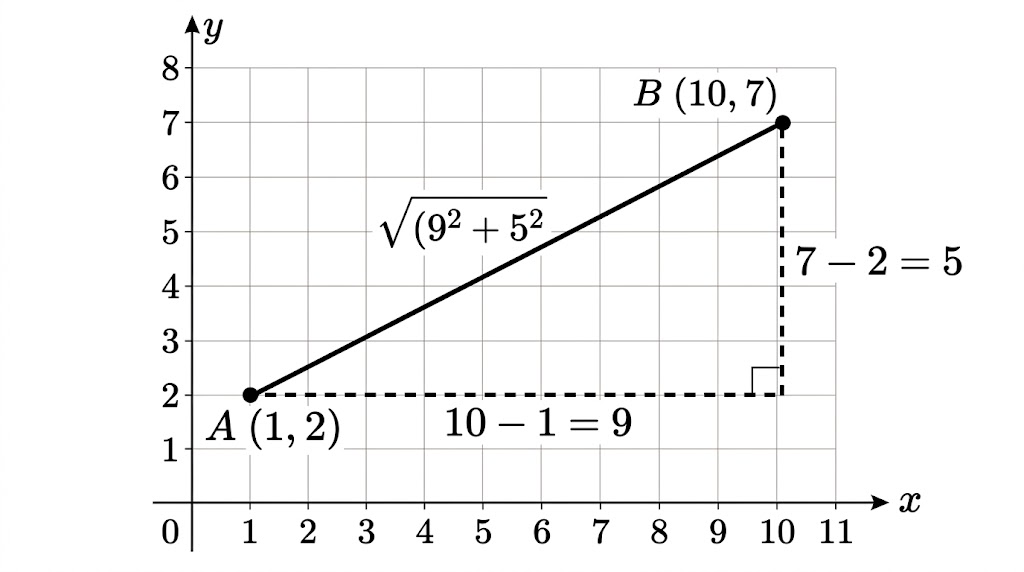
The line joining two points is the hypotenuse of a right-angled triangle.
The Distance Between Two Points
Work out the length of the line joining A(1, 2) and B(10, 7). Give your answer to 1 decimal place.
Show the solutionHide the solution
- 1 Horizontal distance \(10 - 1 = 9\)
- 2 Vertical distance \(7 - 2 = 5\)
- 3 Pythagoras \(AB^2 = 9^2 + 5^2 = 81 + 25 = 106\)
- 4 Square root \(AB = \sqrt{106} = 10.295\ldots\)
Answer10.3 units
Area of an Isosceles Triangle
An isosceles triangle has sides 10 cm, 10 cm and 12 cm. Work out its area.
Show the solutionHide the solution
- 1 The line of symmetry halves the base Half base = 6 cm, hypotenuse 10 cm
- 2 Pythagoras for the height \(h^2 = 10^2 - 6^2 = 100 - 36 = 64\), so \(h = 8\)
- 3 Area \(\frac{1}{2} \times 12 \times 8 = 48\)
Answer48 cm²
The Slant Side of a Trapezium
An isosceles trapezium has parallel sides 10 cm and 16 cm, and a height of 8 cm. Work out its perimeter, to 1 decimal place.
Show the solutionHide the solution
- 1 The extra length on the longer side is shared between the two ends \((16 - 10) \div 2 = 3\) cm
- 2 Pythagoras for one slant side \(s^2 = 3^2 + 8^2 = 73\), so \(s = 8.544\ldots\)
- 3 Add the four sides \(10 + 16 + 2 \times 8.544\ldots = 43.088\ldots\)
Answer43.1 cm
Two Triangles, Two Steps
When two right-angled triangles share a side, find the shared side first.
-
1
Sketch
Draw both triangles and mark the right angles.
-
2
Shared side
Find the side the triangles share, using the triangle where you know two sides.
-
3
Keep it exact
Keep the full value (or its square) in your calculator - don't round yet.
-
4
Second triangle
Use the shared side to find the length asked for.
-
5
Round last
Round only the final answer.
Shortest Route
A spider is in one corner of the floor of a room 4 m long and 3 m wide. A fly is in the opposite corner of the floor. (a) How far does the spider walk if it goes along two walls? (b) How far if it walks straight across the floor? (c) Points P(−3, 1) and Q(5, 7) are two towns on a map grid in km. How far apart are they?
1. Sketch the right-angled triangle.
2. Label the two shorter sides.
3. Use Pythagoras.
A good answer shows: (a) \(4 + 3 = 7\) m (b) \(\sqrt{16 + 9} = 5\) m (c) Horizontal 8, vertical 6, so \(\sqrt{64 + 36} = 10\) km.
Can I...?
- 1Find the distance between two points on a grid.
- 2Find the height of an isosceles triangle.
- 3Find the area of an isosceles triangle.
- 4Find the slant side of a trapezium.
- 5Use Pythagoras twice with two triangles.
Summary & Exam Focus
- Distance between points: horizontal and vertical differences are the shorter sides.
- Isosceles triangle: the line of symmetry halves the base and makes a right angle.
- Two triangles: find the shared side first.
Exam focus
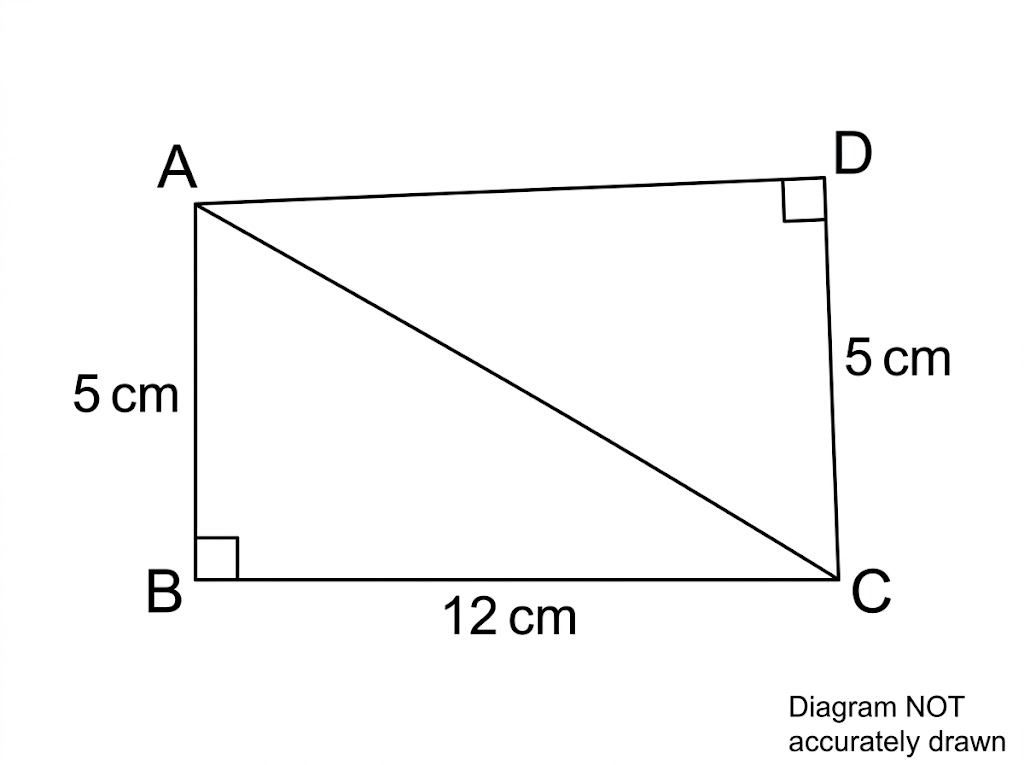
Triangle ABC is right-angled at B, with AB = 5 cm and BC = 12 cm. Triangle ACD is right-angled at D, with CD = 5 cm. Work out the length of AD. (4 marks) (4 marks)
Mark every right angle on the diagram before you start. Each Pythagoras step uses one right-angled triangle - write which one.
Key terms
The vocabulary this lesson expects you to use. Each one is linked from the first place it appears above.
- Hypotenuse
- The longest side of a right-angled triangle, opposite the right angle.
- Line of symmetry
- A line that splits a shape into two mirror-image halves.
- Perpendicular height
- The height measured at right angles to the base.
- Coordinates
- A pair of numbers \((x, y)\) giving the position of a point.
Questions and answers
7 questions set on this lesson, with the mark schemes and model answers open.
Point A has coordinates \((-2, 3)\) and point B has coordinates \((4, 11)\). Work out the length of AB.
Mark scheme — 3 marks available
- 6 and 8 — M1
- \(6^2 + 8^2\) — M1
- 10 — A1
Model answer
Horizontal \(4 - (-2) = 6\), vertical \(11 - 3 = 8\). \(AB = \sqrt{6^2 + 8^2} = \sqrt{100} = 10\)
An isosceles triangle has sides of 13 cm, 13 cm and 10 cm. Work out the area of the triangle.
Mark scheme — 4 marks available
- Half base 5 used in a right-angled triangle with hypotenuse 13 — P1
- \(13^2 - 5^2\) — P1
- Height 12 — P1
- 60 cm² — A1
Model answer
Half the base is 5 cm. Height \(= \sqrt{13^2 - 5^2} = \sqrt{169 - 25} = \sqrt{144} = 12\) cm. Area \(= \frac{1}{2} \times 10 \times 12 = 60\) cm².
The diagram shows two right-angled triangles, ABC and ACD. AB = 5 cm, BC = 12 cm and CD = 5 cm. Work out the length of AD.
Mark scheme — 4 marks available
- \(5^2 + 12^2\) — P1
- AC = 13 — P1
- \(13^2 - 5^2\) — P1
- AD = 12 cm — A1
Model answer
Triangle ABC: \(AC = \sqrt{5^2 + 12^2} = \sqrt{169} = 13\) cm. Triangle ACD: \(AD = \sqrt{13^2 - 5^2} = \sqrt{144} = 12\) cm.
An isosceles trapezium has parallel sides of 10 cm and 16 cm. Its perpendicular height is 8 cm. Work out the perimeter of the trapezium. Give your answer to 1 decimal place.
Mark scheme — 4 marks available
- 3 found — P1
- \(3^2 + 8^2\) — P1
- \(10 + 16 + 2\sqrt{73}\) — P1
- 43.1 cm — A1
Model answer
Each end overhangs \((16 - 10) \div 2 = 3\) cm. Slant side \(= \sqrt{3^2 + 8^2} = \sqrt{73} = 8.544\ldots\) cm. Perimeter \(= 10 + 16 + 2 \times 8.544\ldots = 43.1\) cm.
How far apart are the points \((1, 1)\) and \((4, 5)\)?
Why: Horizontal 3, vertical 4, so the distance is \(\sqrt{9 + 16} = 5\).
An isosceles triangle has sides 5 cm, 5 cm and 8 cm. What is its height?
Why: Half the base is 4, so the height is \(\sqrt{25 - 16} = 3\) cm.
A square has a diagonal of 10 cm. What is its area?
Why: If the side is \(s\), \(s^2 + s^2 = 100\), so \(2s^2 = 100\) and the area \(s^2 = 50\) cm².