Viewing as
Teacher view: planning notes, the answers to every question, and the teacher copies of the files.
Maths · Number
Calculating with powers (indices)
Powers are a shorthand for repeated multiplication. Three index laws let you multiply, divide and raise powers without ever writing out the long multiplication - as long as the bases are the same.
Teacher resources
The teacher copies: slides with the questions built in, the answers, and anything else attached to this lesson for whoever is teaching it.
- Calculating with powers indices - Teacher Slides.pptx Teacher The lesson slides with the teacher's notes on each slide, and every question and mark scheme built in. Built from the lesson script on 28 September 2026. View
- Calculating with powers indices - Teacher Notes.docx Teacher The complete notes with the teacher's notes and every model answer in full. Built from the lesson script on 28 September 2026. View
Student handouts
The same files the students see, to print or hand out.
- Calculating with powers indices.pptx Built from the lesson script on 28 September 2026. View
- Calculating with powers indices - Completed Notes.docx The full notes for the lesson, to revise from. Built from the lesson script on 28 September 2026. View
- Calculating with powers indices - Exam Questions.docx Built from the lesson script on 28 September 2026. View
Last Lesson and Before
Answer each one, then check.
-
1
What is \(5^2\)?
Show answerHide answer
\(25\)
-
2
What is \(\sqrt{81}\)?
Show answerHide answer
\(9\)
-
3
Last lesson: write 72 as a product of prime factors in index form.
Show answerHide answer
\(2^3 \times 3^2\)
-
4
Last lesson: find the HCF of 12 and 18.
Show answerHide answer
\(6\)
-
5
Last lesson: find the LCM of 4 and 10.
Show answerHide answer
\(20\)
Learning Objectives
- 1Know the square numbers to \(15^2\) and the cubes of 1, 2, 3, 4, 5 and 10.
- 2Find square roots and cube roots, including negative roots.
- 3Use index notation for powers.
- 4Use the index laws to multiply, divide and raise powers.
- 5Use the order of operations with powers and roots, with and without a calculator.
Powers and Roots
A power (or index) tells you how many times a number is multiplied by itself.
-
Index notation
\(5^3 = 5 \times 5 \times 5 = 125\). The 5 is the base; the 3 is the index or power.
-
Squares and square roots
\(7^2 = 49\), so \(\sqrt{49} = 7\). But the equation \(x^2 = 49\) has two answers: \(x = 7\) or \(x = -7\), since \((-7)^2 = 49\) too.
-
Cubes and cube roots
\(4^3 = 64\), so \(\sqrt[3]{64} = 4\). A cube root of a negative number is negative: \(\sqrt[3]{-8} = -2\).
-
Roots undo powers
Squaring and square-rooting are inverse operations, like \(\times\) and \(\div\).
Numbers to Know by Heart
-
Square numbers
1, 4, 9, 16, 25, 36, 49, 64, 81, 100, 121, 144, 169, 196, 225 (up to \(15^2\)).
-
Cube numbers
1, 8, 27, 64, 125 (\(1^3\) to \(5^3\)) and \(10^3 = 1000\).
-
Powers of 2
2, 4, 8, 16, 32, 64, 128, 256, 512, 1024 (\(2^1\) to \(2^{10}\)).
-
Powers of 10
10, 100, 1000, 10 000 - the index is the number of zeros.
Why "Squared" and "Cubed"?
A square with sides 3 units long is made of \(3 \times 3 = 9\) unit squares - that is why \(3^2\) is called "3 squared". A cube with edges 3 units long is made of \(3 \times 3 \times 3 = 27\) unit cubes - "3 cubed".
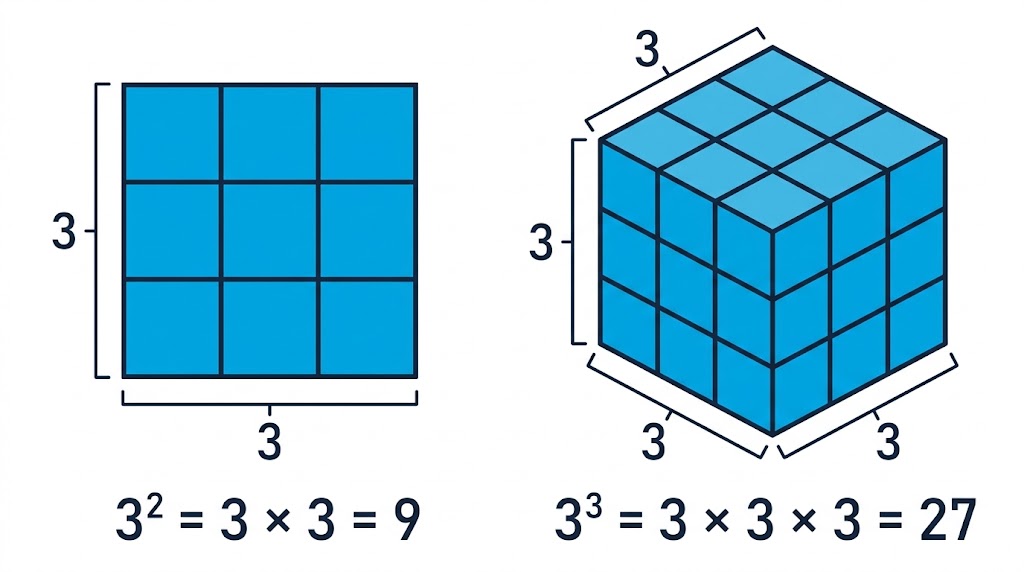
\(3^2\) counts the squares in a square; \(3^3\) counts the cubes in a cube.
The Three Index Laws
They only work when the base is the same.
-
Multiplying
In words: Add the indices. Example: \(3^4 \times 3^2 = 3^6\)
-
Dividing
In words: Subtract the indices. Example: \(5^7 \div 5^3 = 5^4\)
-
Power of a power
In words: Multiply the indices. Example: \((2^3)^4 = 2^{12}\)
-
Different bases
In words: The laws do not apply: work each power out. Example: \(2^3 \times 5^2 = 8 \times 25 = 200\)
Why the Laws Work
Write the powers out in full and count.
-
Multiplying
\(3^4 \times 3^2 = (3 \times 3 \times 3 \times 3) \times (3 \times 3)\): six 3s multiplied, so \(3^6\).
-
Dividing
\(5^7 \div 5^3\): three of the seven 5s cancel, leaving four: \(5^4\).
-
Power of a power
\((2^3)^4 = 2^3 \times 2^3 \times 2^3 \times 2^3\): four lots of three 2s, so \(2^{12}\).
-
In letters
\(a^m \times a^n = a^{m+n}\), \(a^m \div a^n = a^{m-n}\) and \((a^m)^n = a^{mn}\).
Using the Index Laws
Work out the value of \(\dfrac{7^5 \times 7^3}{7^6}\)
Show the solutionHide the solution
- 1 Multiplying: add the indices \(7^5 \times 7^3 = 7^8\)
- 2 Dividing: subtract the indices \(7^8 \div 7^6 = 7^2\)
- 3 Work out the value \(7^2 = 49\)
Answer\(49\)
Changing the Base
Write \(4^3 \times 8^2\) as a single power of 2.
Show the solutionHide the solution
- 1 Write each base as a power of 2 \(4 = 2^2\) and \(8 = 2^3\)
- 2 Power of a power: multiply \(4^3 = (2^2)^3 = 2^6\) and \(8^2 = (2^3)^2 = 2^6\)
- 3 Multiplying: add \(2^6 \times 2^6 = 2^{12}\)
- 4 Check \(4^3 \times 8^2 = 64 \times 64 = 4096 = 2^{12}\)
Answer\(2^{12}\)
Order of Operations
Powers and roots come before multiplying, dividing, adding and subtracting.
-
BIDMAS
Brackets, Indices (powers and roots), Division and Multiplication, Addition and Subtraction.
-
Negative numbers
\(-3^2 = -9\) (square 3, then make it negative), but \((-3)^2 = 9\).
-
A root sign is a bracket
\(\sqrt{9 + 16} = \sqrt{25} = 5\). It is NOT \(\sqrt{9} + \sqrt{16} = 7\).
-
On a calculator
Use brackets for the top and bottom of a fraction, and write down the full display before rounding.
A Non-Calculator Calculation
Work out \(2^3 \times 5^2 - \sqrt{144}\)
Show the solutionHide the solution
- 1 Powers and roots first \(2^3 = 8\), \(5^2 = 25\), \(\sqrt{144} = 12\)
- 2 Then multiply \(8 \times 25 = 200\)
- 3 Then subtract \(200 - 12 = 188\)
Answer\(188\)
Mistakes to Avoid
Wrong
- \(3^4 \times 3^2 = 9^6\)
- \(2^3 = 6\)
- \(5^2 + 5^3 = 5^5\)
- \((-4)^2 = -16\)
Right
- \(3^4 \times 3^2 = 3^6\) - the base stays the same.
- \(2^3 = 2 \times 2 \times 2 = 8\)
- \(5^2 + 5^3 = 25 + 125 = 150\) - no law for adding.
- \((-4)^2 = 16\) - negative times negative is positive.
Case study
Rice on a Chessboard
An old legend tells of a clever inventor who showed a king the game of chess. As a reward he asked for one grain of rice on the first square of the board, two on the second, four on the third, and so on, doubling each time. The king laughed at such a small request - until his treasurers did the maths. The 64th square alone needs \(2^{63}\) grains, and the whole board needs \(2^{64} - 1\): about 18 quintillion grains, far more rice than has ever been grown. The story is a legend, but the numbers are real, and they show how fast powers grow.
Power Pyramids
Write each as a single power, then as an ordinary number. (a) \(2^5 \times 2^3\) (b) \(10^8 \div 10^5\) (c) \((3^2)^3\) (d) \(5^9 \div (5^2 \times 5^4)\) (e) \(9^2 \times 3^3\) as a power of 3 (f) find \(n\) if \(2^n = 4^5 \div 2^3\)
1. Use the index laws.
2. Change a base where you need to.
3. Check one answer the long way.
A good answer shows: (a) \(2^8 = 256\) (b) \(10^3 = 1000\) (c) \(3^6 = 729\) (d) \(5^3 = 125\) (e) \(3^4 \times 3^3 = 3^7 = 2187\) (f) \(4^5 = 2^{10}\), so \(2^{10} \div 2^3 = 2^7\) and \(n = 7\)
Can I...?
- 1Recall square numbers to \(15^2\).
- 2Recall the cubes of 1, 2, 3, 4, 5 and 10.
- 3Find square roots and cube roots.
- 4Give both square roots of a number.
- 5Multiply powers of the same base.
- 6Divide powers of the same base.
- 7Raise a power to a power.
- 8Use BIDMAS with powers and roots.
Summary & Exam Focus
- \(5^3\) means \(5 \times 5 \times 5\); a root undoes a power.
- Same base: multiply, add indices; divide, subtract indices; power of a power, multiply indices.
- Different bases: work each power out separately.
- Powers and roots come before \(\times\), \(\div\), \(+\) and \(-\); a root sign acts as a bracket.
Exam focus
Show that \(9^4 \times 27^2 = 3^{14}\) (3 marks) (3 marks)
In a "show that" question the answer is given, so the marks are all for the working. Write every step, including \(9 = 3^2\) and \(27 = 3^3\).
Key terms
The vocabulary this lesson expects you to use. Each one is linked from the first place it appears above.
- Power (index)
- The small number that says how many times the base is multiplied by itself.
- Base
- The number being multiplied, e.g. the 5 in \(5^3\).
- Square number
- A number made by multiplying a whole number by itself, e.g. \(49 = 7^2\).
- Cube number
- A number made by multiplying a whole number by itself three times, e.g. \(64 = 4^3\).
- Square root
- The number that squares to give a number: \(\sqrt{49} = 7\).
- Cube root
- The number that cubes to give a number: \(\sqrt[3]{64} = 4\).
- Index laws
- The rules for multiplying, dividing and raising powers of the same base.
Questions and answers
9 questions set on this lesson, with the mark schemes and model answers open.
Write down the value of \(3^4\).
Mark scheme — 1 mark available
- \(81\) — B1
Model answer
\(81\)
Write \(\dfrac{5^6 \times 5^3}{5^4}\) as a single power of 5.
Mark scheme — 2 marks available
- \(5^9\) seen, or a correct method for dividing — M1
- \(5^5\) — A1
Model answer
\(5^6 \times 5^3 = 5^9\), and \(5^9 \div 5^4 = 5^5\)
Work out \(2^3 \times 5^2 - \sqrt{144}\)
Mark scheme — 2 marks available
- Two of 8, 25 and 12 seen, or 200 seen — M1
- \(188\) — A1
Model answer
\(8 \times 25 - 12 = 200 - 12 = 188\)
\(2^n = 4^5 \div 2^3\). Find the value of \(n\).
Mark scheme — 2 marks available
- \(4^5\) written as \(2^{10}\), or \(1024 \div 8 = 128\) — M1
- \(n = 7\) — A1
Model answer
\(4^5 = (2^2)^5 = 2^{10}\), so \(2^{10} \div 2^3 = 2^7\) and \(n = 7\).
Show that \(9^4 \times 27^2 = 3^{14}\)
Mark scheme — 3 marks available
- \(9 = 3^2\) or \(27 = 3^3\) used — M1
- \(3^8\) and \(3^6\) — M1
- Fully correct working leading to \(3^{14}\) — A1
Model answer
\(9 = 3^2\), so \(9^4 = (3^2)^4 = 3^8\). \(27 = 3^3\), so \(27^2 = (3^3)^2 = 3^6\). \(3^8 \times 3^6 = 3^{14}\).
(a) Work out \(\dfrac{2.7^3 - \sqrt{18.5}}{1.4^2}\). Write down all the figures on your calculator display. (b) Give your answer to part (a) correct to 3 significant figures.
Mark scheme — 2 marks available
- (a) \(7.8478\ldots\) (at least 5 figures) — B1
- (b) \(7.85\), follow through from (a) — B1
Model answer
(a) \(7.847876207\) (b) \(7.85\)
What is the value of \(4^3\)?
Why: \(4^3 = 4 \times 4 \times 4 = 64\).
Which is \(2^5 \times 2^3\) as a single power?
Why: Multiplying powers of the same base: add the indices, \(5 + 3 = 8\).
What is the value of \(-5^2\)?
Why: The power comes first: \(5^2 = 25\), then the minus sign makes it \(-25\). \((-5)^2\) would be 25.