Viewing as
Teacher view: planning notes, the answers to every question, and the teacher copies of the files.
Maths · Number
Number problems and reasoning
How many outfits, codes or seating plans are possible? Listing them systematically works for small problems; the product rule (Higher) counts them in one line when the list would be too long to write.
Teacher resources
The teacher copies: slides with the questions built in, the answers, and anything else attached to this lesson for whoever is teaching it.
- Number problems and reasoning - Teacher Slides.pptx Teacher The lesson slides with the teacher's notes on each slide, and every question and mark scheme built in. Built from the lesson script on 28 September 2026. View
- Number problems and reasoning - Teacher Notes.docx Teacher The complete notes with the teacher's notes and every model answer in full. Built from the lesson script on 28 September 2026. View
Student handouts
The same files the students see, to print or hand out.
- Number problems and reasoning.pptx Built from the lesson script on 28 September 2026. View
- Number problems and reasoning - Completed Notes.docx The full notes for the lesson, to revise from. Built from the lesson script on 28 September 2026. View
- Number problems and reasoning - Exam Questions.docx Built from the lesson script on 28 September 2026. View
Before We Start
Answer each one, then check.
-
1
Work out \(3 \times 4 \times 5\).
Show answerHide answer
\(60\)
-
2
Work out \(6 \times 5 \times 4\).
Show answerHide answer
\(120\)
-
3
A coin is flipped. How many possible outcomes are there?
Show answerHide answer
2: heads or tails.
-
4
A dice is rolled. How many possible outcomes are there?
Show answerHide answer
6
-
5
List every two-digit number you can make from the digits 1 and 2, using each digit once.
Show answerHide answer
12 and 21
Learning Objectives
- 1List all the possible outcomes of a situation systematically.
- 2Use the product rule to count outcomes without listing them. (Higher)
- 3Count arrangements when items cannot be used twice. (Higher)
- 4Solve counting problems with restrictions. (Higher)
- 5Count the pairs that can be chosen from a group. (Higher)
Listing Systematically
A systematic list follows a pattern, so that no outcome is missed and none is written twice.
-
Fix the first choice
Keep the first item the same and work through every option for the second.
-
Then move on
Change the first item and repeat the same pattern.
-
Use letters
Write S for soup, C for chicken and so on - it is quicker and clearer.
-
Count at the end
Once the list is complete, count it.
A Systematic List
A café offers 2 starters (Soup, Melon) and 3 mains (Chicken, Fish, Pasta).
-
Soup (S)
With Chicken: SC. With Fish: SF. With Pasta: SP
-
Melon (M)
With Chicken: MC. With Fish: MF. With Pasta: MP
-
Total
With Chicken: 2 rows. With Fish: 3 columns. With Pasta: \(2 \times 3 = 6\) meals
The Product Rule for Counting
If one choice can be made in \(m\) ways and a second choice in \(n\) ways, the two choices together can be made in \(m \times n\) ways.
-
Two choices
2 starters and 3 mains give \(2 \times 3 = 6\) meals - exactly the list we wrote.
-
More choices
Keep multiplying: 5 sandwiches, 4 snacks and 3 drinks give \(5 \times 4 \times 3 = 60\) meal deals.
-
Why it works
Every one of the first choices can be paired with every one of the second.
-
When to use it
When the choices are made one after another and each choice does not affect the others.
A Tree Diagram of Choices
A tree diagram shows why the product rule works. Each of the 2 first branches splits into 3, so there are \(2 \times 3 = 6\) routes from start to finish - one for every possible meal.
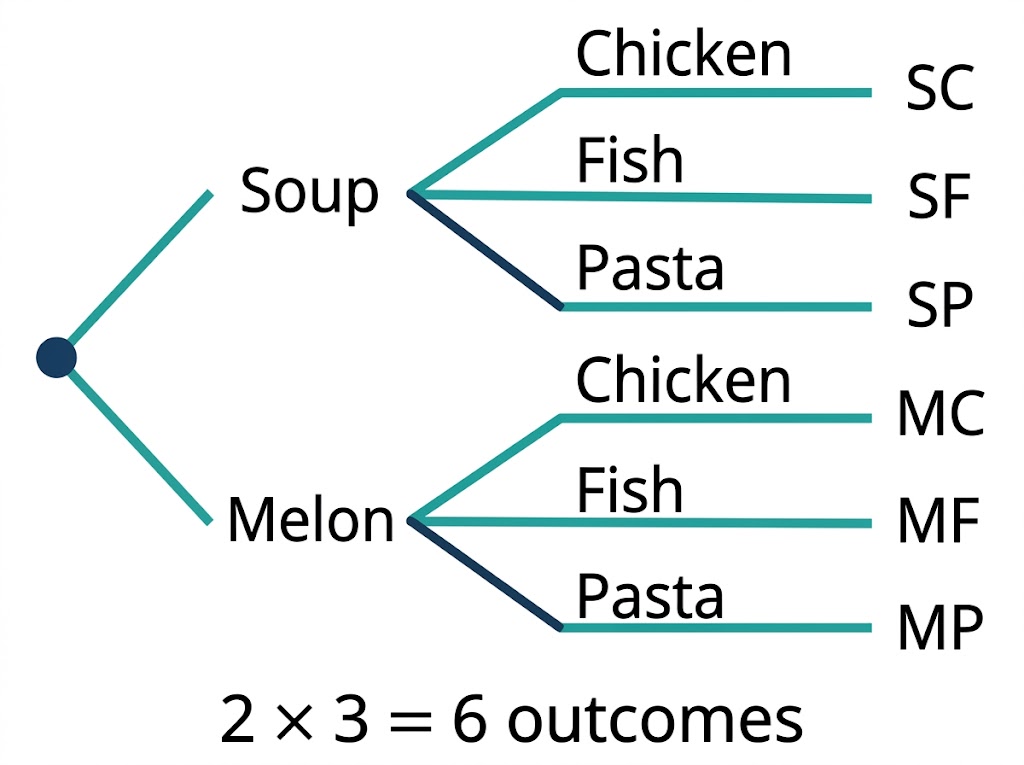
Each starter branches into 3 mains: \(2 \times 3 = 6\) outcomes.
Counting Outfits
Priya has 4 T-shirts, 3 pairs of jeans and 2 pairs of trainers. How many different outfits of one T-shirt, one pair of jeans and one pair of trainers can she make?
Show the solutionHide the solution
- 1 Count the choices for the T-shirt \(4\)
- 2 Count the choices for the jeans \(3\)
- 3 Count the choices for the trainers \(2\)
- 4 The choices are independent, so multiply \(4 \times 3 \times 2 = 24\)
Answer24 different outfits
Counting Codes
A padlock code uses 4 digits from 0 to 9. (a) How many codes are possible? (b) How many are possible if no digit can be used twice?
Show the solutionHide the solution
- 1 (a) Each position can be any of 10 digits \(10 \times 10 \times 10 \times 10\)
- 2 Work it out \(= 10\,000\)
- 3 (b) The first digit has 10 choices \(10\)
- 4 Each digit used leaves one fewer for the next \(10 \times 9 \times 8 \times 7\)
- 5 Work it out \(= 5040\)
Answer(a) \(10\,000\) codes (b) \(5040\) codes
Arranging Items in a Row
When items cannot be repeated, the number of choices goes down by one each time.
-
3 people in a line
\(3 \times 2 \times 1 = 6\) ways.
-
5 people in a line
\(5 \times 4 \times 3 \times 2 \times 1 = 120\) ways.
-
The pattern
\(n\) different items can be arranged in \(n \times (n-1) \times \dots \times 2 \times 1\) ways.
-
Your calculator
The \(x!\) key (factorial) works this out: \(5! = 120\).
Counting with a Restriction
How many three-digit numbers can be made from the digits 2, 3, 5 and 8, using each digit at most once, if the number must be even?
Show the solutionHide the solution
- 1 Deal with the restricted position first: the last digit must be even 2 or 8: \(2\) choices
- 2 The first digit can be any of the 3 digits left \(3\) choices
- 3 The middle digit can be any of the 2 digits left \(2\) choices
- 4 Multiply the choices \(2 \times 3 \times 2 = 12\)
Answer12 even three-digit numbers
Choosing Pairs
When two people are chosen and the order does not matter, each pair gets counted twice.
-
Handshakes
10 people each shake hands with everyone else once. \(10 \times 9 = 90\) counts every handshake twice (A with B, and B with A), so there are \(90 \div 2 = 45\) handshakes.
-
The pattern
\(n\) people make \(\dfrac{n(n-1)}{2}\) pairs.
-
When order matters
Choosing a captain and a vice-captain from 10 people: \(10 \times 9 = 90\) ways. Here A-then-B is different from B-then-A, so do not halve.
Does the Order Matter?
Order matters - do not halve
- Captain and vice-captain.
- 1st and 2nd place in a race.
- Codes and PINs: 12 is not 21.
- Arranging people in a queue.
Order does not matter - halve for pairs
- Handshakes between two people.
- Choosing two people for a team.
- Two games in a round-robin chess club.
- Picking 2 toppings from a list.
Counting Problem Checklist
-
Are repeats allowed?
Codes usually allow repeats; people in a queue cannot be used twice.
-
Does the order matter?
If swapping two choices gives the same outcome, you have double-counted.
-
Is there a restriction?
Fill the restricted positions first, then the rest.
-
Check with a small case
Try the method on a small version you can list, and see if it gives the same count.
Case study
The Rubik's Cube
The Hungarian architecture lecturer Ernő Rubik invented his cube in 1974. It has 26 small visible pieces, and the product rule shows how the number of arrangements explodes: the 8 corner pieces alone can be placed in \(8 \times 7 \times 6 \times 5 \times 4 \times 3 \times 2 \times 1 = 40\,320\) orders, before they are even twisted. Multiply in the ways of placing and twisting the corners and edges, allow for the positions that cannot actually be reached, and the total number of positions is about 43 quintillion - \(43\,252\,003\,274\,489\,856\,000\).
The Ice Cream Van
An ice cream van sells 6 flavours, 3 types of cone and 4 toppings. Work out: (a) how many ice creams with one flavour, one cone and one topping are possible; (b) how many there are if the customer chooses two different flavours, and the order of the flavours does not matter; (c) how many two-flavour ices there are if the order of the scoops DOES matter.
1. Part (a): one flavour.
2. Part (b): two flavours, order does not matter.
3. Part (c): two flavours, order matters.
A good answer shows: (a) \(6 \times 3 \times 4 = 72\). (b) Pairs of flavours: \(6 \times 5 \div 2 = 15\), so \(15 \times 3 \times 4 = 180\). (c) \(6 \times 5 = 30\), so \(30 \times 3 \times 4 = 360\).
Can I...?
- 1List outcomes systematically.
- 2Use a table to list combinations.
- 3Use the product rule for counting. (Higher)
- 4Count codes with and without repeats. (Higher)
- 5Count arrangements of items in a row. (Higher)
- 6Fill a restricted position first. (Higher)
- 7Count pairs chosen from a group. (Higher)
- 8Decide whether the order matters. (Higher)
Summary & Exam Focus
- List systematically: fix the first choice and work through the rest.
- Product rule (Higher): \(m\) ways and \(n\) ways give \(m \times n\) ways altogether.
- No repeats: the choices go down by one each time.
- Restrictions: fill the restricted position first.
- Pairs where order does not matter: \(\dfrac{n(n-1)}{2}\).
Exam focus
There are 12 students in a chess club. Each student plays every other student once. How many games are played? (3 marks) (3 marks)
Write the calculation as well as the answer: the method marks are for the product (\(12 \times 11\)) and for dividing by 2 because each game was counted twice.
Key terms
The vocabulary this lesson expects you to use. Each one is linked from the first place it appears above.
- Outcome
- One possible result of a choice or experiment.
- Systematic list
- A list that follows a pattern so no outcome is missed or repeated.
- Product rule for counting
- If there are \(m\) ways to do one thing and \(n\) ways to do another, there are \(m \times n\) ways to do both. (Higher)
- Arrangement
- An ordering of items, for example people in a queue.
- Restriction
- A rule that limits the choices, such as "the number must be even".
- Factorial
- \(n! = n \times (n-1) \times \dots \times 2 \times 1\). For example, \(4! = 24\).
Questions and answers
8 questions set on this lesson, with the mark schemes and model answers open.
Here are three number cards: 2, 5 and 7. List all the three-digit numbers that can be made using each card once.
Mark scheme — 2 marks available
- All 6 numbers listed, with no repeats and no extras — B2
- At least 4 correct numbers listed — B1
Model answer
257, 275, 527, 572, 725, 752
Sam has 5 shirts and 4 ties. He chooses one shirt and one tie. How many different combinations of shirt and tie can he choose?
Mark scheme — 2 marks available
- \(5 \times 4\) seen, or a systematic list of at least 8 correct combinations — M1
- \(20\) — A1
Model answer
\(5 \times 4 = 20\) combinations.
There are 12 students in a chess club. Each student plays every other student once. How many games are played?
Mark scheme — 3 marks available
- \(12 \times 11\) or \(132\) seen — M1
- Dividing by 2 — M1
- \(66\) — A1
Model answer
Each student plays 11 others: \(12 \times 11 = 132\). Each game has been counted twice, so \(132 \div 2 = 66\) games.
A security code is 2 letters followed by 3 digits. The letters are chosen from the 26 letters of the alphabet and cannot be repeated. The digits are chosen from 0 to 9 and can be repeated. How many different codes are possible?
Mark scheme — 3 marks available
- \(26 \times 25\) or \(650\) — P1
- \(10 \times 10 \times 10\) or \(1000\) — P1
- \(650\,000\) — A1
Model answer
Letters: \(26 \times 25 = 650\). Digits: \(10 \times 10 \times 10 = 1000\). Total \(650 \times 1000 = 650\,000\) codes.
How many odd numbers between 300 and 600 have three different digits?
Mark scheme — 4 marks available
- Splits into cases by first digit (odd first digit and 4 as first digit) — P1
- \(2 \times 4 \times 8\) or \(64\) — P1
- \(1 \times 5 \times 8\) or \(40\) — P1
- \(104\) — A1
Model answer
The first digit is 3, 4 or 5. If it is 3 or 5 (odd), the last digit has 4 odd choices left and the middle digit has 8 choices: \(2 \times 4 \times 8 = 64\). If it is 4, the last digit has 5 odd choices and the middle 8: \(1 \times 5 \times 8 = 40\). Total \(64 + 40 = 104\).
A café has 3 starters, 5 mains and 2 desserts. How many different three-course meals are possible?
Why: \(3 \times 5 \times 2 = 30\).
In how many different orders can 5 people stand in a line?
Why: \(5 \times 4 \times 3 \times 2 \times 1 = 120\).
8 people each shake hands with everyone else once. How many handshakes are there?
Why: \(8 \times 7 = 56\) counts each handshake twice, so \(56 \div 2 = 28\).