Viewing as
Teacher view: planning notes, the answers to every question, and the teacher copies of the files.
Maths · Probability
Independent events and tree diagrams
Recognise independent events, multiply probabilities along the branches of a tree diagram, and add the probabilities of the outcomes you want.
Teacher resources
The teacher copies: slides with the questions built in, the answers, and anything else attached to this lesson for whoever is teaching it.
- Independent events and tree diagrams - Teacher Slides.pptx Teacher The lesson slides with the teacher's notes on each slide, and every question and mark scheme built in. Built from the lesson script on 30 September 2026. View
- Independent events and tree diagrams - Teacher Notes.docx Teacher The complete notes with the teacher's notes and every model answer in full. Built from the lesson script on 30 September 2026. View
Student handouts
The same files the students see, to print or hand out.
- Independent events and tree diagrams.pptx Built from the lesson script on 30 September 2026. View
- Independent events and tree diagrams - Completed Notes.docx The full notes for the lesson, to revise from. Built from the lesson script on 30 September 2026. View
- Independent events and tree diagrams - Exam Questions.docx Built from the lesson script on 30 September 2026. View
Warm-up
Answer each one, then check.
-
1
Work out \(\dfrac{3}{5} \times \dfrac{3}{5}\).
Show answerHide answer
\(\dfrac{9}{25}\)
-
2
Work out \(0.2 \times 0.8\).
Show answerHide answer
0.16
-
3
What is \(1 - 0.2\)?
Show answerHide answer
0.8
-
4
Work out \(\dfrac{9}{25} + \dfrac{4}{25}\).
Show answerHide answer
\(\dfrac{13}{25}\)
-
5
What do all the probabilities on a set of branches add up to?
Show answerHide answer
1
Learning Objectives
- 1Recognise independent events.
- 2Use \(P(A \text{ and } B) = P(A) \times P(B)\) for independent events.
- 3Draw and complete a tree diagram.
- 4Use a tree diagram to find the probability of combined events.
INDEPENDENT EVENTS
Two events are independent if the outcome of one does not affect the outcome of the other.
For independent events, \(P(A \text{ and } B) = P(A) \times P(B)\).
Multiplying Probabilities
The probability that Sam is late for school is 0.3. The probability that it rains is 0.5. These events are independent. Find the probability that Sam is late and it rains.
Show the solutionHide the solution
- 1 Independent events, so multiply \(0.3 \times 0.5\)
- 2 Work it out \(0.15\)
Answer0.15
A Tree Diagram
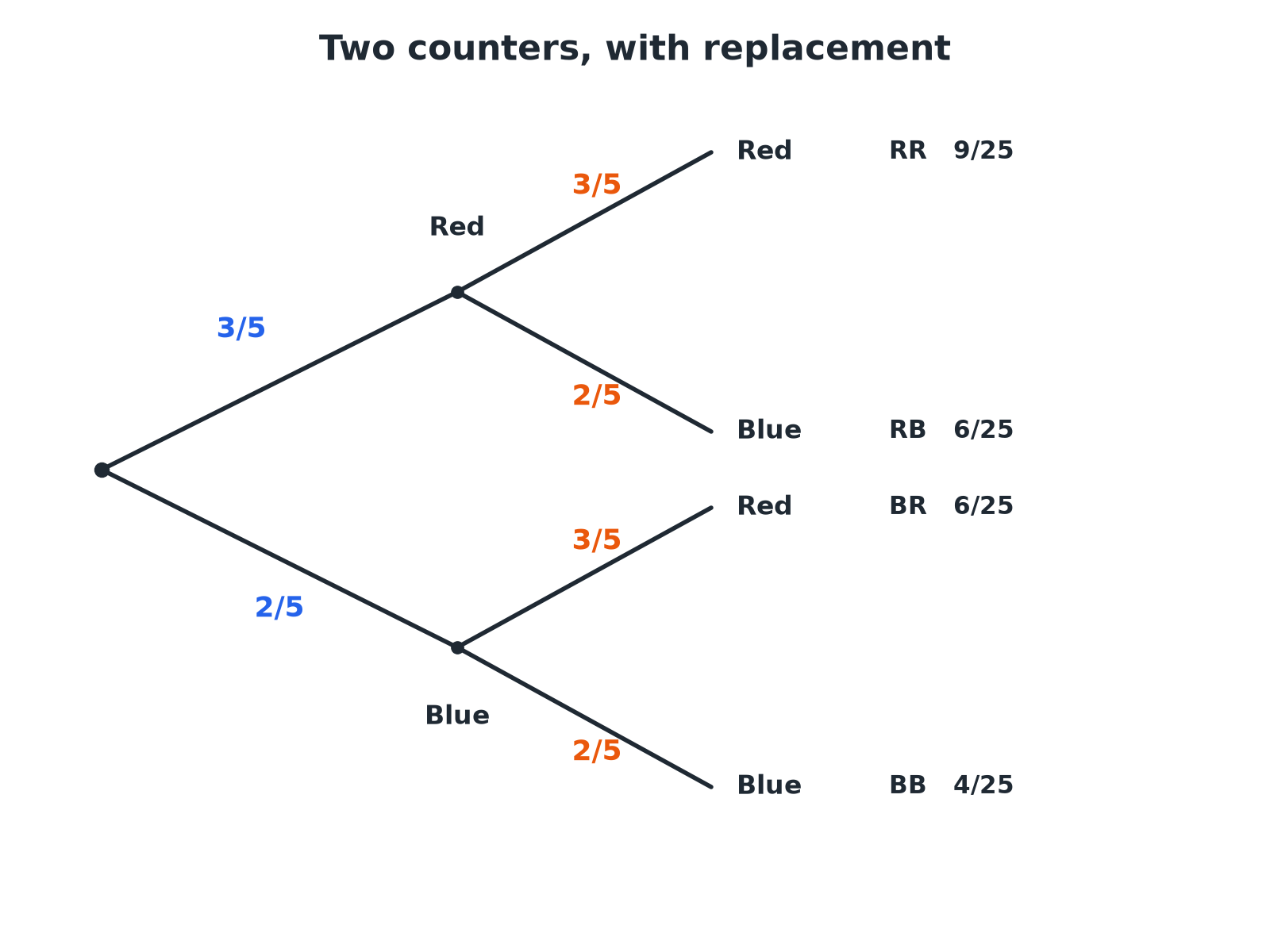
Multiply along the branches; add the outcomes you want.
Using a Tree Diagram
Two rules do all the work.
-
1
Draw the branches
One set for each event, with the probability on each branch
-
2
Check
The probabilities on each set of branches add up to 1
-
3
Multiply along the branches
This gives the probability of each combined outcome
-
4
Add the outcomes you want
If more than one outcome fits, add their probabilities
-
5
Check the total
All the outcomes add up to 1
Two Counters with Replacement
A bag has 3 red and 2 blue counters. A counter is taken, its colour is noted and it is put back. A second counter is then taken. Find the probability that both counters are the same colour.
Show the solutionHide the solution
- 1 Both red \(\dfrac{3}{5} \times \dfrac{3}{5} = \dfrac{9}{25}\)
- 2 Both blue \(\dfrac{2}{5} \times \dfrac{2}{5} = \dfrac{4}{25}\)
- 3 Same colour means RR or BB, so add \(\dfrac{9}{25} + \dfrac{4}{25}\)
Answer\(\dfrac{13}{25}\)
Late Two Days
The probability that Amy is late for school on any day is 0.2, independent of other days. Find (a) the probability she is late on both of two days, (b) late on exactly one of the two days, (c) late on at least one day.
Show the solutionHide the solution
- 1 (a) Multiply \(0.2 \times 0.2 = 0.04\)
- 2 (b) Late then not late, or not late then late \(0.2 \times 0.8 + 0.8 \times 0.2 = 0.16 + 0.16 = 0.32\)
- 3 (c) Use the complement: never late is \(0.8 \times 0.8 = 0.64\) \(1 - 0.64 = 0.36\)
Answer(a) 0.04 (b) 0.32 (c) 0.36
Shortcut: At Least One
"At least one" is easier by subtraction.
-
Find the opposite
"None" is the outcome where the event never happens.
-
Subtract from 1
\(P(\text{at least one}) = 1 - P(\text{none})\).
-
Saves work
You avoid adding many branches.
The Four Outcomes
The outcomes of a two-stage tree with replacement.
-
Red, Red
Working: \(\dfrac{3}{5} \times \dfrac{3}{5}\). Probability: \(\dfrac{9}{25}\)
-
Red, Blue
Working: \(\dfrac{3}{5} \times \dfrac{2}{5}\). Probability: \(\dfrac{6}{25}\)
-
Blue, Red
Working: \(\dfrac{2}{5} \times \dfrac{3}{5}\). Probability: \(\dfrac{6}{25}\)
-
Blue, Blue
Working: \(\dfrac{2}{5} \times \dfrac{2}{5}\). Probability: \(\dfrac{4}{25}\)
-
Total
Probability: 1
Free Throws
A basketball player scores a free throw with probability 0.7, independently each time. She takes two throws. Draw a tree diagram and find the probability she scores (a) both (b) exactly one (c) none.
1. Draw the tree.
2. Multiply along branches.
3. Add the outcomes needed.
A good answer shows: (a) \(0.7 \times 0.7 = 0.49\). (b) \(0.7 \times 0.3 + 0.3 \times 0.7 = 0.42\). (c) \(0.3 \times 0.3 = 0.09\). The three add up to 1.
Can I...?
- 1Decide if events are independent.
- 2Multiply probabilities of independent events.
- 3Draw a two-stage tree diagram.
- 4Label the branches with probabilities.
- 5Multiply along a path.
- 6Add the outcomes I want.
- 7Use "1 minus" for at least one.
- 8Check the total is 1.
Summary & Exam Focus
- Independent: \(P(A \text{ and } B) = P(A) \times P(B)\).
- Multiply along the branches, add between outcomes.
- The branches from a node add up to 1.
- At least one \(= 1 -\) none.
Exam focus
The probability that Amy is late on any day is 0.2. Work out the probability that she is late on at least one of two days. (3 marks) (3 marks)
"At least one" means one minus none. Never late on both days is \(0.8 \times 0.8\).
Key terms
The vocabulary this lesson expects you to use. Each one is linked from the first place it appears above.
- Independent
- The outcome of one event does not change the other.
- Tree diagram
- A diagram showing the outcomes of events and their probabilities on branches.
- Branch
- A line on a tree diagram carrying a probability.
- With replacement
- Putting the item back before the next pick.
- Combined event
- Two or more events considered together.
- Complement
- The event "not A".
Questions and answers
12 questions set on this lesson, with the mark schemes and model answers open.
A and B are independent events. \(P(A) = 0.3\) and \(P(B) = 0.5\). Work out \(P(A \text{ and } B)\).
Mark scheme — 2 marks available
- \(0.3 \times 0.5\) — M1
- 0.15 — A1
Model answer
\(0.3 \times 0.5 = 0.15\).
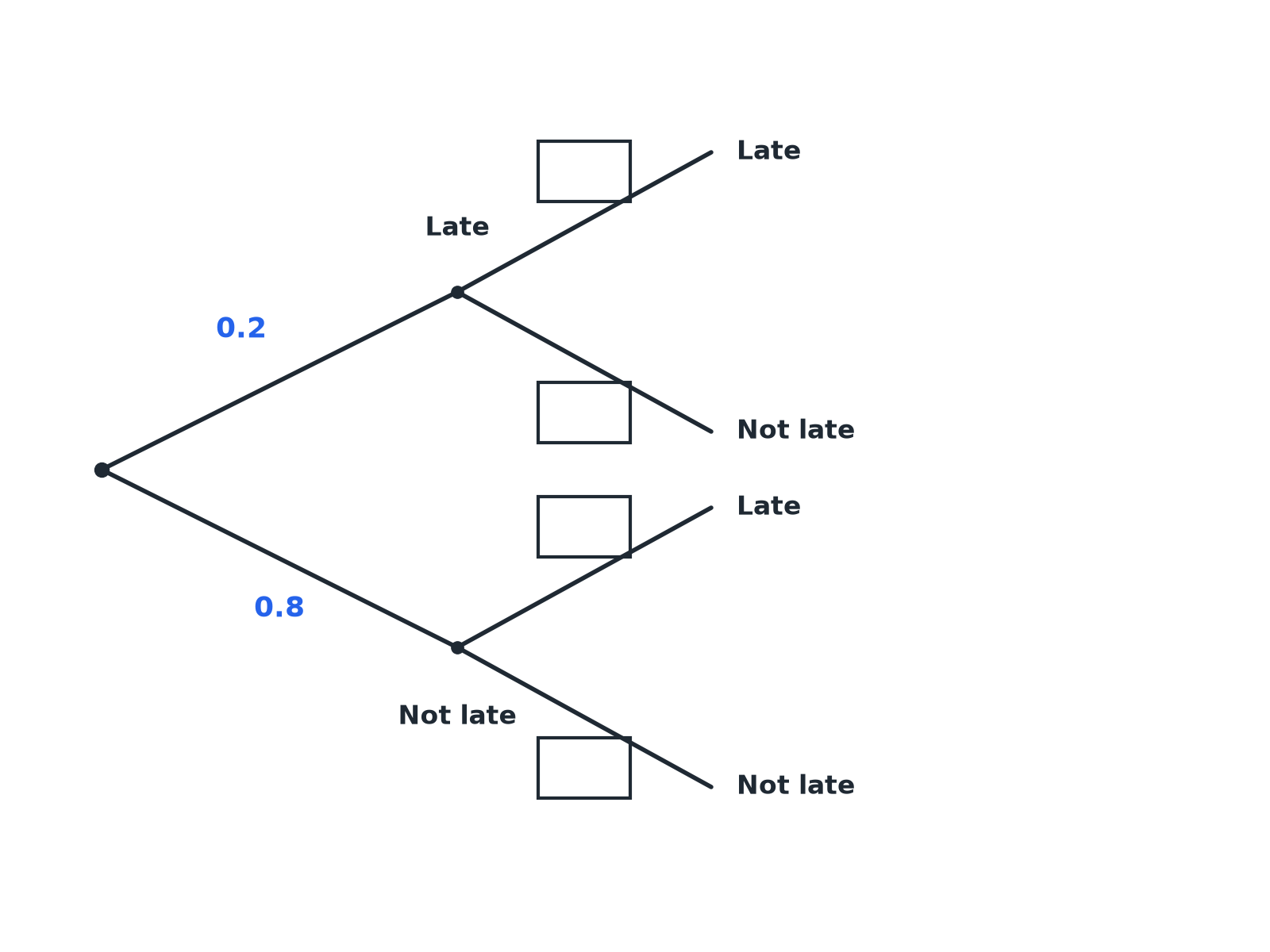
The probability that Amy is late for school on any day is 0.2. The tree diagram shows the probabilities for two days. Complete the tree diagram.
Mark scheme — 3 marks available
- Late branches 0.2 on day 2 — B1
- Not late branches 0.8 on day 2 — B1
- All four correct — B1
Model answer
All four second-stage branches: Late 0.2 and Not late 0.8, after either first-day outcome.
Using the tree diagram, work out the probability that Amy is late on both days.
Mark scheme — 2 marks available
- \(0.2 \times 0.2\) — M1
- 0.04 — A1
Model answer
\(0.2 \times 0.2 = 0.04\).
Using the tree diagram, work out the probability that Amy is late on exactly one of the two days.
Mark scheme — 3 marks available
- One correct product — M1
- Adding the two paths — M1
- 0.32 — A1
Model answer
\(0.2 \times 0.8 + 0.8 \times 0.2 = 0.16 + 0.16 = 0.32\).
Work out the probability that Amy is late on at least one of the two days.
Mark scheme — 3 marks available
- \(0.8 \times 0.8\) — M1
- \(1 - 0.64\) — M1
- 0.36 — A1
Model answer
The probability of never being late is \(0.8 \times 0.8 = 0.64\). So \(P(\text{at least one}) = 1 - 0.64 = 0.36\).
A bag contains 3 red counters and 2 blue counters. A counter is taken at random, its colour is noted and it is replaced. A second counter is taken. Work out the probability that the two counters are the same colour.
Mark scheme — 4 marks available
- \(\dfrac{3}{5} \times \dfrac{3}{5}\) — M1
- \(\dfrac{2}{5} \times \dfrac{2}{5}\) — M1
- Adding the two — M1
- \(\dfrac{13}{25}\) — A1
Model answer
\(P(RR) = \dfrac{3}{5} \times \dfrac{3}{5} = \dfrac{9}{25}\) and \(P(BB) = \dfrac{2}{5} \times \dfrac{2}{5} = \dfrac{4}{25}\). Together: \(\dfrac{13}{25}\).
Two independent events have probabilities 0.4 and 0.5. What is the probability of both?
Why: Multiply: \(0.4 \times 0.5 = 0.2\).
On a tree diagram, the probabilities on the branches from one node add up to...
Why: They cover all the outcomes, so they sum to 1.
To find the probability of a path on a tree diagram, you...
Why: Multiply the probabilities along the branches.
When two outcomes both give the result you want, you...
Why: Add the probabilities of the outcomes.
\(P(\text{late}) = 0.2\). What is the probability of not being late twice in a row?
Why: \(0.8 \times 0.8 = 0.64\).
A coin is flipped three times. What is the probability of three heads?
Why: \(\dfrac{1}{2} \times \dfrac{1}{2} \times \dfrac{1}{2} = \dfrac{1}{8}\).