Viewing as
Teacher view: planning notes, the answers to every question, and the teacher copies of the files.
Maths · Transformations and constructions
Enlargement
Enlarge shapes by a scale factor from a centre, including fractional scale factors, describe enlargements, and at Higher tier use negative scale factors and the effect on area and volume.
Teacher resources
The teacher copies: slides with the questions built in, the answers, and anything else attached to this lesson for whoever is teaching it.
- Enlargement - Teacher Slides.pptx Teacher The lesson slides with the teacher's notes on each slide, and every question and mark scheme built in. Built from the lesson script on 30 September 2026. View
- Enlargement - Teacher Notes.docx Teacher The complete notes with the teacher's notes and every model answer in full. Built from the lesson script on 30 September 2026. View
Student handouts
The same files the students see, to print or hand out.
- Enlargement.pptx Built from the lesson script on 30 September 2026. View
- Enlargement - Completed Notes.docx The full notes for the lesson, to revise from. Built from the lesson script on 30 September 2026. View
- Enlargement - Exam Questions.docx Built from the lesson script on 30 September 2026. View
Warm-up
Answer each one, then check.
-
1
What is \(3 \times 4\)?
Show answerHide answer
12
-
2
Work out \(\dfrac{1}{2} \times 8\).
Show answerHide answer
4
-
3
What is the area of a rectangle 3 by 5?
Show answerHide answer
15
-
4
What is the scale factor from 4 cm to 12 cm?
Show answerHide answer
3
-
5
What does congruent mean?
Show answerHide answer
The same shape and size
Learning Objectives
- 1Enlarge a shape by a positive scale factor from a centre.
- 2Use fractional scale factors.
- 3Describe an enlargement fully.
- 4Use negative scale factors and similar-shape area and volume ratios (Higher).
THE KEY IDEA
An enlargement changes the size of a shape but not its shape: every length is multiplied by the scale factor.
The centre of enlargement stays in the same place.
Enlarging from a Centre
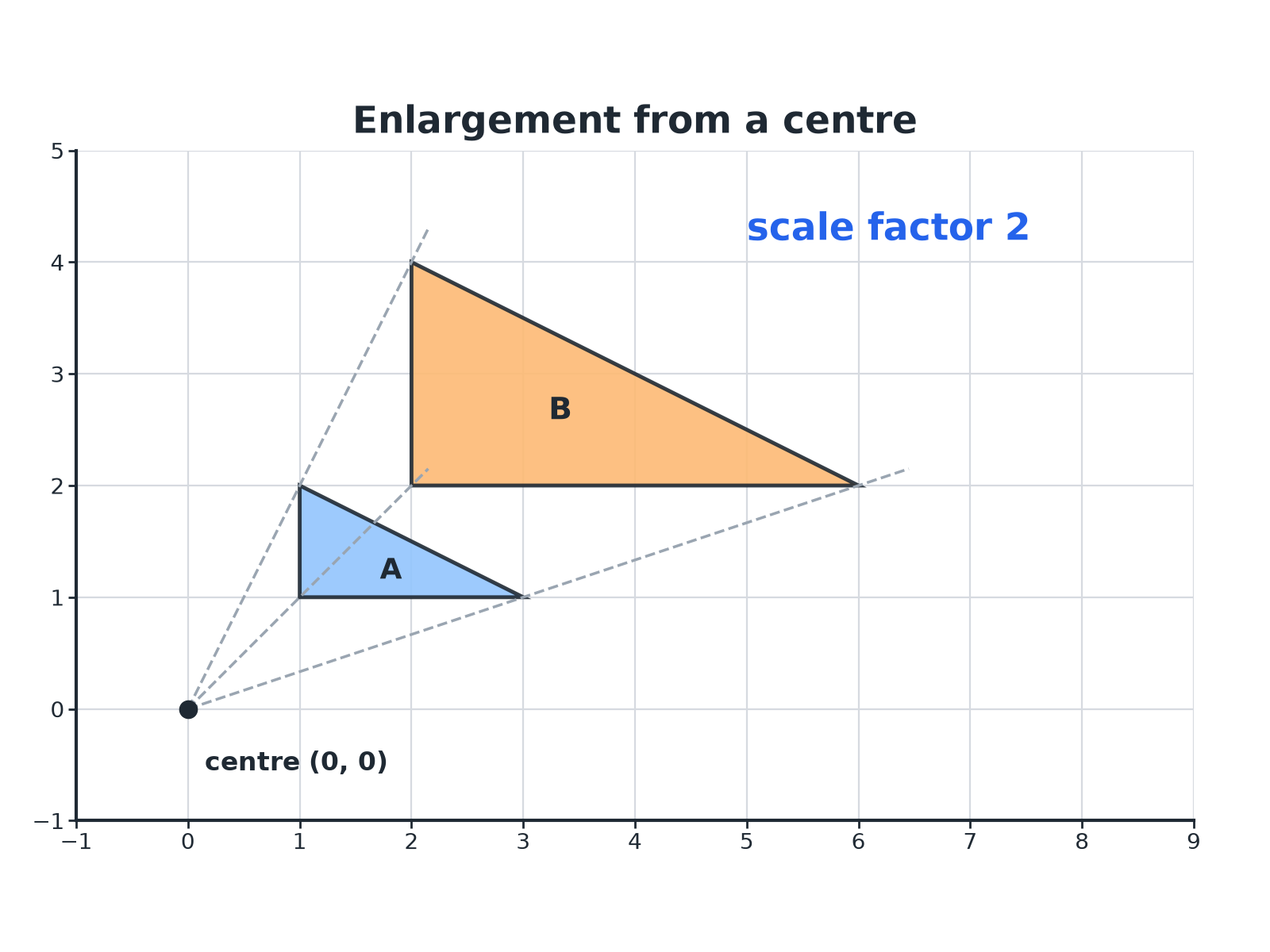
Lines through matching points all meet at the centre of enlargement.
How to Enlarge a Shape
Work from the centre to each vertex.
-
1
Pick the centre
It is given, or found where lines through matching points meet.
-
2
Measure to a vertex
Count squares across and up from the centre.
-
3
Multiply by the scale factor
Multiply both distances.
-
4
Plot the new vertex
Start again from the centre.
-
5
Join up
Join the new vertices to make the image.
Enlarging from the Origin
Triangle A has vertices \((1, 1)\), \((3, 1)\) and \((1, 2)\). Enlarge it by scale factor 2 with centre \((0, 0)\).
Show the solutionHide the solution
- 1 Multiply each coordinate by 2 \((1, 1) \to (2, 2)\)
- 2 The other vertices \((3, 1) \to (6, 2)\) and \((1, 2) \to (2, 4)\)
AnswerThe image has vertices \((2, 2)\), \((6, 2)\) and \((2, 4)\).
Enlarging from Another Centre
A triangle has vertices \((2, 2)\), \((4, 2)\) and \((2, 3)\). Enlarge it by scale factor 2 about the centre \((1, 1)\).
Show the solutionHide the solution
- 1 Vector from the centre to the first vertex \((2, 2) - (1, 1) = (1, 1)\)
- 2 Multiply by 2 \((2, 2)\)
- 3 Add back to the centre \((1 + 2, 1 + 2) = (3, 3)\)
- 4 The other vertices \((4, 2)\): vector \((3, 1)\), doubled \((6, 2)\), so \((7, 3)\); \((2, 3)\): vector \((1, 2)\), doubled \((2, 4)\), so \((3, 5)\)
AnswerThe image has vertices \((3, 3)\), \((7, 3)\) and \((3, 5)\).
A Fractional Scale Factor
Enlarge the triangle with vertices \((2, 4)\), \((6, 4)\) and \((2, 8)\) by scale factor \(\dfrac{1}{2}\) with centre \((0, 0)\).
Show the solutionHide the solution
- 1 Multiply each coordinate by \(\dfrac{1}{2}\) \((2, 4) \to (1, 2)\)
- 2 The other vertices \((6, 4) \to (3, 2)\) and \((2, 8) \to (1, 4)\)
AnswerThe image has vertices \((1, 2)\), \((3, 2)\) and \((1, 4)\); it is smaller than the original.
Scale Factor Sizes
Scale factor greater than 1
- The image is bigger than the object.
- Lengths are multiplied by the scale factor.
- Example: scale factor 3 makes every side three times as long.
Scale factor between 0 and 1
- The image is smaller than the object.
- Still called an enlargement.
- Example: scale factor \(\dfrac{1}{2}\) halves every length.
A Negative Scale Factor
Enlarge the point \((1, 2)\) by scale factor \(-2\) about the origin.
Show the solutionHide the solution
- 1 Multiply the coordinates by \(-2\) \((1, 2) \to (-2, -4)\)
- 2 The image is on the opposite side of the centre And twice as far away
Answer\((-2, -4)\)
Lengths, Areas and Volumes
For similar shapes with length scale factor \(k\).
-
Lengths
Scale factor: \(k\)
-
Areas
Scale factor: \(k^2\)
-
Volumes
Scale factor: \(k^3\)
Area and Volume Scale Factors
Two similar bottles have heights 6 cm and 9 cm. The label of the smaller bottle has area 20 cm². Find the label area on the larger bottle. The smaller bottle holds 250 ml; find the capacity of the larger.
Show the solutionHide the solution
- 1 Length scale factor \(9 \div 6 = 1.5\)
- 2 Area scale factor \(1.5^2 = 2.25\), so \(20 \times 2.25 = 45\)
- 3 Volume scale factor \(1.5^3 = 3.375\), so \(250 \times 3.375 = 843.75\)
AnswerLabel area 45 cm² and capacity 843.75 ml.
Describe the Enlargement
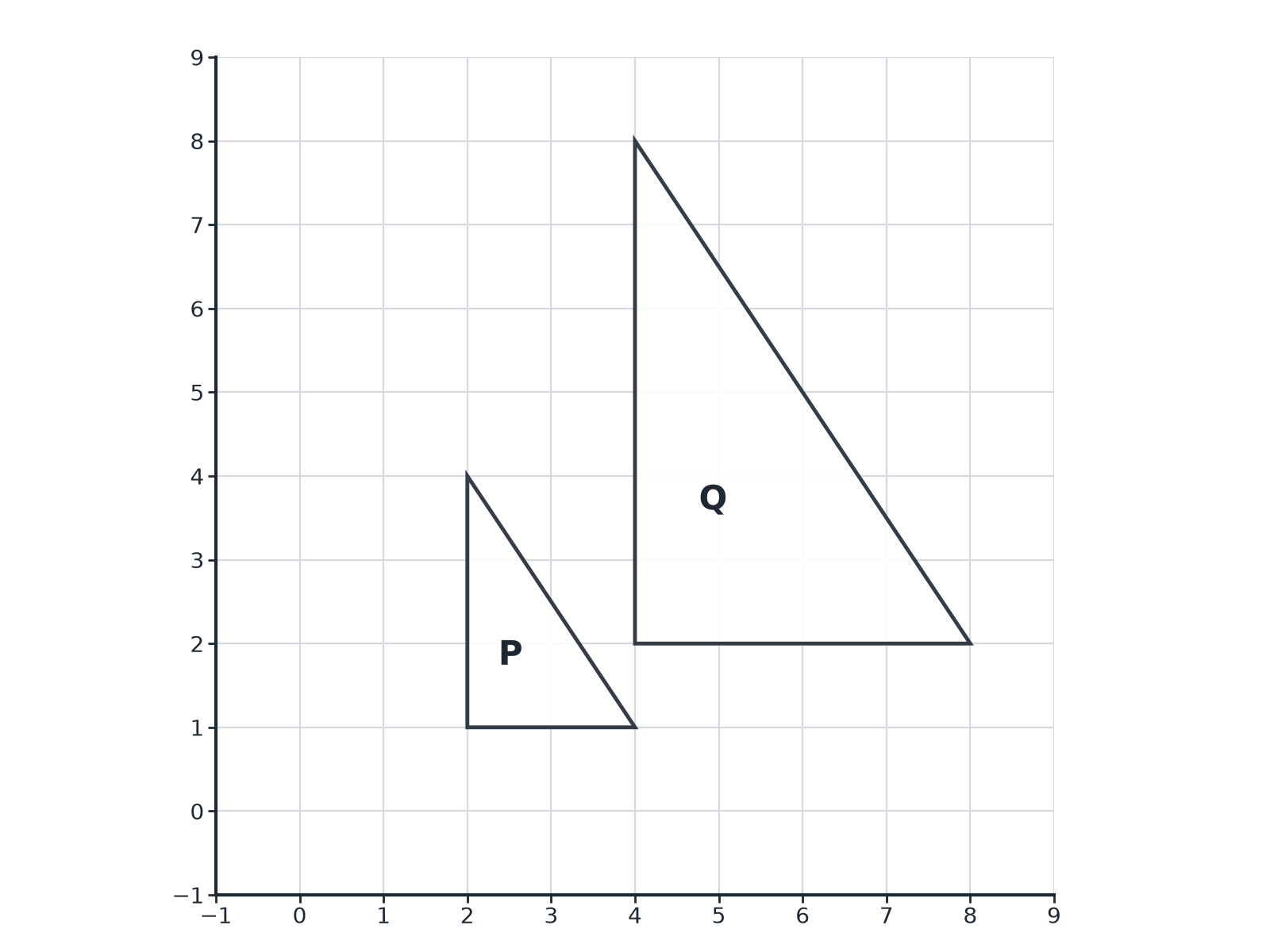
Triangle P has vertices \((2, 1)\), \((4, 1)\) and \((2, 4)\). Triangle Q has vertices \((4, 2)\), \((8, 2)\) and \((4, 8)\). Describe fully the single transformation that maps P onto Q. Then find the ratio of their areas.
1. Compare corresponding side lengths.
2. Draw rays to find the centre.
3. Compare areas.
A good answer shows: Enlargement, scale factor 2, centre \((0, 0)\). The area of P is 3 and the area of Q is 12, a ratio of \(1:4\), which is \(2^2\).
Can I...?
- 1Enlarge from the origin.
- 2Enlarge from another centre.
- 3Use a fractional scale factor.
- 4Describe an enlargement fully.
- 5Find the centre using rays.
- 6Use a negative scale factor (Higher).
- 7Use \(k^2\) for areas (Higher).
- 8Use \(k^3\) for volumes (Higher).
Summary & Exam Focus
- Every length is multiplied by the scale factor.
- Scale factors below 1 make the image smaller.
- To describe: enlargement, scale factor, centre.
- Higher: areas scale by \(k^2\) and volumes by \(k^3\).
Exam focus
Describe fully the single transformation that maps triangle P onto triangle Q, where P has vertices \((2, 1)\), \((4, 1)\), \((2, 4)\) and Q has vertices \((4, 2)\), \((8, 2)\), \((4, 8)\). (3 marks) (3 marks)
For an enlargement give three things: the word enlargement, the scale factor, and the centre.
Key terms
The vocabulary this lesson expects you to use. Each one is linked from the first place it appears above.
- Enlargement
- A transformation that changes the size of a shape by a scale factor.
- Scale factor
- The number every length is multiplied by.
- Centre of enlargement
- The fixed point the enlargement is measured from.
- Similar
- The same shape but a different size.
- Ray
- A straight line drawn from the centre through a vertex.
- Congruent
- The same shape and size.
Questions and answers
12 questions set on this lesson, with the mark schemes and model answers open.
Triangle A has vertices \((1, 1)\), \((3, 1)\) and \((1, 2)\). It is enlarged by scale factor 2 with centre \((0, 0)\). Write down the coordinates of the vertices of the image.
Mark scheme — 2 marks available
- Two vertices correct — B1
- All three correct — B1
Model answer
\((2, 2)\), \((6, 2)\) and \((2, 4)\).
A rectangle measures 3 cm by 5 cm. It is enlarged by scale factor 4. Write down the dimensions of the enlarged rectangle.
Mark scheme — 2 marks available
- One length correct — M1
- Both correct — A1
Model answer
12 cm by 20 cm.
A triangle has vertices \((2, 2)\), \((4, 2)\) and \((2, 3)\). It is enlarged by scale factor 2 with centre \((1, 1)\). Write down the coordinates of the vertices of the image.
Mark scheme — 3 marks available
- A correct method: vector from the centre doubled — M1
- Two vertices correct — A1
- All three correct — A1
Model answer
\((3, 3)\), \((7, 3)\) and \((3, 5)\).
Triangle Q is an enlargement of triangle P. Describe fully the single transformation that maps P onto Q.
Mark scheme — 3 marks available
- Enlargement — B1
- Scale factor 2 — B1
- Centre \((0, 0)\) — B1
Model answer
An enlargement with scale factor 2 and centre \((0, 0)\).
Two similar vases have heights 6 cm and 9 cm. The surface area of the smaller vase is 20 cm². Work out the surface area of the larger vase.
Mark scheme — 3 marks available
- Length scale factor 1.5 — M1
- \(1.5^2\) — M1
- 45 — A1
Model answer
The length scale factor is \(\dfrac{9}{6} = 1.5\). The area scale factor is \(1.5^2 = 2.25\). The area is \(20 \times 2.25 = 45\) cm².
A model of a ship is made to a scale of 1 : 5. The volume of the model is 250 cm³. Work out the volume of the real ship in cm³.
Mark scheme — 3 marks available
- Length scale factor 5 — M1
- \(5^3 = 125\) — M1
- 31 250 — A1
Model answer
The length scale factor is 5, so the volume scale factor is \(5^3 = 125\). The real volume is \(250 \times 125 = 31\,250\) cm³.
A triangle is enlarged by scale factor 3. A side of length 4 cm becomes...
Why: \(4 \times 3 = 12\) cm.
A shape is enlarged by scale factor \(\dfrac{1}{2}\). The image is...
Why: A scale factor less than 1 makes the shape smaller.
What is the image of \((3, 2)\) under enlargement scale factor 3, centre the origin?
Why: Multiply both coordinates by 3.
To describe an enlargement fully you need...
Why: The scale factor and the centre of enlargement.
Two similar shapes have length scale factor 3. What is the area scale factor?
Why: Area scales by the square of the length scale factor: 9.
Two similar solids have length scale factor 2. What is the volume scale factor?
Why: \(2^3 = 8\).