Viewing as
Teacher view: planning notes, the answers to every question, and the teacher copies of the files.
Maths · Transformations and constructions
Loci
Draw loci as sets of points that follow a rule, using circles, perpendicular bisectors and angle bisectors, and shade regions that satisfy several rules at once.
Teacher resources
The teacher copies: slides with the questions built in, the answers, and anything else attached to this lesson for whoever is teaching it.
- Loci - Teacher Slides.pptx Teacher The lesson slides with the teacher's notes on each slide, and every question and mark scheme built in. Built from the lesson script on 30 September 2026. View
- Loci - Teacher Notes.docx Teacher The complete notes with the teacher's notes and every model answer in full. Built from the lesson script on 30 September 2026. View
Student handouts
The same files the students see, to print or hand out.
Warm-up
Answer each one, then check.
-
1
What is the distance round a circle called?
Show answerHide answer
The circumference
-
2
What is a perpendicular bisector?
Show answerHide answer
A line at \(90^\circ\) through the midpoint of a segment
-
3
What does an angle bisector do?
Show answerHide answer
Cuts an angle in half
-
4
What is the radius of a circle with diameter 8 cm?
Show answerHide answer
4 cm
-
5
What does equidistant mean?
Show answerHide answer
The same distance from
Learning Objectives
LOCUS
A locus is the set of all points that follow a rule.
The plural is loci.
The Standard Loci
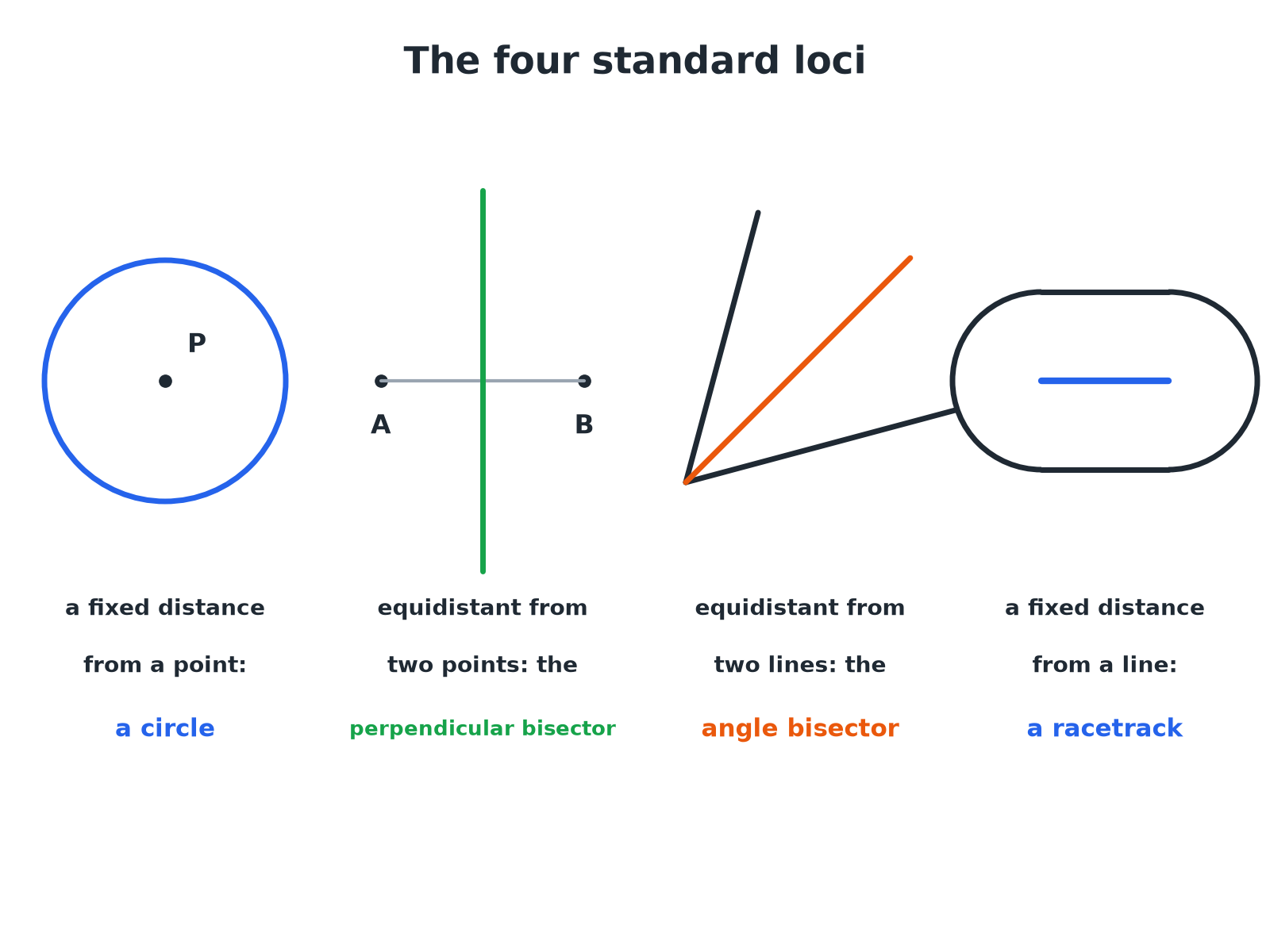
Learn these four and you can solve most locus questions.
The Four Standard Loci
-
A fixed distance from a point
A circle, centred on the point.
-
Equidistant from two points
The perpendicular bisector of the line joining the points.
-
Equidistant from two lines
The angle bisector of the angle between them.
-
A fixed distance from a line
A racetrack: two parallel lines with semicircular ends.
A Region Bounded by Two Loci
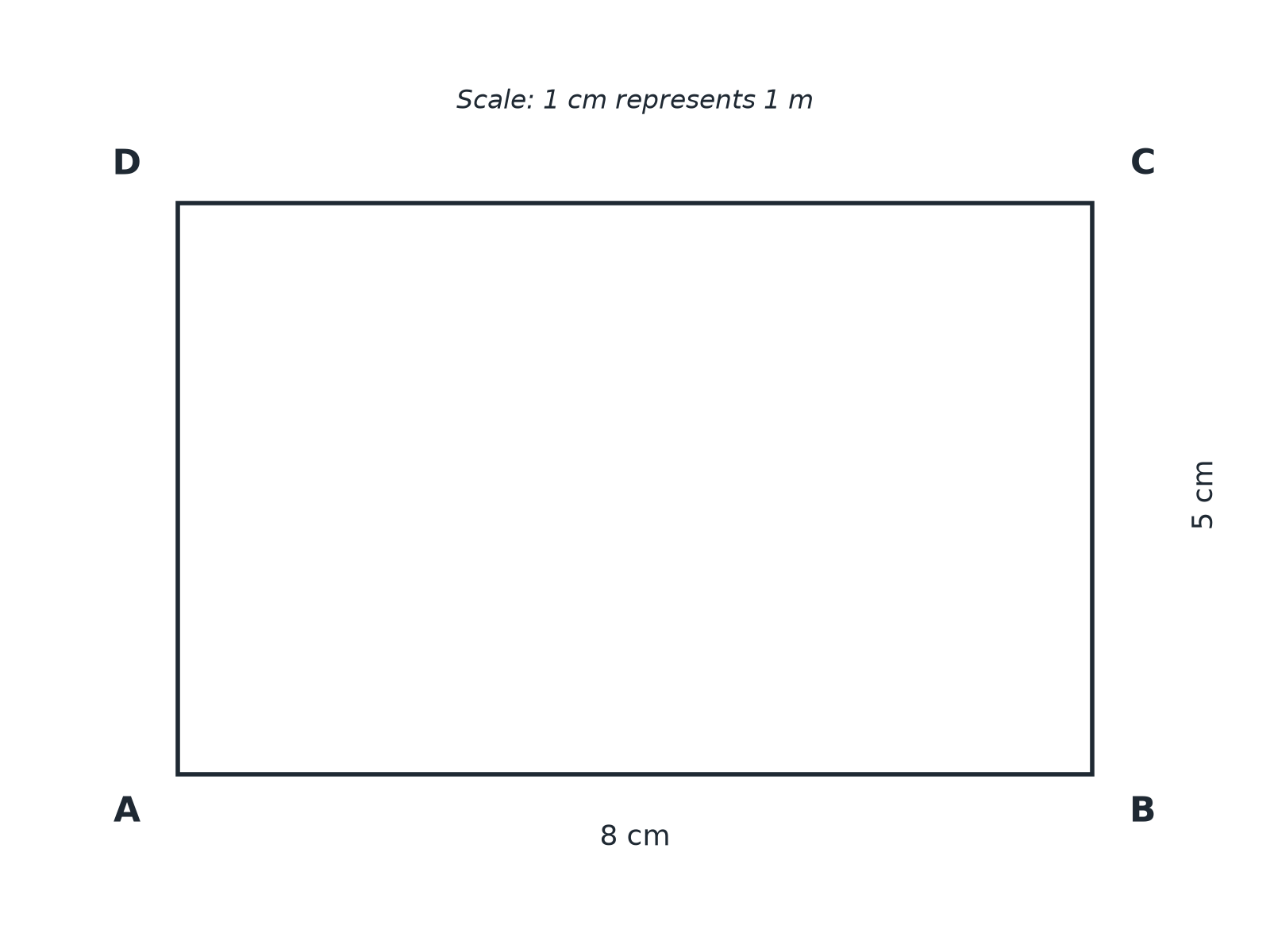
ABCD is a rectangle with A at \((0, 0)\), B at \((8, 0)\), C at \((8, 5)\) and D at \((0, 5)\), with 1 cm representing 1 m. A tree is nearer to AB than to AD and less than 4 m from C. Describe the region where the tree can be.
Show the solutionHide the solution
- 1 Equidistant from AB and AD The bisector of angle DAB, the line from A at \(45^\circ\)
- 2 Nearer to AB than AD The side of the bisector next to AB (below the line \(y = x\))
- 3 Less than 4 m from C Inside a circle of radius 4 cm centred on C
- 4 Combine The part of the rectangle that is both below the bisector and inside the circle
AnswerThe region inside the rectangle, below the bisector from A and inside the circle of radius 4 cm centred on C.
Tackling a Locus Question
Split the rule into simple loci.
-
1
Read the rule
Underline each condition.
-
2
Draw the standard locus for each
Circle, bisector, perpendicular bisector, or parallel lines.
-
3
Decide which side
Use a test point.
-
4
Shade the region
Or mark the route required.
Equidistant from Two Points
P and Q are 6 cm apart. Draw the locus of points equidistant from P and Q, and within 4 cm of P.
Show the solutionHide the solution
- 1 The locus of points equidistant from P and Q The perpendicular bisector of PQ
- 2 Within 4 cm of P Inside a circle of radius 4 cm centred on P
- 3 The part of the bisector inside the circle A line segment where the bisector crosses the circle
AnswerThe segment of the perpendicular bisector of PQ that lies inside the circle of radius 4 cm centred on P.
A Fixed Distance from a Line
A path is 6 m long. A dog is allowed within 2 m of the path. Describe the boundary of the area.
Show the solutionHide the solution
- 1 The set of points 2 m from a line Two parallel lines, 2 m either side
- 2 Ends of the path Two semicircles of radius 2 m
- 3 Together A racetrack shape around the path
AnswerA racetrack: two parallel lines 2 m either side of the path with a semicircle of radius 2 m at each end.
Where Should the Mast Go?
Three villages A, B and C form a triangle. A phone mast must be equidistant from A and B, and no more than 5 km from C. Draw the triangle (AB = 8 cm, AC = 6 cm, BC = 7 cm, where 1 cm = 1 km), construct the perpendicular bisector of AB, draw the circle of radius 5 cm about C, and shade the possible positions.
1. Construct the triangle.
2. Draw the two loci.
3. Identify the overlap.
A good answer shows: The possible positions lie along the segment of the perpendicular bisector of AB that lies within the circle. Students should show construction arcs for the bisector and mark the two points where it meets the circle.
Can I...?
- 1Explain what a locus is.
- 2Draw a circle locus.
- 3Draw a perpendicular bisector locus.
- 4Draw an angle bisector locus.
- 5Draw a racetrack locus.
- 6Combine two loci.
- 7Use a scale in a locus problem.
- 8Shade the correct region.
Summary & Exam Focus
- Circle: a fixed distance from a point.
- Perpendicular bisector: equidistant from two points.
- Angle bisector: equidistant from two lines.
- Racetrack: a fixed distance from a line segment.
Exam focus
ABCD is a rectangle with AB = 8 cm and BC = 5 cm. A point is nearer to AB than to AD, and is less than 4 cm from C. Shade the region that contains all such points. (4 marks) (4 marks)
Draw each locus, then use one test point in the rectangle to decide which side of each locus to shade.
Key terms
The vocabulary this lesson expects you to use. Each one is linked from the first place it appears above.
- Locus
- A set of points that all obey a rule.
- Loci
- More than one locus.
- Equidistant
- The same distance from two points or lines.
- Region
- An area of the plane described by one or more rules.
- Perpendicular bisector
- The locus of points equidistant from two points.
- Angle bisector
- The locus of points equidistant from two lines.
Questions and answers
11 questions set on this lesson, with the mark schemes and model answers open.
P is a point. Draw the locus of all the points that are 3 cm from P.
Mark scheme — 2 marks available
- A circle drawn, centre P — M1
- Radius 3 cm — A1
Model answer
A circle of radius 3 cm with centre P.
A and B are two points 6 cm apart. Using ruler and compasses only, construct the locus of points that are the same distance from A and from B.
Mark scheme — 3 marks available
- Equal arcs from A and B — M1
- Crossings joined — M1
- A correct line with arcs shown — A1
Model answer
The perpendicular bisector of AB, with construction arcs.
The diagram shows a rectangle ABCD. The scale is 1 cm to 1 m. A tree will be planted nearer to AB than to AD and less than 4 m from C. Shade the region where the tree can be planted.
Mark scheme — 4 marks available
- Bisector of angle DAB — M1
- Circle of radius 4 cm centred on C — M1
- Correct side of each locus — M1
- Correct region shaded — A1
Model answer
The bisector of angle DAB is drawn from A, a circle of radius 4 cm is drawn centred on C, and the region inside the rectangle below the bisector and inside the circle is shaded.
A robot moves so that it is always 2 m from a straight fence 6 m long. Describe the shape of its path.
Mark scheme — 2 marks available
- Two parallel lines 2 m from the fence — B1
- Semicircular ends — B1
Model answer
A racetrack: two straight lines parallel to the fence, 2 m from it, joined by a semicircle of radius 2 m at each end.
Two straight roads meet at a point O. A phone mast must be the same distance from both roads. Describe how to find the possible positions of the mast on a map.
Mark scheme — 3 marks available
- Angle bisector — B1
- Construction method: arcs from O, then from the crossings — M1
- The mast can be anywhere on the bisector — A1
Model answer
Construct the bisector of the angle between the two roads. The mast can be anywhere on this line.
What is the locus of points 5 cm from a fixed point?
Why: A circle of radius 5 cm.
The locus of points equidistant from two points is...
Why: The perpendicular bisector of the line joining them.
The locus of points equidistant from two intersecting lines is...
Why: The bisector of the angle between them.
The locus of points 2 cm from a line segment is a...
Why: Two parallel lines with semicircular ends: a racetrack.
"Nearer to A than B" means the region is on which side of the perpendicular bisector?
Why: The side containing A.
Less than 3 cm from P means the point is...
Why: Inside the circle of radius 3 cm centred on P.