Viewing as
Teaching this? The teacher view adds 2 files, the mark schemes and the model answers.
Maths · Equations and graphs
Representing inequalities graphically
Shade the region that satisfies one or more inequalities on a graph, use solid and dashed boundaries, and write inequalities for a given region.
Warm-up
Answer each one, then check.
-
1
What does \(x > 3\) mean?
Show answerHide answer
\(x\) is greater than 3
-
2
What does \(y \le 2\) mean?
Show answerHide answer
\(y\) is less than or equal to 2
-
3
What is the line \(x = 4\)?
Show answerHide answer
A vertical line through 4 on the x-axis
-
4
What is the line \(y = 2\)?
Show answerHide answer
A horizontal line through 2 on the y-axis
-
5
Draw the line \(y = x\): what is its gradient?
Show answerHide answer
\(1\)
Learning Objectives
- 1Draw a boundary line for an inequality.
- 2Choose a solid or dashed line.
- 3Shade the correct region.
- 4Write inequalities for a region and list integer points.
INEQUALITY REGIONS
An inequality describes a region. Draw the boundary line, then shade the side where the inequality is true.
Solid line for \(\le\) or \(\ge\). Dashed line for \(<\) or \(>\).
A Region from Three Inequalities
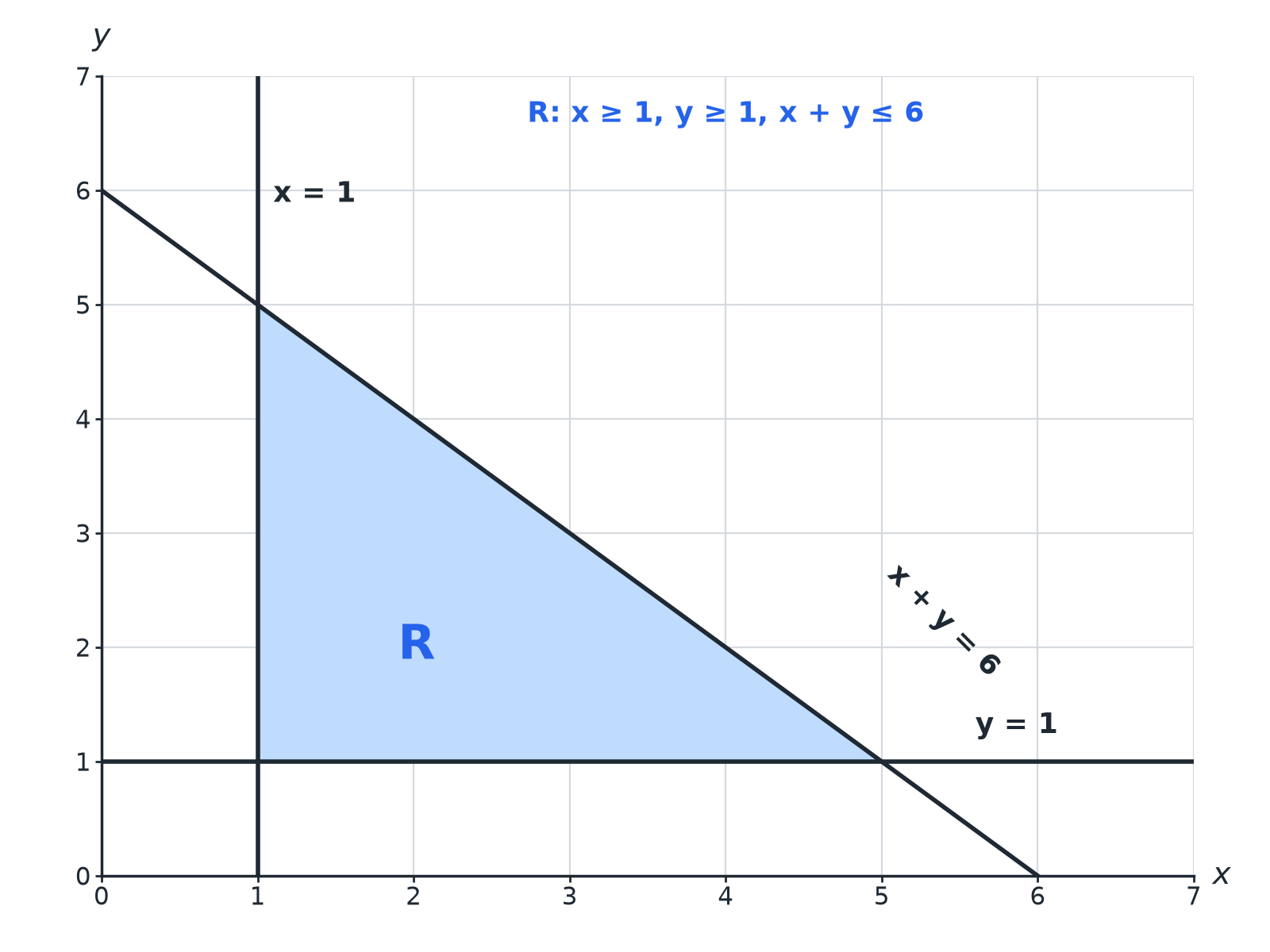
The region R satisfies all three inequalities.
Solid or Dashed?
The boundary is part of the region only for \(\le\) and \(\ge\).
-
\(y \ge 2\)
Boundary line: Solid. Points on the line: Included
-
\(y > 2\)
Boundary line: Dashed. Points on the line: Not included
-
\(x + y \le 6\)
Boundary line: Solid. Points on the line: Included
-
\(y < x\)
Boundary line: Dashed. Points on the line: Not included
Test a Point
Show which side of the line \(x + y = 6\) satisfies \(x + y \le 6\).
Show the solutionHide the solution
- 1 Test the origin \(0 + 0 = 0\)
- 2 Compare \(0 \le 6\) is true
- 3 So shade The side of the line containing the origin
AnswerShade the region below the line \(x + y = 6\), including the line.
Integer Points in a Region
List the integer points in \(x \ge 1\), \(y \ge 1\), \(x + y \le 4\).
Show the solutionHide the solution
- 1 Try \(x = 1\) \(y = 1, 2, 3\)
- 2 Try \(x = 2\) \(y = 1, 2\)
- 3 Try \(x = 3\) \(y = 1\)
Answer\((1,1), (1,2), (1,3), (2,1), (2,2), (3,1)\)
Writing Inequalities
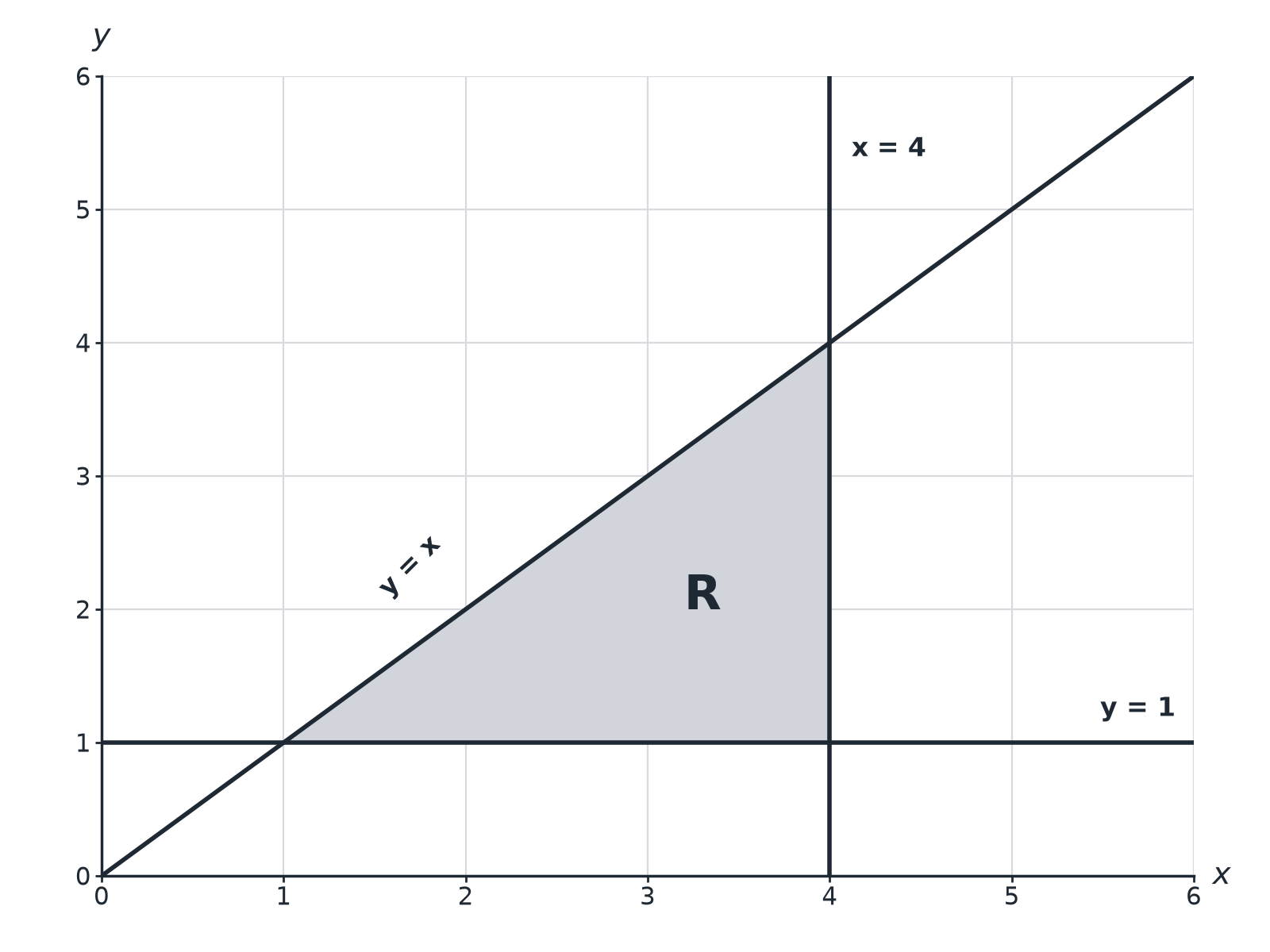
A region is bounded by \(y = 1\), \(x = 4\) and \(y = x\), and lies above \(y = 1\), to the left of \(x = 4\) and below \(y = x\). Write the inequalities.
Show the solutionHide the solution
- 1 Above \(y = 1\) \(y \ge 1\)
- 2 Left of \(x = 4\) \(x \le 4\)
- 3 Below \(y = x\) \(y \le x\)
Answer\(y \ge 1\), \(x \le 4\), \(y \le x\)
Tips
Keep it clear.
-
Label R
Mark the required region clearly.
-
Check with a point
Test one point in the region in every inequality.
-
Boundary lines
Draw all lines even if only part of them bounds the region.
-
Read the instruction
Some questions ask you to shade the region that is NOT wanted.
Sketch the Region
Draw the region satisfying \(x \ge 2\), \(y \ge 1\) and \(x + y \le 6\). List the integer points that lie in it.
1. Draw each boundary line.
2. Count integer points column by column.
A good answer shows: The region is a triangle with corners \((2, 1)\), \((5, 1)\) and \((2, 4)\). Integer points: \((2,1),(2,2),(2,3),(2,4),(3,1),(3,2),(3,3),(4,1),(4,2),(5,1)\).
Can I...?
- 1Draw x = a and y = b lines.
- 2Draw sloping boundary lines.
- 3Use solid and dashed lines.
- 4Test a point.
- 5Shade the correct region.
- 6Write inequalities for a region.
- 7List integer points.
- 8Label R clearly.
Summary & Exam Focus
- \(\le\) and \(\ge\): solid line. \(<\) and \(>\): dashed.
- Test a point to decide which side to shade.
- The region satisfies all inequalities at once.
- Integer points on a solid boundary are included.
Exam focus
The diagram shows a region R. Write down the three inequalities that define R. (3 marks) (3 marks)
Name each boundary line first, then decide which side is R.
Key terms
The vocabulary this lesson expects you to use. Each one is linked from the first place it appears above.
- Inequality
- A statement using \(<\), \(>\), \(\le\) or \(\ge\).
- Boundary
- The line separating the region from the rest.
- Region
- The set of points that satisfy the inequalities.
- Integer
- A whole number.
- Test point
- A point used to decide which side to shade.
- Solid line
- Boundary included.
Practice questions
Have a go at each one before you open its answer.
-
Question 1 Write down 3 marks
The region R is shown shaded on the grid. Write down the three inequalities that define R.
Show answerHide answer
Model answer
\(y \ge 1\), \(x \le 4\), \(y \le x\)
Mark scheme
- One correct inequality — B1
- Two correct — B1
- All three correct — B1
-
Question 2 Write down 3 marks
\(x\) and \(y\) are integers with \(x \ge 1\), \(y \ge 1\) and \(x + y \le 4\). Write down all the possible pairs \((x, y)\).
Show answerHide answer
Model answer
\((1,1), (1,2), (1,3), (2,1), (2,2), (3,1)\)
Mark scheme
- At least 3 correct pairs and none wrong — M1
- 5 correct — A1
- All 6 correct — A1
-
Question 3 Write down 3 marks
A region on a grid is bounded by the lines \(x = 1\), \(y = 1\) and \(x + y = 6\), and lies above \(y = 1\), to the right of \(x = 1\) and below \(x + y = 6\). Write down the three inequalities that define the region.
Show answerHide answer
Model answer
\(x \ge 1\), \(y \ge 1\), \(x + y \le 6\)
Mark scheme
- One correct — B1
- Two correct — B1
- All three — B1
-
Question 4 Explain 2 marks
Explain when you would draw a dashed line rather than a solid line for the boundary of an inequality.
Show answerHide answer
Model answer
Use a dashed line for \(<\) or \(>\), because points on the line are not included in the region. Use a solid line for \(\le\) or \(\ge\).
Mark scheme
- Dashed for \(<\) or \(>\) — M1
- Points on the line not included — C1
-
Question 5 Decide 2 marks
Is the point \((2, 3)\) in the region \(y > 2x - 1\)? Give a reason.
Show answerHide answer
Model answer
No. When \(x = 2\), \(2x - 1 = 3\), and \(3 > 3\) is false, so the point is on the boundary, which is not included.
Mark scheme
- Substitutes — M1
- No, with reason — A1
-
Question 6 Shade 3 marks
On a grid, show by shading the region defined by \(x \ge 2\), \(y < 3\) and \(y \ge 0\). Describe the shape you have shaded.
Show answerHide answer
Model answer
A rectangular strip: the region to the right of the line \(x = 2\) (solid), below the dashed line \(y = 3\) and above the x-axis (solid line \(y = 0\)).
Mark scheme
- \(x = 2\) solid — B1
- \(y = 3\) dashed — B1
- Correct region — B1
Quick check
-
A dashed line is used for...
Show answerHide answer
B: \(<\) and \(>\)
Strict inequalities: \(<\) and \(>\).
-
The line \(x = 3\) is...
Show answerHide answer
C: Vertical
A vertical line through 3 on the x-axis.
-
To decide which side to shade, you can...
Show answerHide answer
A: Test a point
Test a point, such as the origin.
-
\(x + y \le 6\) is true at \((1, 1)\) because...
Show answerHide answer
D: \(2 \le 6\)
\(1 + 1 = 2\) and \(2 \le 6\).
-
The integer points in \(x \ge 1\), \(y \ge 1\), \(x + y \le 3\) are...
Show answerHide answer
B: \((1,1),(1,2),(2,1)\)
\((1,1)\), \((1,2)\), \((2,1)\).
-
A region satisfies all its inequalities...
Show answerHide answer
C: At the same time
At the same time.
Downloads
Free to keep, print and annotate.
- Representing inequalities graphically.pptx Built from the lesson script on 30 September 2026. View
- Representing inequalities graphically - Completed Notes.docx The full notes for the lesson, to revise from. Built from the lesson script on 30 September 2026. View
- Representing inequalities graphically - Exam Questions.docx Built from the lesson script on 30 September 2026. View
Something here looks wrong?
Tell us what and we will go and look. It goes to whoever writes these pages, nobody else, and we do not ask who you are — so there is nothing to sign and nothing comes back to you.