Viewing as
Teacher view: planning notes, the answers to every question, and the teacher copies of the files.
Maths · Equations and graphs
Using quadratic graphs
Draw quadratic graphs from a table, find roots, the turning point and the line of symmetry, and use a graph to solve related equations.
Teacher resources
The teacher copies: slides with the questions built in, the answers, and anything else attached to this lesson for whoever is teaching it.
- Using quadratic graphs - Teacher Slides.pptx Teacher The lesson slides with the teacher's notes on each slide, and every question and mark scheme built in. Built from the lesson script on 30 September 2026. View
- Using quadratic graphs - Teacher Notes.docx Teacher The complete notes with the teacher's notes and every model answer in full. Built from the lesson script on 30 September 2026. View
Student handouts
The same files the students see, to print or hand out.
- Using quadratic graphs.pptx Built from the lesson script on 30 September 2026. View
- Using quadratic graphs - Completed Notes.docx The full notes for the lesson, to revise from. Built from the lesson script on 30 September 2026. View
- Using quadratic graphs - Exam Questions.docx Built from the lesson script on 30 September 2026. View
Warm-up
Answer each one, then check.
-
1
Work out \(x^2 - 2x - 3\) when \(x = 2\).
Show answerHide answer
\(-3\)
-
2
What shape is a graph of \(y = x^2\)?
Show answerHide answer
A U-shaped parabola
-
3
What is a root of a graph?
Show answerHide answer
Where it crosses the x-axis
-
4
What is a line of symmetry?
Show answerHide answer
A line the graph reflects onto itself in
-
5
What is \(y\) on the y-axis?
Show answerHide answer
The vertical coordinate
Learning Objectives
- 1Complete a table of values and draw a quadratic graph.
- 2Find roots, the y-intercept, the turning point and the line of symmetry.
- 3Solve \(ax^2 + bx + c = 0\) using a graph.
- 4Solve related equations such as \(x^2 - 2x - 3 = 2\) by drawing a line.
QUADRATIC GRAPH
A quadratic graph is a smooth curve called a parabola. It is symmetrical about a vertical line through its turning point.
The roots are where \(y = 0\). To solve \(f(x) = k\), draw the line \(y = k\) and read the \(x\)-values where it meets the curve.
Key Features of a Parabola
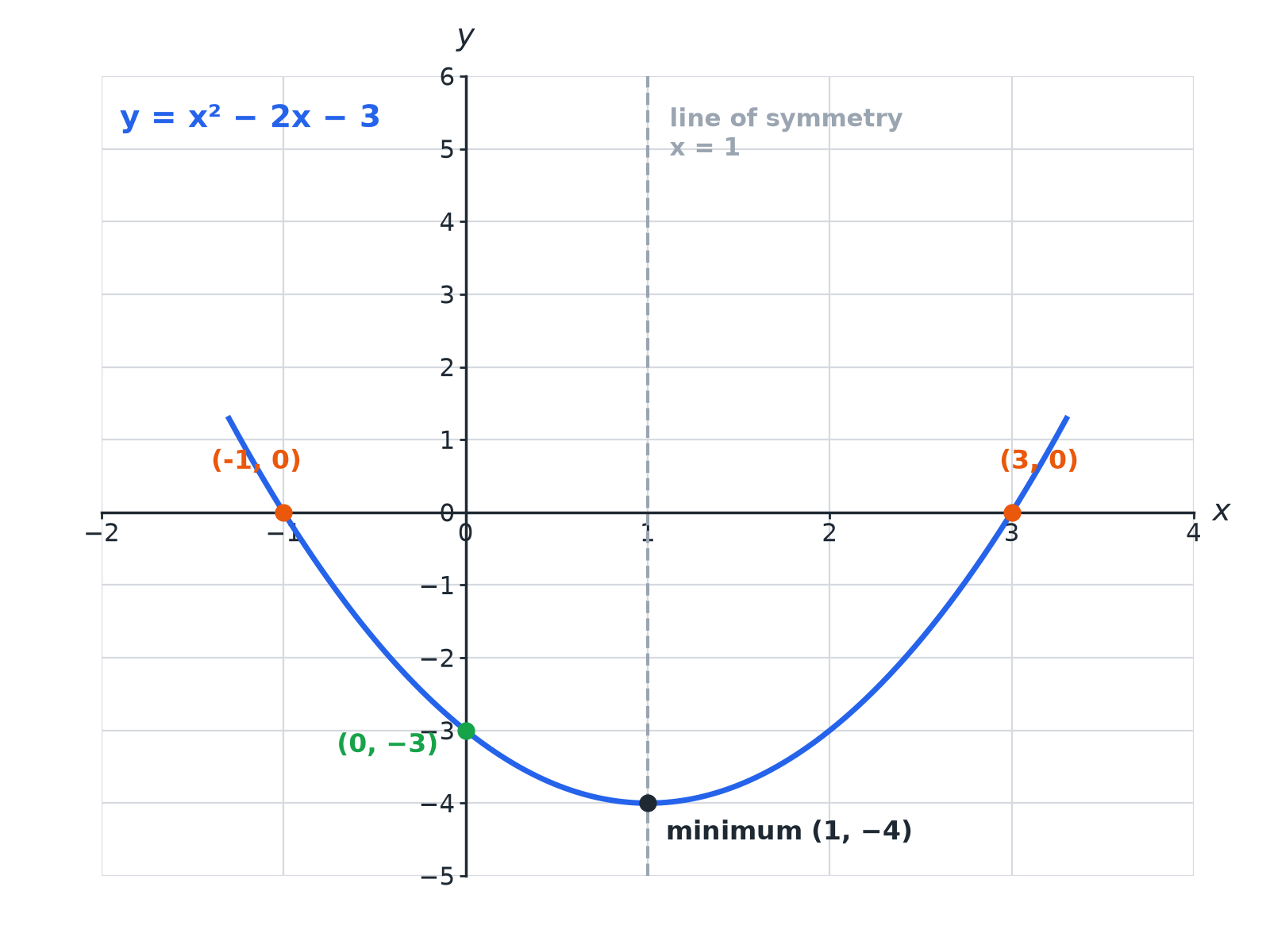
Roots, minimum point, y-intercept and axis of symmetry.
Table of Values
\(y = x^2 - 2x - 3\).
-
\(y\)
\(-2\): \(5\). \(-1\): \(0\). \(0\): \(-3\). \(1\): \(-4\) | \(-3\) | \(0\) | \(5\)
Roots and Turning Point
For \(y = x^2 - 2x - 3\), find the roots, the turning point and the line of symmetry.
Show the solutionHide the solution
- 1 Roots \(y = 0\): \((x - 3)(x + 1) = 0\), so \(x = 3\) or \(-1\)
- 2 Line of symmetry Halfway between the roots: \(x = 1\)
- 3 Turning point \(y = 1 - 2 - 3 = -4\), so \((1, -4)\)
AnswerRoots \(-1\) and \(3\); line of symmetry \(x = 1\); minimum point \((1, -4)\).
Solving a Related Equation
Use the graph of \(y = x^2 - 2x - 3\) to solve \(x^2 - 2x - 3 = 2\).
Show the solutionHide the solution
- 1 Draw the line \(y = 2\) across the graph
- 2 Read the \(x\)-values where it meets the curve \(x \approx -1.4\) and \(x \approx 3.4\)
- 3 Check \(1 \pm \sqrt{6} = -1.45,\ 3.45\)
Answer\(x \approx -1.4\) or \(x \approx 3.4\)
Completed Square Form
Write \(y = x^2 - 2x - 3\) in the form \((x - a)^2 + b\) and write down the turning point.
Show the solutionHide the solution
- 1 Complete the square \((x - 1)^2 - 1 - 3\)
- 2 Simplify \(y = (x - 1)^2 - 4\)
- 3 Turning point \((1, -4)\)
Answer\(y = (x - 1)^2 - 4\); the turning point is \((1, -4)\).
Drawing Tips
Get a smooth curve.
-
Plot every point
Then join with a smooth curve, not straight segments.
-
No flat bottom
Near the turning point the curve rounds gently.
-
Check symmetry
Values on each side of the turning point should match.
-
Use a ruler for lines
Use a pencil for the curve.
Sketch and Solve
Complete the table for \(y = x^2 - 4x\) for \(x = 0\) to \(4\) and sketch the graph. Write down the roots and the turning point.
1. Substitute each x value.
2. Join with a smooth curve.
A good answer shows: \(y = 0, -3, -4, -3, 0\). Roots \(x = 0\) and \(x = 4\); turning point \((2, -4)\).
Can I...?
- 1Complete a table.
- 2Plot the points.
- 3Draw a smooth curve.
- 4Find the roots.
- 5Find the turning point.
- 6Give the line of symmetry.
- 7Solve a related equation.
- 8Use the completed square form.
Summary & Exam Focus
- Roots are where \(y = 0\).
- The turning point lies on the line of symmetry.
- Solve \(f(x) = k\) with the line \(y = k\).
- Completed square form gives the turning point directly.
Exam focus
The graph of \(y = x^2 - 2x - 3\) is drawn. Use it to solve \(x^2 - 2x - 3 = 0\) and to find the coordinates of the turning point. (3 marks) (3 marks)
Draw your line across the graph and mark the intersections.
Key terms
The vocabulary this lesson expects you to use. Each one is linked from the first place it appears above.
- Parabola
- The U-shaped graph of a quadratic.
- Root
- A value of \(x\) where \(y = 0\).
- Turning point
- The lowest or highest point of the curve.
- Line of symmetry
- The vertical line through the turning point.
- \(y\)-intercept
- Where the graph crosses the y-axis.
- Minimum
- The lowest point of a U-shaped curve.
Questions and answers
12 questions set on this lesson, with the mark schemes and model answers open.
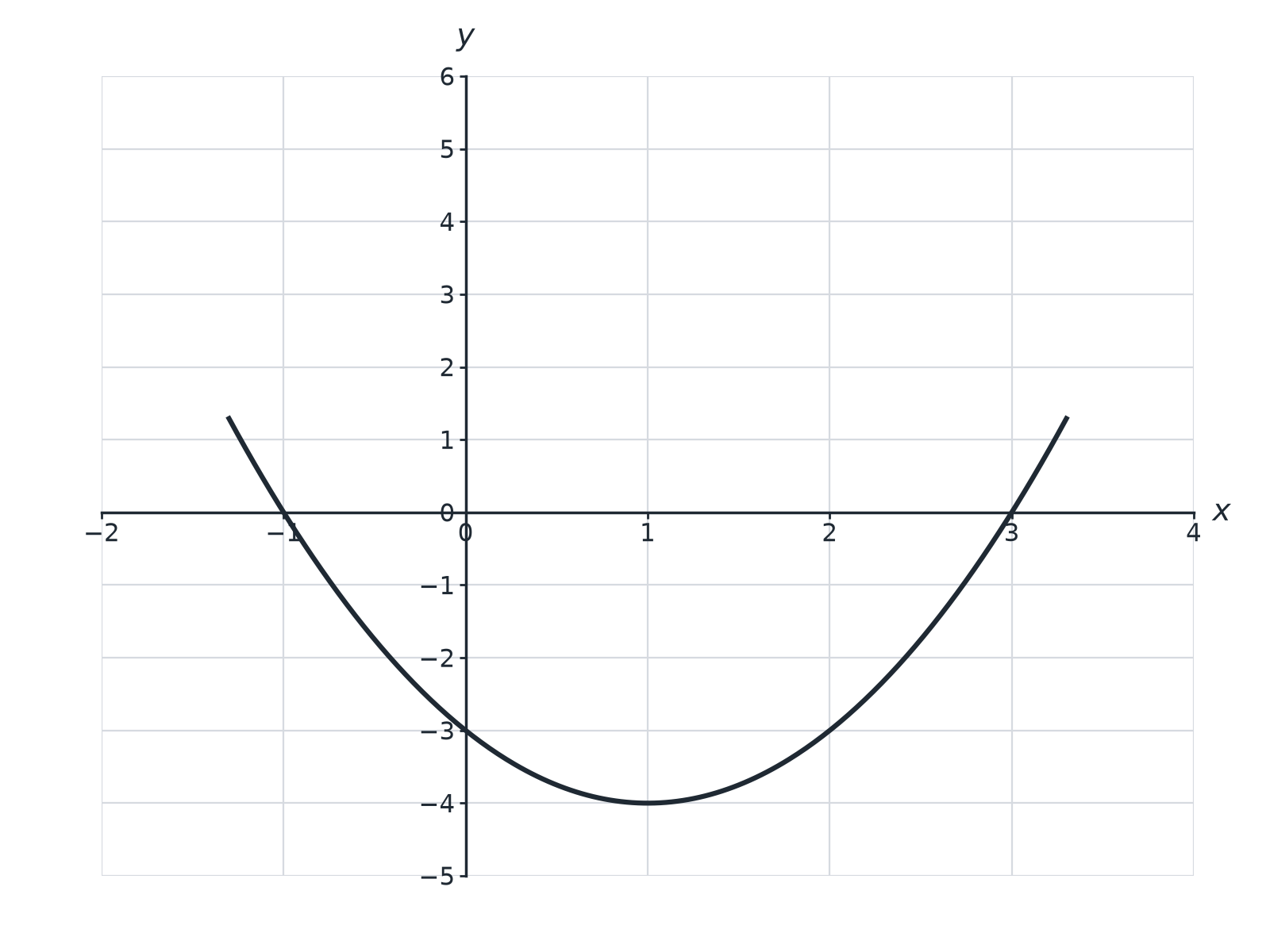
The graph of \(y = x^2 - 2x - 3\) is drawn on the grid. (a) Use the graph to solve \(x^2 - 2x - 3 = 0\). (b) Write down the coordinates of the turning point.
Mark scheme — 3 marks available
- \(-1\) — B1
- 3 — B1
- \((1, -4)\) — B1
Model answer
(a) \(x = -1\) and \(x = 3\). (b) \((1, -4)\).
Use the same graph to find estimates for the solutions of \(x^2 - 2x - 3 = 2\).
Mark scheme — 2 marks available
- Draws \(y = 2\) — M1
- Both estimates — A1
Model answer
Draw \(y = 2\). The solutions are \(x \approx -1.4\) and \(x \approx 3.4\). Accept \(-1.6\) to \(-1.3\) and \(3.3\) to \(3.6\).
Complete the table of values for \(y = x^2 - 2x - 3\) for \(x = -2, -1, 0, 1, 2, 3, 4\).
Mark scheme — 2 marks available
- At least 4 correct — M1
- All correct — A1
Model answer
\(y = 5, 0, -3, -4, -3, 0, 5\)
\(y = (x - 1)^2 - 4\). Write down the coordinates of the turning point of the graph and the equation of its line of symmetry.
Mark scheme — 2 marks available
- \((1, -4)\) — B1
- \(x = 1\) — B1
Model answer
Turning point \((1, -4)\); line of symmetry \(x = 1\).
Sketch the graph of \(y = x^2 - 4\), showing where it crosses the axes.
Mark scheme — 3 marks available
- Correct U shape — B1
- x-intercepts \(\pm 2\) — B1
- y-intercept \(-4\) — B1
Model answer
A U-shaped parabola with its minimum at \((0, -4)\), crossing the x-axis at \((-2, 0)\) and \((2, 0)\), and the y-axis at \((0, -4)\).
A quadratic graph has roots at \(x = 2\) and \(x = 6\). Write down the equation of its line of symmetry and explain how you know.
Mark scheme — 2 marks available
- \(x = 4\) — B1
- Halfway between the roots — C1
Model answer
\(x = 4\); it is halfway between the roots.
The roots of a graph are where...
Why: \(y = 0\).
A U-shaped quadratic graph has a...
Why: Minimum turning point.
Roots \(-1\) and \(3\) give a line of symmetry at...
Why: Halfway: \(x = 1\).
To solve \(x^2 - 2x - 3 = 2\) using the graph, draw...
Why: The line \(y = 2\).
\(y = (x - 3)^2 + 5\) has turning point...
Why: \((3, 5)\).
A quadratic with negative \(x^2\) coefficient looks...
Why: Like an upside-down U, with a maximum point.