Viewing as
Teacher view: planning notes, the answers to every question, and the teacher copies of the files.
Physics · Atomic structure
Half-lives and the random nature of radioactive decay
Define half-life, explain how it relates to the random nature of decay, determine half-lives from data, and calculate the net decline after a number of half-lives (Higher tier).
Teacher resources
The teacher copies: slides with the questions built in, the answers, and anything else attached to this lesson for whoever is teaching it.
- Half-lives and the random nature of radioactive decay - Teacher Slides.pptx Teacher The lesson slides with the teacher's notes on each slide, and every question and mark scheme built in. Built from the lesson script on 30 September 2026. View
- Half-lives and the random nature of radioactive decay - Teacher Notes.docx Teacher The complete notes with the teacher's notes and every model answer in full. Built from the lesson script on 30 September 2026. View
Student handouts
The same files the students see, to print or hand out.
- Half-lives and the random nature of radioactive decay.pptx Built from the lesson script on 30 September 2026. View
- Half-lives and the random nature of radioactive decay - Completed Notes.docx The full notes for the lesson, to revise from. Built from the lesson script on 30 September 2026. View
- Half-lives and the random nature of radioactive decay - Exam Questions.docx Built from the lesson script on 30 September 2026. View
Warm-up
Answer each one, then check.
-
1
What does random mean?
Show answerHide answer
Cannot be predicted
-
2
What is half of 800?
Show answerHide answer
400
-
3
What is activity measured in?
Show answerHide answer
Becquerel (Bq)
-
4
What is a count rate?
Show answerHide answer
Number of counts per second
-
5
What does exponential decay look like on a graph?
Show answerHide answer
A curve that falls quickly then more slowly
Learning Objectives
HALF-LIFE
The half-life of a radioactive isotope is the time it takes for the number of nuclei of the isotope in a sample to halve, or the time it takes for the count rate (or activity) to fall to half its initial level.
Radioactive decay is random: we cannot say when any one nucleus will decay, but for a large number of nuclei the half-life is predictable.
A Decay Curve
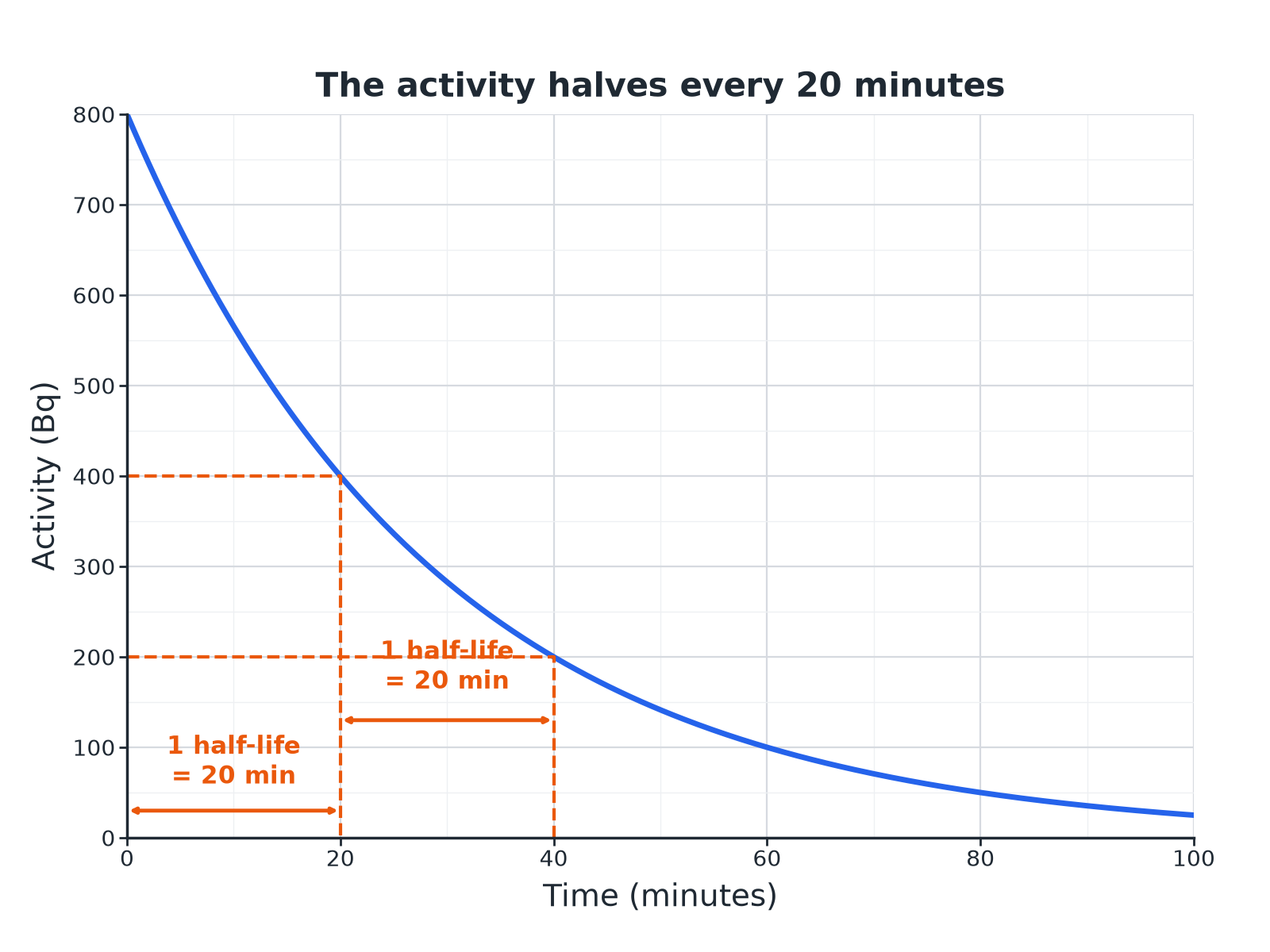
Each half-life the activity halves.
Number of Half-Lives
Higher tier: net decline as a ratio.
-
0
Fraction left: 1. Ratio of final to initial: 1 : 1
-
1
Fraction left: 1/2. Ratio of final to initial: 1 : 2
-
2
Fraction left: 1/4. Ratio of final to initial: 1 : 4
-
3
Fraction left: 1/8. Ratio of final to initial: 1 : 8
-
4
Fraction left: 1/16. Ratio of final to initial: 1 : 16
Finding a Half-Life from a Graph
The activity of a sample falls from 800 Bq to 400 Bq in 20 minutes and to 200 Bq after 40 minutes. What is the half-life?
Show the solutionHide the solution
- 1 800 to 400 Halved in 20 minutes
- 2 400 to 200 Halved again in the next 20 minutes
AnswerThe half-life is 20 minutes.
Activity After Several Half-Lives
A source has an activity of 800 Bq and a half-life of 6 hours. Find its activity after 24 hours.
Show the solutionHide the solution
- 1 Number of half-lives \(24 \div 6 = 4\)
- 2 Halve four times \(800 \rightarrow 400 \rightarrow 200 \rightarrow 100 \rightarrow 50\)
Answer50 Bq
Net Decline as a Ratio (Higher)
Calculate the ratio of the final activity to the initial activity after 3 half-lives.
Show the solutionHide the solution
- 1 Each half-life Halve the activity
- 2 After 3 \(\left(\tfrac{1}{2}\right)^3 = \tfrac{1}{8}\)
AnswerThe activity falls to 1/8 of its initial value, a ratio of 1 : 8.
Random Decay
How to explain it.
-
One nucleus
It is impossible to predict when a particular nucleus will decay.
-
Many nuclei
The number decaying in a given time follows a pattern, so half-life is a reliable measure.
-
Count rate
Count rate is also random, so it varies slightly between measurements.
-
Background
Correct for background radiation to find the true count rate.
Halve It
A sample has a count rate of 640 counts per minute. Its half-life is 3 hours. What is the count rate after 12 hours? What is the ratio of final to initial count rate?
1. Work out the number of half-lives.
2. Halve each time.
A good answer shows: 12 ÷ 3 = 4 half-lives: 640 → 320 → 160 → 80 → 40 counts per minute. The ratio is 1 : 16.
Can I...?
- 1Define half-life.
- 2Explain random decay.
- 3Find half-life from a graph.
- 4Halve repeatedly.
- 5Work out the number of half-lives.
- 6State the ratio after several half-lives.
- 7Explain why decay is random.
- 8Use correct units.
Summary & Exam Focus
- Half-life: time for activity to halve.
- Random decay but a predictable half-life for many nuclei.
- After n half-lives: fraction (1/2)ⁿ.
- Read half-life from a graph.
Exam focus
A radioactive source has a half-life of 20 minutes and an activity of 800 Bq. Find its activity after 60 minutes. (2 marks) (2 marks)
Three half-lives: halve three times.
Key terms
The vocabulary this lesson expects you to use. Each one is linked from the first place it appears above.
- Half-life
- The time for the number of nuclei (or the activity) to halve.
- Random
- Cannot be predicted for a single nucleus.
- Count rate
- The number of decays detected each second.
- Activity
- The rate of decay of a source, in becquerel.
- Decay curve
- A graph showing how activity falls with time.
- Background
- The radiation that is always around us.
Questions and answers
10 questions set on this lesson, with the mark schemes and model answers open.
What is meant by the half-life of a radioactive isotope?
Mark scheme — 2 marks available
- Time for the number of nuclei to halve — 1 mark
- or activity or count rate falls to half — 1 mark
Model answer
The time it takes for the number of nuclei in a sample to halve, or the time for the count rate (activity) to fall to half its initial value.
The graph shows how the activity of a radioactive source changes with time. (a) Determine the half-life of the source. (b) Calculate the activity after 100 minutes.
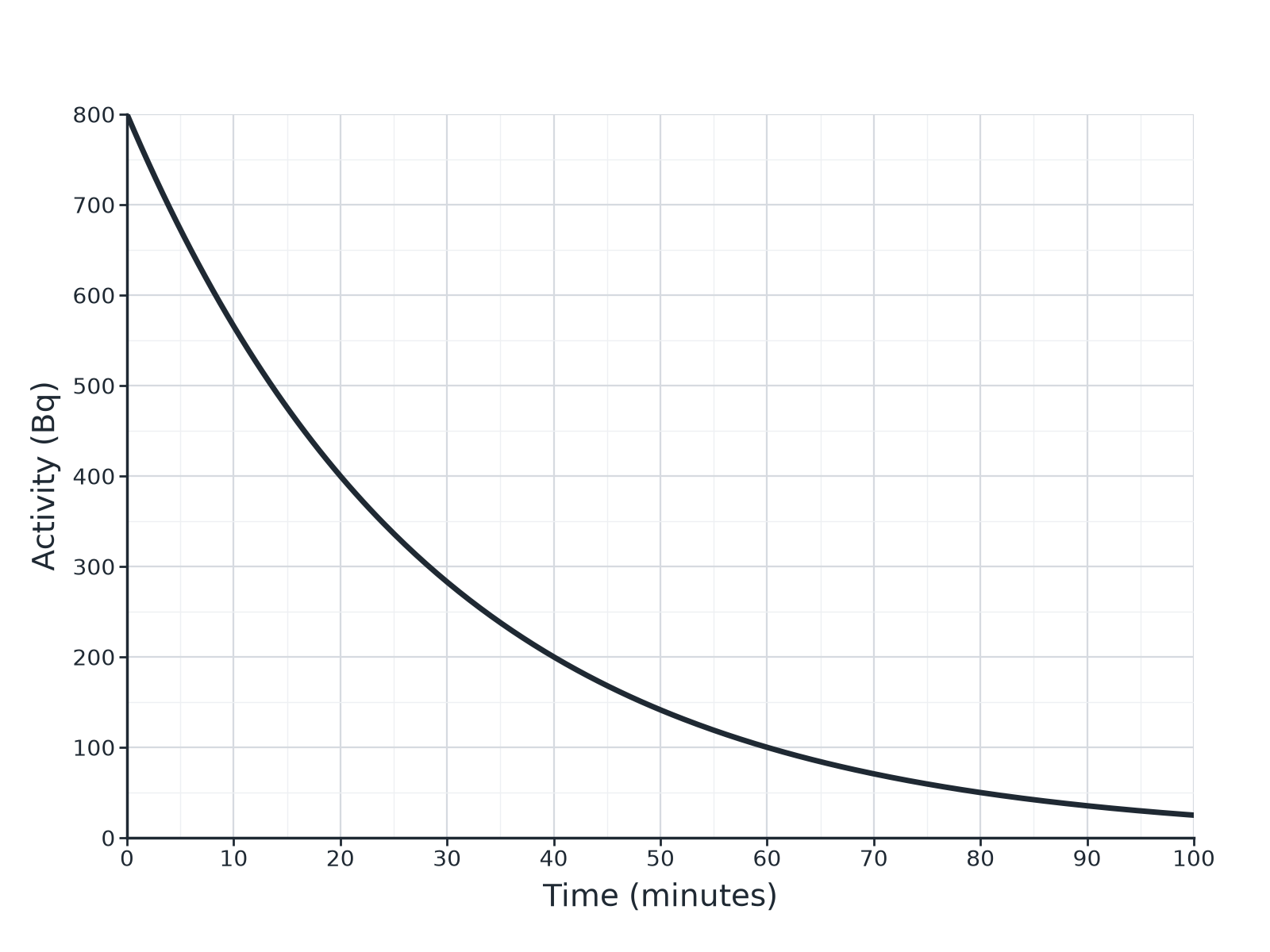
Mark scheme — 4 marks available
- Reads 400 Bq at half of 800 — 1 mark
- 20 minutes — 1 mark
- 5 half-lives — 1 mark
- 25 Bq — 1 mark
Model answer
(a) The activity halves from 800 Bq to 400 Bq in 20 minutes, so the half-life is 20 minutes. (b) 100 minutes is 5 half-lives: 800 → 400 → 200 → 100 → 50 → 25 Bq.
A radioactive sample has an activity of 800 Bq. Its half-life is 6 hours. Calculate the activity after 24 hours.
Mark scheme — 3 marks available
- 4 half-lives — 1 mark
- Halves four times — 1 mark
- 50 Bq — 1 mark
Model answer
24 ÷ 6 = 4 half-lives; 800 ÷ 16 = 50 Bq
The count rate from a radioactive source falls to one eighth of its original value in 15 hours. Calculate the half-life of the source. Also state the net decline as a ratio.
Mark scheme — 3 marks available
- 1/8 means 3 half-lives — 1 mark
- 5 hours — 1 mark
- Ratio 1 : 8 — 1 mark
Model answer
1/8 is 3 half-lives, so 15 ÷ 3 = 5 hours. The ratio of final to initial count rate is 1 : 8.
Radioactive decay is a random process. Explain what this means.
Mark scheme — 2 marks available
- Cannot predict which nucleus — 1 mark
- Or when it will decay — 1 mark
Model answer
It is not possible to predict when a particular nucleus will decay.
After one half-life the activity is...
Why: It halves.
After two half-lives the activity is...
Why: (1/2)² = 1/4.
A source of 400 Bq has a half-life of 2 days. After 6 days it has...
Why: Three half-lives: 400 → 200 → 100 → 50.
Radioactive decay is...
Why: You cannot predict a single decay.
After 3 half-lives the ratio of final to initial activity is...
Why: (1/2)³ = 1/8.