Viewing as
Teaching this? The teacher view adds 2 files, the mark schemes and the model answers.
Physics · Forces
Forces and elasticity
Describe elastic and inelastic deformation, use \(F = ke\) and \(E_e = \tfrac{1}{2}ke^2\), and investigate the relationship between force and extension (Required Practical 6).
Warm-up
Answer each one, then check.
-
1
What is a spring?
Show answerHide answer
A coiled wire that can be stretched or compressed
-
2
What does proportional mean?
Show answerHide answer
Doubling one doubles the other
-
3
Convert 6 cm to m.
Show answerHide answer
0.06 m
-
4
What is elastic potential energy?
Show answerHide answer
Energy stored in a stretched spring
-
5
What is the unit of force?
Show answerHide answer
Newton
Learning Objectives
- 1Explain why more than one force is needed to stretch, bend or compress an object.
- 2Describe elastic and inelastic deformation.
- 3Recall and apply \(F = ke\) and \(E_e = \tfrac{1}{2}ke^2\).
- 4Interpret force-extension graphs and describe Required Practical 6.
HOOKE'S LAW
force \(=\) spring constant \(\times\) extension \(F = ke\)
The extension of an elastic object is directly proportional to the force applied, provided the limit of proportionality is not exceeded. The same applies to compression.
Force and Extension
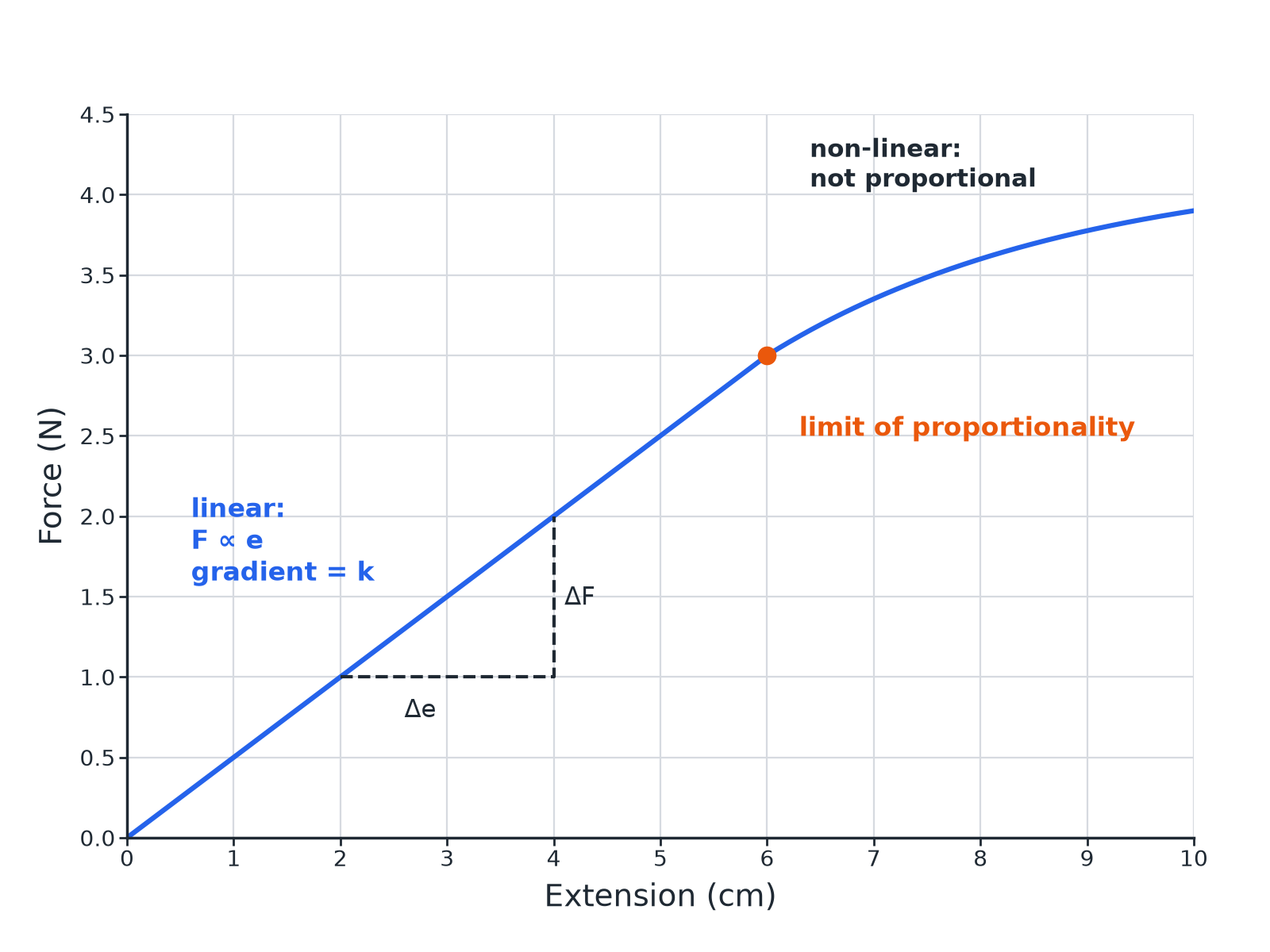
Beyond the limit, the spring does not return to its original length.
Required Practical 6: Stretching a Spring
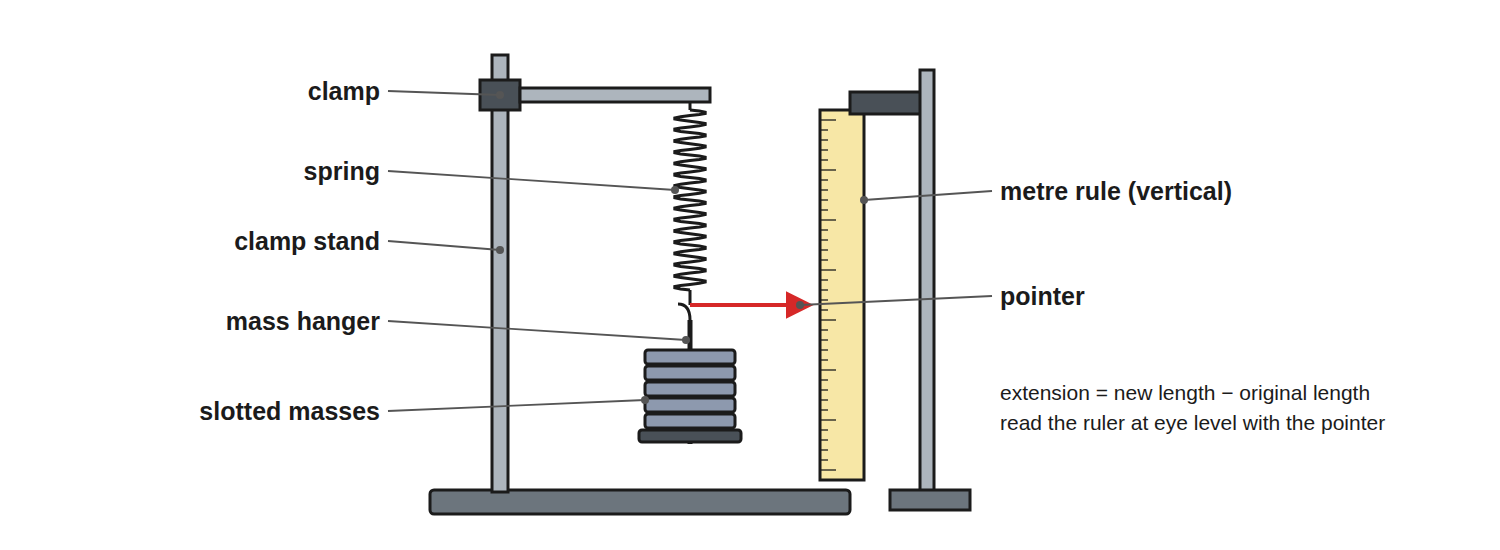
Measure the length with each extra mass added.
Required Practical 6: Method
Investigate force and extension.
-
1
Measure the original length
With no masses on the spring.
-
2
Add a mass
Record the force (weight = mg) and the new length.
-
3
Calculate the extension
New length minus original length.
-
4
Repeat
Add masses one at a time, keeping below the limit of proportionality at first.
-
5
Plot
Force (y-axis) against extension (x-axis).
-
6
Gradient
Gradient of the straight part = spring constant k.
Spring Constant
A force of 3.0 N stretches a spring by 6.0 cm (within the limit of proportionality). Calculate the spring constant.
Show the solutionHide the solution
- 1 Convert \(6.0\) cm \(= 0.060\) m
- 2 Rearrange \(k = F \div e\)
- 3 Substitute \(k = 3.0 \div 0.060\)
- 4 Answer \(k = 50\) N/m
Answer50 N/m
Elastic Potential Energy
Calculate the energy stored in the spring when the extension is 0.040 m and k = 50 N/m.
Show the solutionHide the solution
- 1 Write the equation \(E_e = \tfrac{1}{2}ke^2\)
- 2 Substitute \(E_e = 0.5 \times 50 \times 0.040^2\)
- 3 Answer \(E_e = 0.040\) J
Answer0.040 J
Elastic or Inelastic?
Elastic deformation
- The object returns to its original shape when the force is removed.
- Happens within the limit of proportionality.
Inelastic deformation
- The object does not return to its original shape.
- Happens beyond the limit of proportionality.
Key Ideas
Learn these.
-
Two forces
To stretch, bend or compress a stationary object, more than one force is needed (for example pull at both ends).
-
Work done
The work done on an elastic object equals the elastic potential energy stored, provided it is not inelastically deformed.
-
Linear
A straight line through the origin: proportional.
-
Non-linear
A curve: not proportional.
Stretching, Bending and Compressing
A stationary object needs at least two forces to change shape.
-
Stretching
A spring hung from a clamp: the clamp pulls up, the mass pulls down.
-
Bending
A diving board: the stand holds one end, the diver pushes down on the other.
-
Compressing
A car suspension spring: the car pushes down, the wheel pushes up.
Reading a Force–Extension Graph
Each part of the line tells you something.
-
Straight section
The line is straight through the origin, so force is directly proportional to extension and Hooke's law is obeyed. The gradient is the spring constant k.
-
Curved section
Beyond the limit of proportionality the line bends. The spring stretches more for each extra newton and may be permanently deformed.
-
Comparing springs
A steeper line means a stiffer spring with a larger spring constant: more force is needed for each metre of extension.
Getting the Practical Right
Accuracy and safety in Required Practical 6.
-
Measuring length
Read the ruler at eye level, level with a fixed pointer on the spring, to avoid parallax error.
-
Extension, not length
Always subtract the original length. Plotting total length is the most common mistake.
-
Safety
Wear eye protection, and keep feet away from the masses in case the spring snaps or slips off.
Spring Test
A spring stretches 4.0 cm when a 2.0 N force is applied. (a) Calculate k in N/m. (b) What force gives an extension of 10 cm if the limit is not exceeded? (c) What energy is stored at 10 cm?
1. Convert cm to m.
2. Use F = ke and Ee = ½ke².
A good answer shows: (a) 50 N/m. (b) F = 50 × 0.10 = 5.0 N. (c) E = 0.5 × 50 × 0.10² = 0.25 J.
Can I...?
- 1State F = ke.
- 2Convert cm to m.
- 3Calculate a spring constant.
- 4Calculate stored energy.
- 5Describe elastic and inelastic deformation.
- 6Read a force-extension graph.
- 7Describe Required Practical 6.
- 8Find the gradient.
Summary & Exam Focus
- \(F = ke\).
- \(E_e = \tfrac{1}{2}ke^2\).
- Beyond the limit of proportionality: non-linear, may not return.
- Spring constant = gradient of the linear part.
- Elastic potential energy stored = ½ke².
Exam focus
A spring has a spring constant of 50 N/m. Calculate the force needed to stretch it by 0.10 m. (2 marks) (2 marks)
Write F = ke, substitute 50 × 0.10 and give 5.0 N. Make sure the extension is in metres: 10 cm = 0.10 m.
Key terms
The vocabulary this lesson expects you to use. Each one is linked from the first place it appears above.
- Extension
- The increase in length of a spring.
- Spring constant
- The force needed per metre of extension (N/m).
- Limit of proportionality
- The point beyond which force and extension are no longer proportional.
- Elastic deformation
- A change of shape that is reversed when the force is removed.
- Inelastic deformation
- A permanent change of shape.
- Linear
- Following a straight line.
- Compression
- A decrease in length when an object is squashed.
- Elastic potential energy
- Energy stored in a stretched or compressed elastic object.
- Hooke's law
- Extension is directly proportional to force, up to the limit of proportionality.
Practice questions
Have a go at each one before you open its answer.
-
Question 1 Calculate 2 marks
A spring has a spring constant of 50 N/m. Calculate the force needed to stretch the spring by 0.10 m. Use the equation: force = spring constant × extension
Show answerHide answer
Model answer
\(50 \times 0.10 = 5.0\) N
Mark scheme
- Correct substitution — 1 mark
- 5.0 N — 1 mark
-
Question 2 Use the graph 5 marks
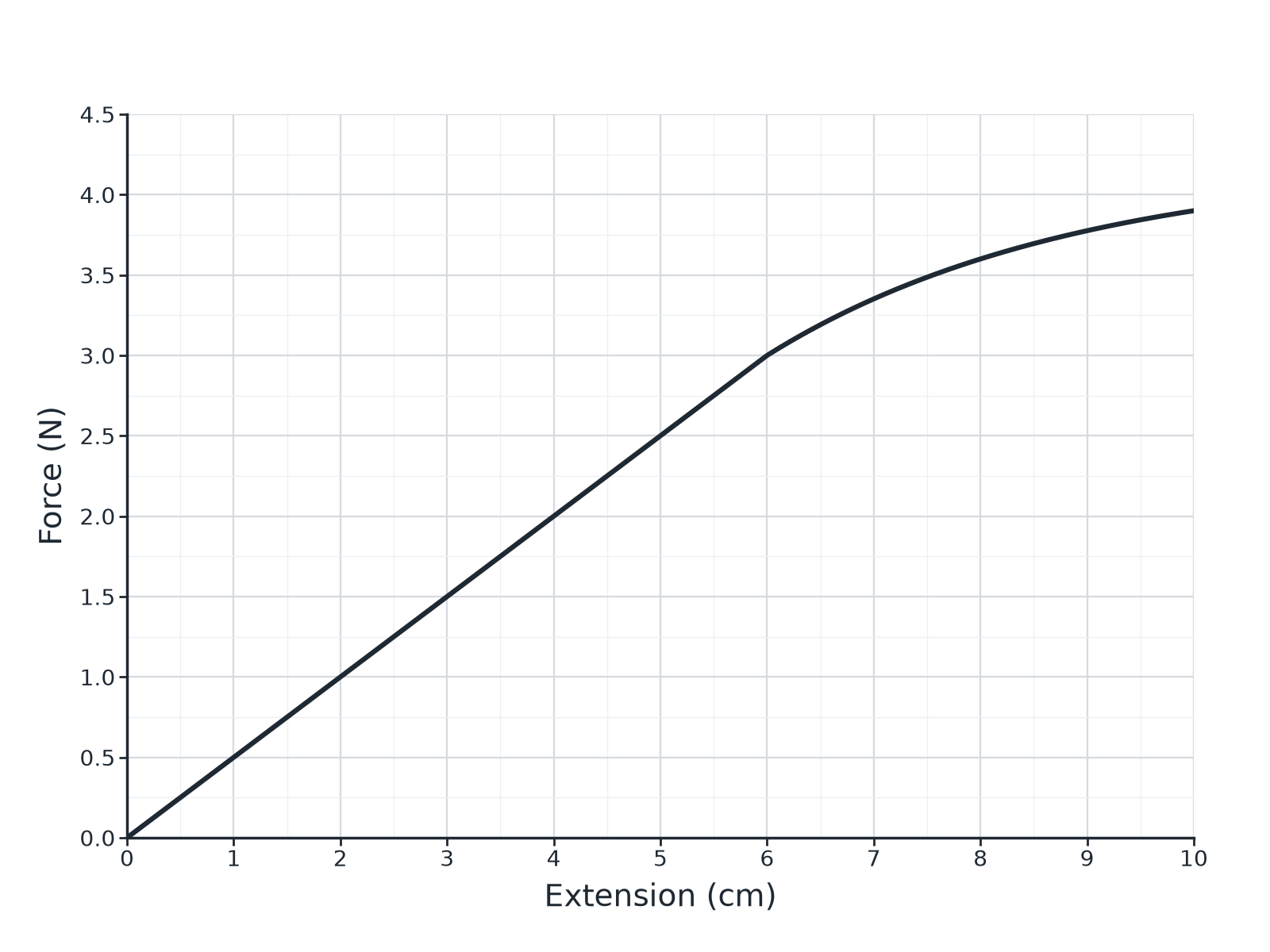
A student investigates a spring. The graph shows how the force changes with extension. (a) State the extension at the limit of proportionality. (b) Calculate the spring constant of the spring. (c) Calculate the elastic potential energy stored when the extension is 0.040 m.
Show answerHide answer
Model answer
(a) About 6 cm. (b) \(k = 3.0 \div 0.060 = 50\) N/m. (c) \(E_e = 0.5 \times 50 \times 0.040^2 = 0.040\) J
Mark scheme
- 6 cm (accept 5.5 to 6.5) — 1 mark
- Uses 3.0 N at 0.060 m — 1 mark
- 50 N/m — 1 mark
- Correct substitution — 1 mark
- 0.040 J — 1 mark
-
Question 3 Describe 2 marks
Describe the difference between elastic deformation and inelastic deformation of a spring.
Show answerHide answer
Model answer
In elastic deformation the spring returns to its original length when the force is removed; in inelastic deformation it does not and is permanently changed.
Mark scheme
- Elastic: returns to original shape — 1 mark
- Inelastic: does not return — 1 mark
-
Question 4 Describe 6 marks
Describe how to investigate the relationship between the force applied to a spring and the extension of the spring. Your answer should include the apparatus, the measurements, and how you would use them.
Show answerHide answer
Model answer
See levels-of-response scheme.
Mark scheme
- Level 3 (5 to 6 marks): a complete method with stand, ruler and masses, original length measured, several forces (weights) applied with the new length each time, extension calculated, graph plotted and spring constant from the gradient, with a precaution (eye level, avoid overstretching) — 5 to 6 marks
- Level 2 (3 to 4 marks): a method covering force and extension with some detail missing — 3 to 4 marks
- Level 1 (1 to 2 marks): simple statements about adding masses and measuring length — 1 to 2 marks
-
Question 5 Explain 2 marks
Explain why two forces are needed to stretch a spring that is fixed to a wall.
Show answerHide answer
Model answer
The wall applies a force in the opposite direction to the pulling force, so the spring is stretched; with only one force the object would accelerate rather than change shape.
Mark scheme
- Forces act at both ends — 1 mark
- Equal and opposite forces — 1 mark
Quick check
-
A spring has original length 10 cm and stretches to 14 cm. What is the extension?
Show answerHide answer
B: 4 cm
Extension = new length − original length = 14 − 10 = 4 cm.
-
Why are at least two forces needed to stretch a stationary spring?
Show answerHide answer
D: One force alone would make it accelerate instead
With one force, the spring would just move; two opposite forces are needed to change its shape.
-
A spring with k = 200 N/m is stretched by 0.05 m. How much elastic potential energy is stored?
Show answerHide answer
A: 0.25 J
Ee = ½ × 200 × 0.05² = 0.25 J.
-
Extension is...
Show answerHide answer
B: new length minus original length
It is the increase in length.
-
A 4 N force gives a 0.08 m extension. k =
Show answerHide answer
C: 50 N/m
4 ÷ 0.08 = 50.
-
A straight line force-extension graph through the origin shows...
Show answerHide answer
D: direct proportion
F ∝ e.
-
Beyond the limit of proportionality the spring...
Show answerHide answer
A: may not return to its original length
It is inelastically deformed.
-
The gradient of the linear section is the...
Show answerHide answer
B: spring constant
F ÷ e.
Downloads
Free to keep, print and annotate.
- Forces and elasticity.pptx Built from the lesson script on 1 October 2026. View
- Forces and elasticity - Completed Notes.docx The full notes for the lesson, to revise from. Built from the lesson script on 1 October 2026. View
- Forces and elasticity - Exam Questions.docx Built from the lesson script on 1 October 2026. View
Something here looks wrong?
Tell us what and we will go and look. It goes to whoever writes these pages, nobody else, and we do not ask who you are — so there is nothing to sign and nothing comes back to you.