Viewing as
Teacher view: planning notes, the answers to every question, and the teacher copies of the files.
Physics · Forces
Pressure in a column of liquid and upthrust
Use \(p = h\rho g\), explain why pressure increases with depth and density, and explain upthrust, floating and sinking (Higher tier).
Teacher resources
The teacher copies: slides with the questions built in, the answers, and anything else attached to this lesson for whoever is teaching it.
- Pressure in a column of liquid and upthrust - Teacher Slides.pptx Teacher The lesson slides with the teacher's notes on each slide, and every question and mark scheme built in. Built from the lesson script on 30 September 2026. View
- Pressure in a column of liquid and upthrust - Teacher Notes.docx Teacher The complete notes with the teacher's notes and every model answer in full. Built from the lesson script on 30 September 2026. View
Student handouts
The same files the students see, to print or hand out.
- Pressure in a column of liquid and upthrust.pptx Built from the lesson script on 30 September 2026. View
- Pressure in a column of liquid and upthrust - Completed Notes.docx The full notes for the lesson, to revise from. Built from the lesson script on 30 September 2026. View
- Pressure in a column of liquid and upthrust - Exam Questions.docx Built from the lesson script on 30 September 2026. View
Warm-up
Answer each one, then check.
-
1
What is density?
Show answerHide answer
Mass per unit volume
-
2
Write the equation for pressure.
Show answerHide answer
\(p = F \div A\)
-
3
What unit is pressure in?
Show answerHide answer
Pascal
-
4
What is g?
Show answerHide answer
Gravitational field strength, 9.8 N/kg
-
5
What is a fluid?
Show answerHide answer
A liquid or gas
Learning Objectives
PRESSURE IN A LIQUID
pressure \(=\) height of column \(\times\) density \(\times\) gravitational field strength \(p = h\rho g\)
The equation is given on the Physics equation sheet. In any calculation g will be given. Pressure is in pascals (Pa), h in metres, ρ in kg/m³ and g in N/kg.
Pressure Increases with Depth
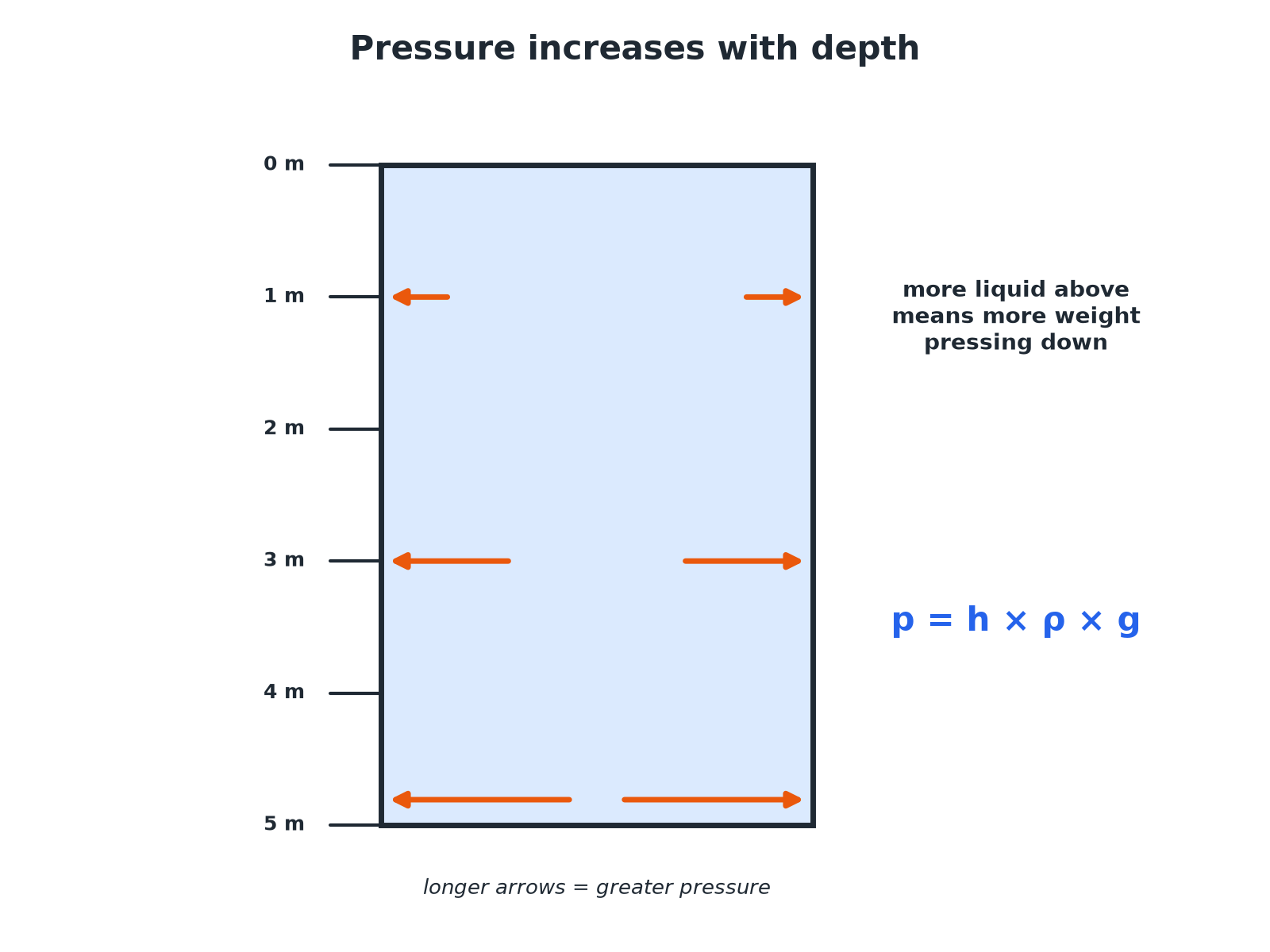
More liquid above means more pressure.
Upthrust
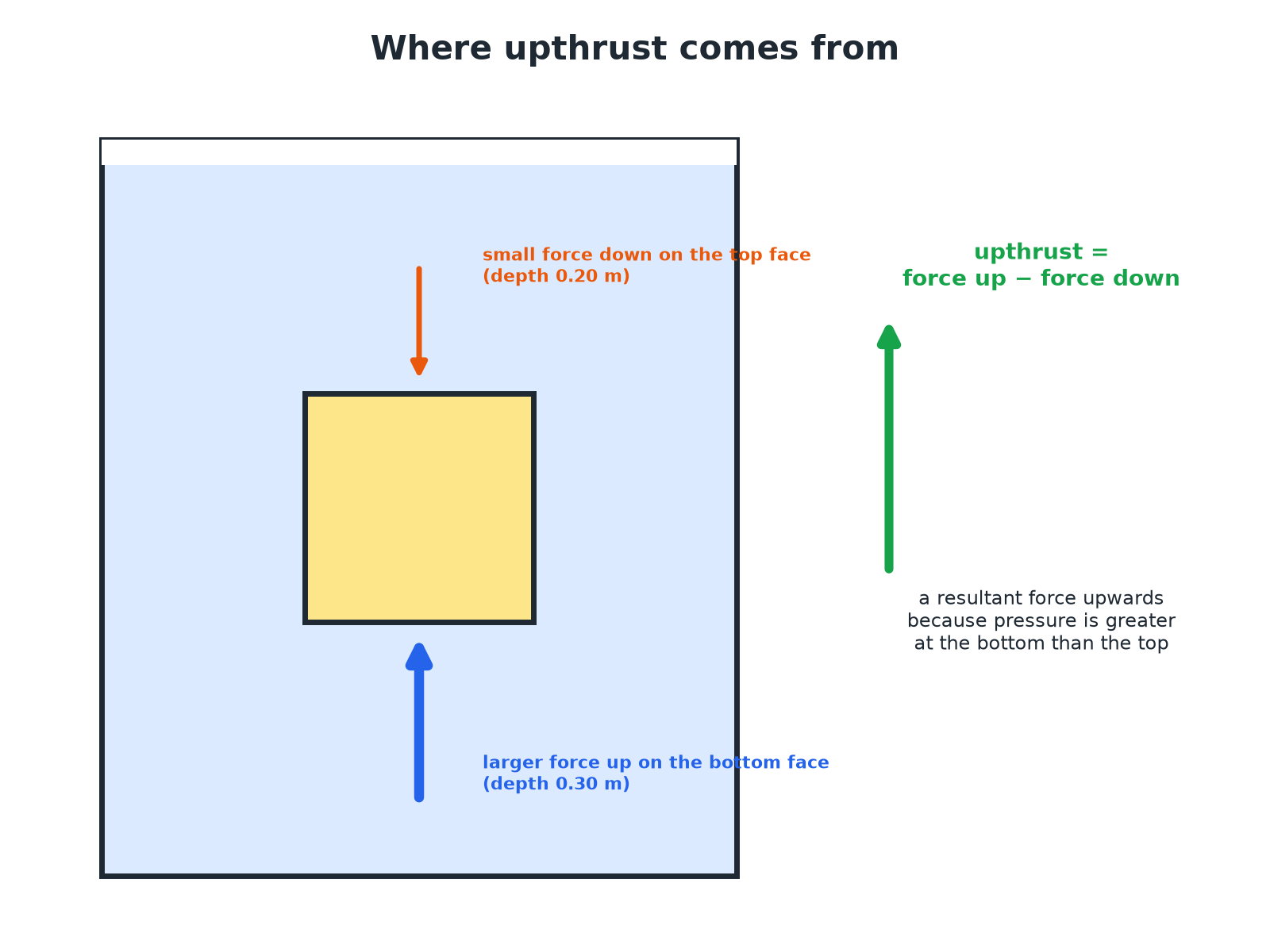
Pressure is greater at the bottom than the top.
Pressure at a Depth
Calculate the pressure due to the sea water at a depth of 20 m. Density of sea water = 1030 kg/m³; g = 9.8 N/kg.
Show the solutionHide the solution
- 1 Write the equation \(p = h\rho g\)
- 2 Substitute \(p = 20 \times 1030 \times 9.8\)
- 3 Answer \(p = 201\,880\) Pa, about \(2.0 \times 10^5\) Pa
AnswerAbout \(2.0 \times 10^5\) Pa
Pressure Difference
Calculate the difference in pressure between depths of 2.0 m and 5.0 m in fresh water (density 1000 kg/m³). g = 9.8 N/kg.
Show the solutionHide the solution
- 1 Difference in depth \(5.0 - 2.0 = 3.0\) m
- 2 Substitute \(p = 3.0 \times 1000 \times 9.8\)
- 3 Answer \(29\,400\) Pa
Answer29 400 Pa
Upthrust on a Cube
A cube of side 0.10 m is submerged with its top face at a depth of 0.20 m. Calculate the upthrust. Density of water = 1000 kg/m³; g = 9.8 N/kg.
Show the solutionHide the solution
- 1 Pressure difference between bottom and top \(0.10 \times 1000 \times 9.8 = 980\) Pa
- 2 Area of a face \(0.10 \times 0.10 = 0.010\) m²
- 3 Force difference \(F = pA = 980 \times 0.010 = 9.8\) N
AnswerUpthrust = 9.8 N, upwards.
Floating and Sinking
Compare upthrust with weight.
-
Float
Upthrust equals weight when an object floats; its average density is less than the liquid's.
-
Sink
If the weight is greater than the maximum upthrust, the object sinks.
-
Ships
A steel ship floats because its shape displaces a lot of water, giving it a low average density.
-
Submarines
Change their average density by taking in or pushing out water.
Dive Down
A diver is 15 m deep in water (density 1000 kg/m³, g = 9.8 N/kg). Calculate the pressure due to the water. Explain why the pressure is greater than at 5 m.
1. Use p = hρg.
2. Explain with depth.
A good answer shows: p = 15 × 1000 × 9.8 = 147 000 Pa. There is more water above the diver, so its weight produces a greater pressure.
Can I...?
- 1State p = hρg.
- 2Calculate pressure at a depth.
- 3Find a pressure difference.
- 4Explain why pressure increases with depth.
- 5Explain why pressure increases with density.
- 6Explain upthrust.
- 7Explain floating.
- 8Explain sinking.
Summary & Exam Focus
- \(p = h\rho g\).
- Pressure increases with depth and density.
- Upthrust = difference in force on bottom and top.
- Floats if upthrust equals weight.
Exam focus
Calculate the pressure due to the sea at a depth of 20 m. Density = 1030 kg/m³; g = 9.8 N/kg. (2 marks) (2 marks)
Substitute into p = hρg.
Key terms
The vocabulary this lesson expects you to use. Each one is linked from the first place it appears above.
- Upthrust
- The resultant upward force on a submerged object due to pressure.
- Column of liquid
- The liquid above a point.
- Density
- Mass per unit volume.
- Submerged
- Completely under the surface.
- Displaced
- Pushed out of the way.
- Average density
- Total mass divided by total volume.
Questions and answers
10 questions set on this lesson, with the mark schemes and model answers open.
A submarine is at a depth of 20 m in sea water of density 1030 kg/m³. Gravitational field strength = 9.8 N/kg. Calculate the pressure on the submarine due to the water.
Mark scheme — 3 marks available
- Correct equation — 1 mark
- Correct substitution — 1 mark
- 201 880 Pa — 1 mark
Model answer
\(p = 20 \times 1030 \times 9.8 = 201\,880\) Pa (about \(2.0 \times 10^5\) Pa)
Explain why the pressure at the bottom of a swimming pool is greater than the pressure near the surface.
Mark scheme — 3 marks available
- Pressure due to the weight of water above — 1 mark
- More water above at the bottom — 1 mark
- So greater pressure — 1 mark
Model answer
The pressure is caused by the weight of the water above. At the bottom there is more water above, so the weight and therefore the pressure is greater.
Calculate the difference in pressure between depths of 2.0 m and 5.0 m in fresh water. Density of water = 1000 kg/m³; g = 9.8 N/kg.
Mark scheme — 3 marks available
- Height difference 3.0 m — 1 mark
- Correct substitution — 1 mark
- 29 400 Pa — 1 mark
Model answer
\(p = 3.0 \times 1000 \times 9.8 = 29\,400\) Pa
A brick is completely submerged in water. Explain why it experiences an upward force called upthrust.
Mark scheme — 3 marks available
- Pressure greater on the bottom — 1 mark
- Force greater on the bottom surface — 1 mark
- Resultant upward force — 1 mark
Model answer
The pressure increases with depth, so the pressure on the bottom surface is greater than on the top surface. The force on the bottom is larger, giving a resultant upward force.
A steel ship floats but a steel ball of the same mass sinks. Explain why.
Mark scheme — 4 marks available
- Ship displaces a large volume — 1 mark
- Upthrust equals weight for the ship — 1 mark
- Ball: upthrust less than weight — 1 mark
- Comparison of average density — 1 mark
Model answer
The ship's shape displaces a large volume of water, so the upthrust equals the ship's weight and its average density is less than water. The ball has a small volume so the upthrust is less than its weight and it sinks.
Pressure in a liquid depends on...
Why: p = hρg.
Pressure increases as depth...
Why: More liquid above.
Upthrust acts...
Why: It opposes the weight.
An object floats when upthrust is...
Why: Balanced forces.
A denser liquid gives a...
Why: ρ is in the equation.