Viewing as
Teacher view: planning notes, the answers to every question, and the teacher copies of the files.
Business · Making financial decisions
Business calculations
Gross profit shows what a business earns from selling its products; net profit shows what is left after every cost. Turning each into a percentage of revenue - the gross and net profit margins - makes performance easy to compare.
Teacher resources
The teacher copies: slides with the questions built in, the answers, and anything else attached to this lesson for whoever is teaching it.
- Business calculations - Teacher Slides.pptx Teacher The lesson slides with the teacher's notes on each slide, and every question and mark scheme built in. Built from the lesson script on 28 September 2026. View
- Business calculations - Teacher Notes.docx Teacher The complete notes with the teacher's notes and every model answer in full. Built from the lesson script on 28 September 2026. View
Student handouts
The same files the students see, to print or hand out.
- Business calculations.pptx Built from the lesson script on 28 September 2026. View
- Business calculations - Completed Notes.docx The full notes for the lesson, to revise from. Built from the lesson script on 28 September 2026. View
- Business calculations - Exam Questions.docx Built from the lesson script on 28 September 2026. View
From Topic 1
Answer from memory before the answers appear.
-
How do you calculate revenue?
Price × quantity sold.
-
How do you calculate total costs?
Fixed costs + total variable costs.
-
How do you calculate profit?
Total revenue - total costs.
-
How do you calculate interest as a percentage?
(Total repayment - borrowed amount) ÷ borrowed amount × 100.
Learning Objectives
- 1Calculate gross profit.
- 2Calculate net profit.
- 3Calculate the gross profit margin.
- 4Calculate the net profit margin.
- 5Interpret profit and profit margins to judge performance.
Gross Profit
Gross profit = sales revenue - cost of sales.
-
Sales revenue
The money received from selling products.
-
Cost of sales
The direct cost of making or buying the products that were sold - raw materials, stock bought to sell and production wages.
-
What it shows
How much profit the business makes from its products, before paying for everything else.
-
Example
Bright Bikes sells £500,000 of bikes. The bikes and parts it sold cost £300,000. Gross profit = £500,000 - £300,000 = £200,000.
Net Profit
Net profit = gross profit - other operating expenses and interest.
-
Other operating expenses
The costs of running the business that are not part of cost of sales - rent, salaries of office staff, marketing, insurance and utilities.
-
Interest
The cost of borrowing - interest paid on loans and overdrafts.
-
What it shows
The true profit left for the owners after every cost has been paid.
-
Example
Bright Bikes' other operating expenses are £120,000 and it pays £10,000 interest. Net profit = £200,000 - £120,000 - £10,000 = £70,000.
Bright Bikes Ltd: Income Statement
-
Sales revenue
£: 500,000
-
Cost of sales
£: (300,000)
-
Gross profit
£: 200,000
-
Other operating expenses
£: (120,000)
-
Interest
£: (10,000)
-
Net profit
£: 70,000
Reading the Accounts
Revenue alone tells an owner little. Gross profit shows whether the business is buying and making its products at the right cost; net profit shows whether it is controlling everything else. The margins let the owner compare one year with another.
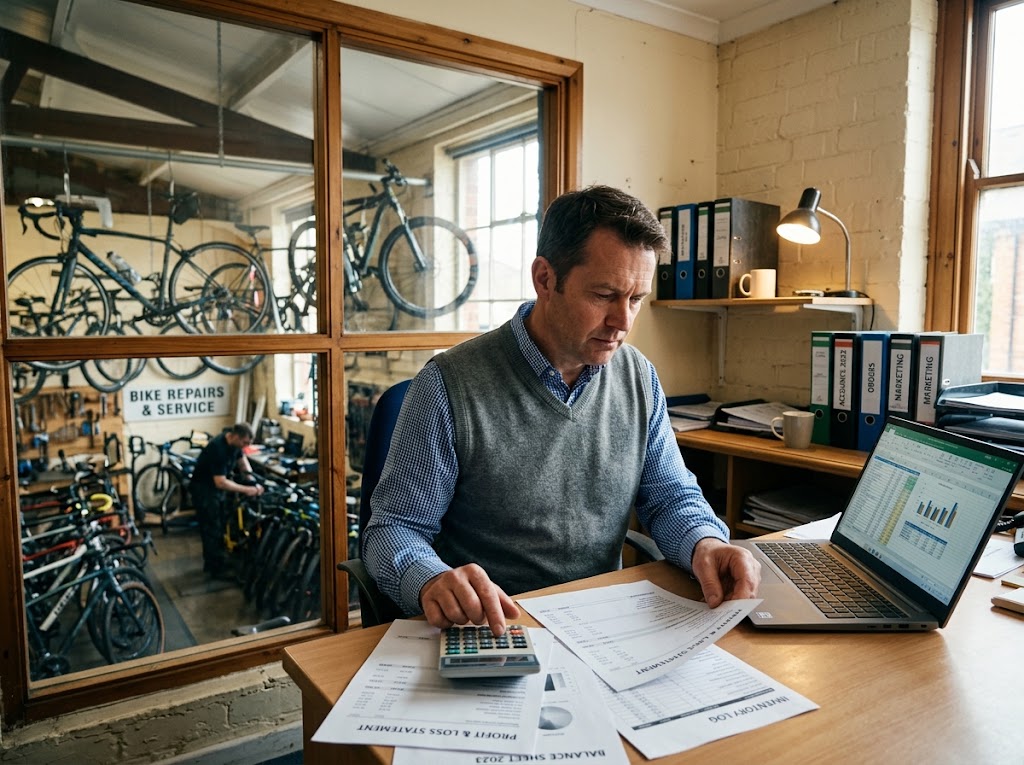
Gross profit, net profit and margins tell an owner how the business is really doing.
Gross Profit Margin
Gross profit margin (%) = (gross profit ÷ sales revenue) × 100.
-
What it shows
How many pence of gross profit the business makes from every £1 of sales.
-
A higher margin
Means the business buys or makes its products cheaply compared with its selling price.
-
How to improve it
Raise prices, or find cheaper suppliers and cut the cost of sales.
Bright Bikes' Gross Profit Margin
Divide, then multiply by 100.
Bright Bikes' gross profit is £200,000 and its sales revenue is £500,000. Calculate its gross profit margin.
- 1 Write the formula GPM = (gross profit ÷ sales revenue) × 100
- 2 Put in the numbers = (£200,000 ÷ £500,000) × 100
- 3 Work it out = 0.4 × 100 = 40%
AnswerGross profit margin = 40%
Net Profit Margin
Net profit margin (%) = (net profit ÷ sales revenue) × 100.
-
What it shows
How many pence of net profit the business keeps from every £1 of sales, after all costs.
-
A higher margin
Means the business controls its costs well.
-
The gap between margins
A big gap between gross and net margin means operating expenses and interest are taking a large share - a sign to control overheads.
Bright Bikes' Net Profit Margin
Same method, using net profit.
Bright Bikes' net profit is £70,000 and its sales revenue is £500,000. Calculate its net profit margin.
- 1 Write the formula NPM = (net profit ÷ sales revenue) × 100
- 2 Put in the numbers = (£70,000 ÷ £500,000) × 100
- 3 Work it out = 0.14 × 100 = 14%
AnswerNet profit margin = 14%
Bright Bikes at a Glance
-
£200,000
Gross profit
-
40%
Gross profit margin
-
£70,000
Net profit
-
14%
Net profit margin
Case study
Supermarkets: Pennies in the Pound
The UK's big supermarkets sell billions of pounds of food and household goods every year, but their net profit margins are usually very low - often just a few pence of profit for every pound customers spend. Competition on price is fierce, so they keep prices low and make their profit through enormous sales volumes. A luxury brand, by contrast, may sell far less but keep a much larger share of every pound as profit. Comparing margins, not just profit in pounds, shows how differently businesses make their money.
Run the Accounts
A sports shop has sales revenue of £250,000, cost of sales of £150,000, other operating expenses of £60,000 and interest of £5,000. Calculate its gross profit, net profit, gross profit margin and net profit margin. Then suggest one way to improve each margin.
1. Calculate gross profit.
2. Calculate net profit.
3. Calculate both margins.
4. Suggest improvements.
A good answer shows: Gross profit £100,000; net profit £35,000; GPM 40%; NPM 14%; a way to cut cost of sales or raise prices, and a way to cut overheads.
Can I...?
- 1Explain cost of sales.
- 2Calculate gross profit.
- 3Explain other operating expenses.
- 4Calculate net profit.
- 5Calculate gross profit margin.
- 6Calculate net profit margin.
- 7Read an income statement.
- 8Suggest how to improve margins.
Summary & Exam Focus
- Gross profit = sales revenue - cost of sales.
- Net profit = gross profit - other operating expenses and interest.
- Gross profit margin = (gross profit ÷ sales revenue) × 100.
- Net profit margin = (net profit ÷ sales revenue) × 100.
Exam focus
Calculate the net profit margin for a business with net profit of £45,000 and sales revenue of £300,000. (2 marks) (2 marks)
Write the formula, show the division, give the answer with a % sign. Margins always divide by sales revenue - never by costs.
Key terms
The vocabulary this lesson expects you to use. Each one is linked from the first place it appears above.
- Sales revenue
- The money received from selling products.
- Cost of sales
- The direct cost of making or buying the products sold.
- Gross profit
- Sales revenue minus cost of sales.
- Other operating expenses
- Costs of running the business not included in cost of sales, such as rent and salaries.
- Net profit
- Gross profit minus other operating expenses and interest.
- Gross profit margin
- Gross profit as a percentage of sales revenue.
- Net profit margin
- Net profit as a percentage of sales revenue.
- Income statement
- A financial statement showing a business's revenue, costs and profit over a period.
Questions and answers
9 questions set on this lesson, with the mark schemes and model answers open.
Define the term 'gross profit'.
Mark scheme — 1 mark available
- Revenue - cost of sales — 1 mark
Model answer
Sales revenue minus the cost of sales.
A business has sales revenue of £800,000 and cost of sales of £480,000. Calculate its gross profit margin. You are advised to show your working.
Mark scheme — 2 marks available
- Correct method: (revenue - cost of sales) ÷ revenue × 100 — 1 mark
- Correct answer: 40% — 1 mark (award 2 marks for the correct answer with no working)
Model answer
Gross profit = £800,000 - £480,000 = £320,000. GPM = (£320,000 ÷ £800,000) × 100 = 40%
The same business has other operating expenses of £200,000 and interest of £16,000. Calculate its net profit margin. You are advised to show your working.
Mark scheme — 2 marks available
- Correct method: net profit ÷ revenue × 100 — 1 mark
- Correct answer: 13% — 1 mark (own figure rule applies)
Model answer
Net profit = £320,000 - £200,000 - £16,000 = £104,000. NPM = (£104,000 ÷ £800,000) × 100 = 13%
Explain one way a business could increase its gross profit margin.
Mark scheme — 3 marks available
- A way identified, e.g. cheaper supplier / raise prices / reduce waste — 1 mark
- First linked point of explanation — 1 mark
- Second linked point of explanation — 1 mark
Model answer
It could find a cheaper supplier (1). This would reduce its cost of sales while its selling prices stay the same (1). As a result each sale produces more gross profit, so the gross profit margin rises (1).
Source: Fresh Plate Ltd runs three restaurants. This year its sales revenue rose from £900,000 to £1,000,000. Its gross profit margin stayed at 65%, but its net profit margin fell from 12% to 8%, because rent, energy bills and managers' salaries all rose. Analyse the financial performance of Fresh Plate Ltd this year.
Mark scheme — 6 marks available
- AO2 (Application, 3 marks): uses the figures - revenue £900,000 to £1,000,000, GPM 65%, NPM 12% to 8% — Level 1-3
- AO3a (Analysis, 3 marks): chains of reasoning interpreting the margins — Level 1-3
Model answer
Fresh Plate's sales revenue rose by £100,000, which shows its restaurants are attracting more customers. Its gross profit margin stayed at 65%, so it is controlling the cost of its food and drink well and making the same profit on each meal. However, its net profit margin fell from 12% to 8%. Net profit fell from £108,000 to £80,000, even though revenue rose. This is because its other operating expenses - rent, energy and managers' salaries - rose faster than its gross profit. This means Fresh Plate's problem is overheads, not its menu, so it needs to control its running costs to improve its profit.
How is gross profit calculated?
Why: Gross profit = sales revenue - cost of sales.
A business has net profit of £30,000 and sales revenue of £200,000. What is its net profit margin?
Why: (£30,000 ÷ £200,000) × 100 = 15%.
Which cost is deducted from gross profit to find net profit?
Why: Rent is an other operating expense, deducted from gross profit. Raw materials are part of cost of sales.
A business's gross profit margin stays the same but its net profit margin falls. What is the most likely cause?
Why: If GPM is unchanged, cost of sales is under control; a falling NPM means operating expenses or interest have risen.