Viewing as
Teacher view: planning notes, the answers to every question, and the teacher copies of the files.
Business · Making operational decisions
Working with suppliers
A business needs the right materials, at the right time, at the right price. That means managing stock - with bar gate stock graphs or just-in-time - and choosing suppliers on quality, delivery, availability, cost and trust.
Teacher resources
The teacher copies: slides with the questions built in, the answers, and anything else attached to this lesson for whoever is teaching it.
- Working with suppliers - Teacher Slides.pptx Teacher The lesson slides with the teacher's notes on each slide, and every question and mark scheme built in. Built from the lesson script on 28 September 2026. View
- Working with suppliers - Teacher Notes.docx Teacher The complete notes with the teacher's notes and every model answer in full. Built from the lesson script on 28 September 2026. View
Student handouts
The same files the students see, to print or hand out.
- Working with suppliers.pptx Built from the lesson script on 28 September 2026. View
- Working with suppliers - Completed Notes.docx The full notes for the lesson, to revise from. Built from the lesson script on 28 September 2026. View
- Working with suppliers - Exam Questions.docx Built from the lesson script on 28 September 2026. View
Last Lesson
Answer from memory before the answers appear.
-
Name the three production processes.
Job, batch and flow.
-
Which process has the lowest cost per unit?
Flow production.
-
What is productivity?
Output per worker in a period of time.
-
Give one impact of technology on production.
Lower unit costs, higher productivity, better quality or more flexibility.
Learning Objectives
- 1Interpret a bar gate stock graph.
- 2Explain just-in-time (JIT) stock control.
- 3Explain the factors in choosing a supplier: quality, delivery, availability, cost and trust.
- 4Explain the effect of logistics and supply decisions on costs, reputation and customer satisfaction.
Why Manage Stock?
Stock is the raw materials, components and finished goods a business holds.
-
Too much stock
Ties up cash, costs money to store and insure, and may go out of date, be damaged or stolen.
-
Too little stock
Production stops and customers are let down, so sales and reputation suffer.
-
The balance
Enough stock to keep running and meet demand, without wasting money holding too much.
Reading a Bar Gate Stock Graph
A bar gate stock graph shows stock falling as it is used, then jumping back up when a delivery arrives. Here the business uses 200 units a week. When stock falls to 400 it reorders; one week later 800 units arrive, just as stock reaches the 200-unit buffer.
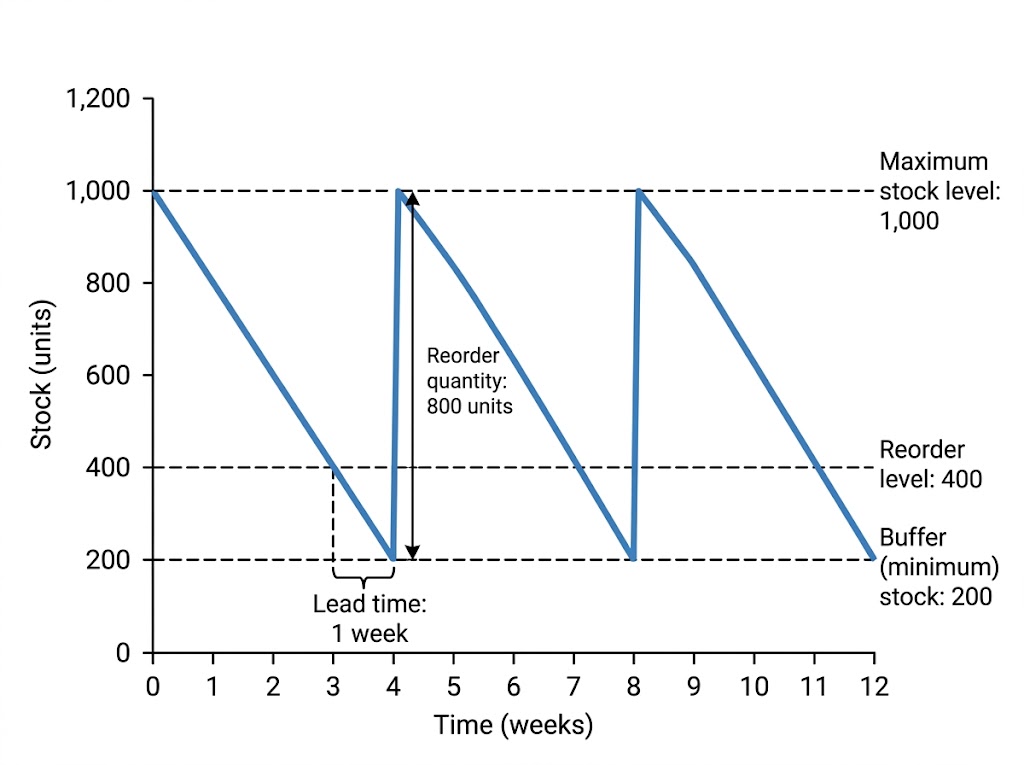
Stock falls as it is used, is reordered at 400 units, and is topped back up to 1,000 when the delivery arrives.
The Parts of a Bar Gate Stock Graph
-
Maximum stock level
Meaning: The most stock the business wants to hold. On the graph: 1,000 units
-
Reorder level
Meaning: The stock level at which a new order is placed. On the graph: 400 units
-
Buffer (minimum) stock
Meaning: The lowest level stock should fall to, kept for emergencies. On the graph: 200 units
-
Reorder quantity
Meaning: The amount ordered each time. On the graph: 800 units
-
Lead time
Meaning: The time between placing an order and it arriving. On the graph: 1 week
Using the Graph
Work out what is used during the lead time.
The business uses 200 units a week and reorders when stock falls to 400 units. The lead time is 1 week. How much stock will be left when the delivery arrives, and what will stock be after the 800-unit delivery?
- 1 Stock used during the lead time 200 units a week × 1 week = 200 units
- 2 Stock left when the delivery arrives 400 - 200 = 200 units (the buffer stock)
- 3 Stock after the delivery 200 + 800 = 1,000 units (the maximum)
Answer200 units left; 1,000 units after the delivery.
Just-in-Time (JIT) Stock Control
Advantages
- Very little money tied up in stock.
- Low storage, insurance and waste costs.
- Less space needed, so smaller premises.
- Stock is always fresh and up to date.
Disadvantages
- Production stops if a delivery is late.
- Relies on very reliable suppliers.
- Frequent small deliveries can cost more.
- Cannot meet a sudden rise in demand.
- Loses bulk-buying discounts.
How JIT Works
Just-in-time means ordering materials to arrive exactly when they are needed, and holding little or no stock.
-
Frequent deliveries
Suppliers deliver small amounts often, sometimes several times a day.
-
Close relationships
The business and its suppliers share production plans so deliveries arrive on time.
-
Suits
Businesses with reliable suppliers nearby and predictable demand, such as car makers and supermarkets.
Factors in Choosing a Supplier
-
Quality
Materials must be good enough to make a quality product; poor materials mean faults and complaints.
-
Delivery
The cost, speed and reliability of delivery - late deliveries stop production.
-
Availability
The supplier must be able to supply the quantities needed, when they are needed.
-
Cost
A lower price reduces the business's costs, but the cheapest is not always the best.
-
Trust
A reliable supplier with a good track record, who communicates honestly when problems arise.
Stock on the Shelves
Modern businesses track every item of stock with barcodes and software. The system can warn managers - or even order automatically - when stock reaches the reorder level.
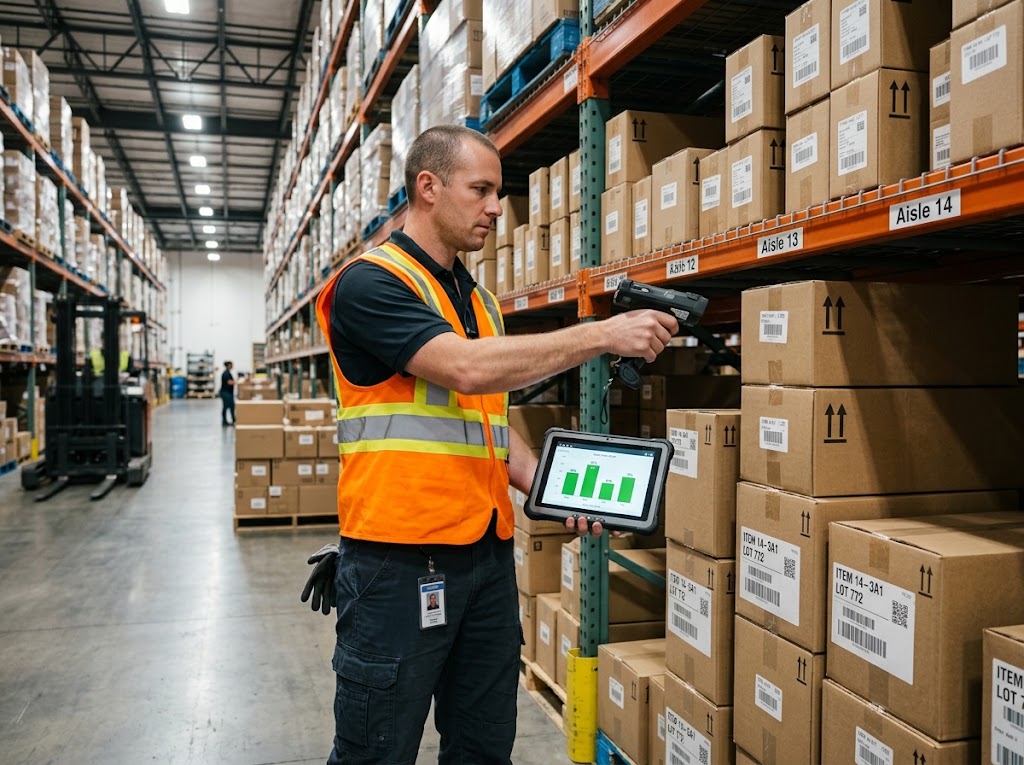
Barcode scanning keeps an exact, up-to-date record of stock.
The Effect of Supply Decisions
Logistics is the management of getting materials in and products out on time. Supply decisions affect the whole business.
-
Costs
Cheaper suppliers and efficient deliveries reduce costs; unreliable ones cause expensive delays.
-
Reputation
Poor-quality materials or unethical suppliers can damage the business's reputation.
-
Customer satisfaction
Products in stock, of good quality and delivered on time keep customers happy and loyal.
Case study
Toyota and the Chip Shortage
Toyota developed just-in-time production in Japan, and car makers around the world copied it. JIT kept their stock costs extremely low. But in 2021 a worldwide shortage of computer chips showed the risk. Modern cars need hundreds of chips, and car makers holding little stock could not get enough. Factories around the world, including in the UK, had to cut or stop production, and customers waited months for new cars. Many businesses began holding more buffer stock of key parts.
Stock Detective
A café uses 50 bags of coffee beans a week. Its maximum stock is 300 bags, its reorder level is 150 bags, its buffer stock is 50 bags and the lead time is 2 weeks. Sketch the bar gate stock graph for 12 weeks. Then explain one risk if the supplier's lead time increased to 3 weeks.
1. Draw the graph with the levels labelled.
2. Mark the reorder point and delivery each time.
3. Explain the risk of a longer lead time.
A good answer shows: A correct saw-tooth graph with all levels labelled, and the risk that the café runs out - stock would fall to 0 before delivery.
Can I...?
- 1Explain why businesses manage stock.
- 2Read and label a bar gate stock graph.
- 3Calculate stock levels from a graph.
- 4Explain just-in-time.
- 5Give advantages and disadvantages of JIT.
- 6Explain the five factors in choosing a supplier.
- 7Explain how supply decisions affect costs, reputation and customer satisfaction.
Summary & Exam Focus
- A bar gate stock graph shows maximum stock, reorder level, buffer stock, reorder quantity and lead time.
- JIT holds little stock, cutting costs, but relies on reliable suppliers.
- Suppliers are chosen on quality, delivery, availability, cost and trust.
- Supply decisions affect costs, reputation and customer satisfaction.
Exam focus
Explain one disadvantage to a business of using just-in-time stock control. (3 marks) (3 marks)
For bar gate graphs, read the numbers carefully off the axes and show your working. For JIT, link any answer to the reliability of suppliers.
Key terms
The vocabulary this lesson expects you to use. Each one is linked from the first place it appears above.
- Stock
- Raw materials, components and finished goods held by a business.
- Bar gate stock graph
- A graph showing how stock levels rise and fall over time.
- Reorder level
- The stock level at which a new order is placed.
- Buffer stock
- The minimum stock kept for emergencies.
- Lead time
- The time between ordering stock and it arriving.
- Just-in-time (JIT)
- Ordering stock to arrive exactly when it is needed, holding little or none.
- Procurement
- Finding and buying the materials and services a business needs.
- Logistics
- Managing the movement of materials and products into and out of a business.
Questions and answers
8 questions set on this lesson, with the mark schemes and model answers open.
Define the term 'lead time'.
Mark scheme — 1 mark available
- Time between ordering and delivery — 1 mark
Model answer
The time between placing an order for stock and the stock arriving.
A business uses 150 units of stock a day. It reorders when stock falls to 600 units, and the lead time is 3 days. Calculate how many units will be left when the delivery arrives. You are advised to show your working.
Mark scheme — 2 marks available
- Correct method: reorder level - (daily use × lead time) — 1 mark
- Correct answer: 150 units — 1 mark (award 2 marks for the correct answer with no working)
Model answer
Stock used during the lead time = 150 × 3 = 450 units. Stock left = 600 - 450 = 150 units.
Outline one reason why a business holds buffer stock.
Mark scheme — 2 marks available
- A reason identified — 1 mark
- Developed — 1 mark
Model answer
To keep production going if a delivery is late (1), so the business does not run out of materials and let customers down (1).
Explain one disadvantage to a business of using just-in-time stock control.
Mark scheme — 3 marks available
- A disadvantage identified, e.g. relies on suppliers / cannot meet sudden demand / lost bulk discounts — 1 mark
- First linked point of explanation — 1 mark
- Second linked point of explanation — 1 mark
Model answer
Production may stop if a supplier delivers late (1). Because the business holds almost no stock, it has nothing to fall back on (1). This means it cannot meet customer orders, losing sales and damaging its reputation (1).
Source: Pedal Power Ltd makes electric bikes. It needs a new supplier of batteries. Supplier A is based in the UK, delivers within 2 days and has a strong reputation for quality, but charges £180 per battery. Supplier B is based in Asia, charges £120 per battery, but deliveries take 6 weeks and it has had some quality complaints. Justify which supplier Pedal Power Ltd should choose.
Mark scheme — 9 marks available
- AO2 (Application, 3 marks): uses the context - electric bikes, £180 vs £120, 2 days vs 6 weeks, quality complaints — Level 1-3
- AO3a (Analysis, 3 marks): chains of reasoning about each supplier — Level 1-3
- AO3b (Evaluation, 3 marks): a justified choice with a supported judgement — Level 1-3
Model answer
Supplier B would cut Pedal Power's costs by £60 per battery, which on thousands of bikes would greatly increase profit or allow lower prices. However, a 6-week lead time means Pedal Power must hold much more stock, tying up cash, and it cannot react quickly to changes in demand. Its quality complaints are also a serious risk: a faulty battery in an electric bike could be dangerous and damage Pedal Power's reputation. Supplier A is more expensive, but its 2-day delivery means Pedal Power can hold little stock, and its reputation for quality protects Pedal Power's brand. On balance Pedal Power should choose Supplier A, because batteries are the most important and safety-critical part of an electric bike, and poor quality could cost far more in recalls and lost reputation than the £60 saving. This depends on whether customers will accept a higher bike price.
On a bar gate stock graph, what is the reorder level?
Why: The reorder level is the stock level at which a new order is placed.
What is the main advantage of just-in-time stock control?
Why: Holding little stock means less money tied up and lower storage costs.
A business uses 100 units a week, reorders at 300 units and has a lead time of 2 weeks. How much stock is left when the delivery arrives?
Why: 100 × 2 = 200 units used during the lead time; 300 - 200 = 100 units.