1.9 Electronic structure
How electrons are arranged in shells (energy levels) for the first 20 elements, writing electronic structures such as 2.8.1 and drawing them, and how the number of outer electrons and shells links to the group and period in the periodic table.
Electron shells
Key terms
- Electron shell (energy level): a region around the nucleus where electrons are found.
- Electronic structure: the arrangement of electrons in the shells, written as numbers separated by dots, such as 2.8.1.
- Outer shell: the highest occupied energy level, which decides how an element reacts.
Electrons occupy the lowest available energy levels (the shells closest to the nucleus) first. For the first 20 elements:
- the first shell holds up to 2 electrons
- the second shell holds up to 8
- the third shell holds up to 8 (for the first 20 elements), then the fourth shell starts.
Writing and drawing them
Sodium has 11 electrons: 2 in the first shell, 8 in the second and 1 in the third, so its electronic structure is 2.8.1.
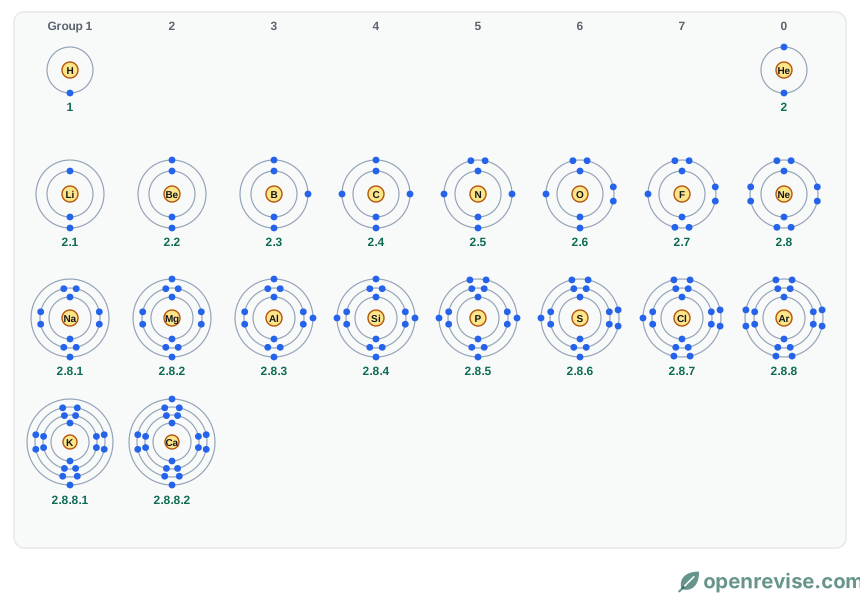
To draw one, draw the nucleus with the symbol, then circles for the shells, and add the electrons as dots or crosses, usually in pairs.
Links to the periodic table
- The number of shells that contain electrons equals the period (row). Sodium has 3 shells, so it is in period 3.
- The number of electrons in the outer shell equals the group number (for groups 1 to 7). Sodium has 1 outer electron, so it is in group 1.
- Group 0 elements have a full outer shell (helium has 2, the others 8).
Elements in the same group have the same number of outer electrons, which is why they have similar chemical properties.
Test yourself on this lesson
6 exam questions · 11 marks · with mark schemes and model answers
Found a mistake?