1.10 The modern periodic table
How the modern periodic table is arranged by atomic number into groups and periods, how an element's position links to its electronic structure, and the positions and properties of metals and non-metals.
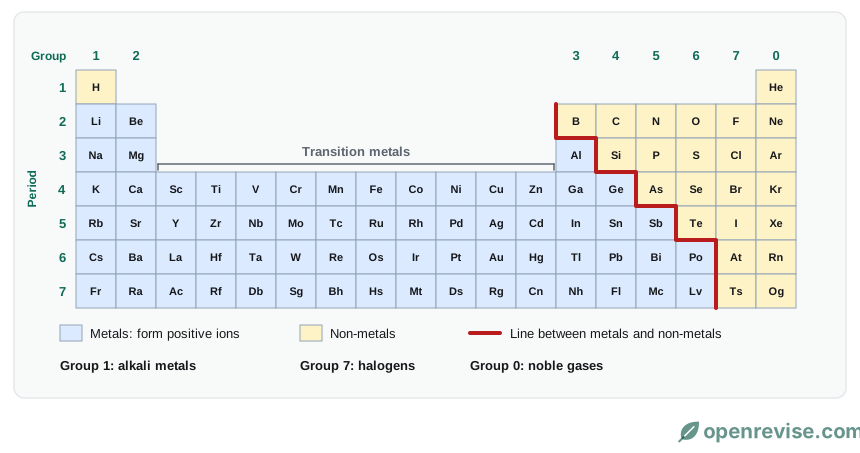
How the table is arranged
Key terms
- Atomic number: the number of protons in the nucleus of an atom. The modern periodic table is in order of atomic number.
- Group: a vertical column of the periodic table. Elements in a group have the same number of outer-shell electrons.
- Period: a horizontal row of the periodic table. Elements in a period have the same number of occupied electron shells.
- Elements are arranged in order of increasing atomic number.
- Elements with similar properties are in the same group (column).
- For Groups 1 to 7, the group number = the number of outer electrons. Group 0 atoms have a full outer shell.
- The period number = the number of shells that contain electrons.
Example: chlorine is 2.8.7. It has 7 outer electrons, so it is in Group 7, and 3 shells, so it is in Period 3.
Elements in the same group react in similar ways because chemical reactions involve the outer electrons, and they have the same number of them.
Metals and non-metals
Most elements are metals. They are on the left and in the middle of the table. The non-metals are on the right, plus hydrogen. A stepped line separates them.
| Property | Metals | Non-metals |
|---|---|---|
| Appearance | shiny | dull |
| Melting and boiling points | usually high | usually low |
| Density | usually high | usually low |
| Conduct electricity | yes | no (except graphite) |
| Solid form | malleable (can be hammered into shape) | brittle |
| Ions formed | positive ions | negative ions, or share electrons |
| Oxides | basic | acidic |
Why the division?
The position of an element depends on its electronic structure:
- Metal atoms usually have 1, 2 or 3 outer electrons. They lose these to form positive ions.
- Non-metal atoms usually have 4 to 7 outer electrons. They gain or share electrons instead.
So you can predict how an element will react from where it is in the table.
Test yourself on this lesson
6 exam questions · 12 marks · with mark schemes and model answers
Found a mistake?