1.8 Isotopes and relative atomic mass
What isotopes are (atoms of the same element with different numbers of neutrons), how to write them, why relative atomic masses are often not whole numbers, and how to calculate relative atomic mass from isotope masses and abundances.
Isotopes
Key terms
- Isotopes: atoms of the same element with the same number of protons but different numbers of neutrons.
- Abundance: the percentage of an element's atoms that are a particular isotope.
- Relative atomic mass (A_\mathrm{r}): the average mass of an element's atoms, taking into account the abundance of each isotope.
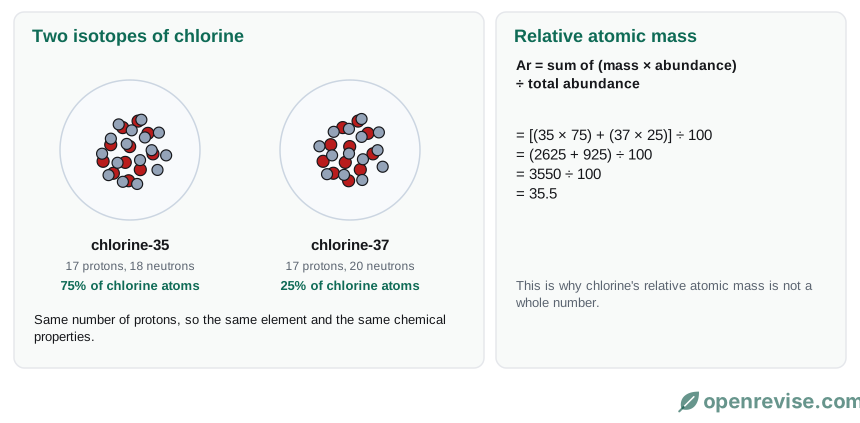
Isotopes have the same atomic number but different mass numbers. Because they have the same number of protons and electrons, they have the same chemical properties.
Examples:
- Carbon-12 (6 protons, 6 neutrons) and carbon-14 (6 protons, 8 neutrons)
- Chlorine-35 (17 protons, 18 neutrons) and chlorine-37 (17 protons, 20 neutrons).
Relative atomic mass
Most elements are a mixture of isotopes, so the relative atomic mass is an average. It is often not a whole number.
Example: chlorine is 75% chlorine-35 and 25% chlorine-37.
A_\mathrm{r} = (35 × 75 + 37 × 25) ÷ 100 = (2625 + 925) ÷ 100 = 35.5
The A_\mathrm{r} is closer to 35 than to 37, because there is more chlorine-35.
Another example
Copper is 69% copper-63 and 31% copper-65.
A_\mathrm{r} = (63 × 69 + 65 × 31) ÷ 100 = (4347 + 2015) ÷ 100 = 63.6 (to 1 decimal place)
Test yourself on this lesson
5 exam questions · 10 marks · with mark schemes and model answers
Found a mistake?