1.7 Protons, neutrons and electrons
The structure of an atom: a tiny nucleus of protons and neutrons surrounded by electrons; their relative charges and masses; atomic number and mass number; working out the numbers of each particle; and the sizes of atoms and nuclei.
AQA
Edexcel
OCR
1 min read
Inside an atom
Key terms
- Nucleus: the tiny centre of an atom, containing protons and neutrons.
- Atomic number: the number of protons in the nucleus of an atom.
- Mass number: the total number of protons and neutrons in the nucleus.
An atom has a small central nucleus made of protons and neutrons, surrounded by electrons in shells (energy levels).
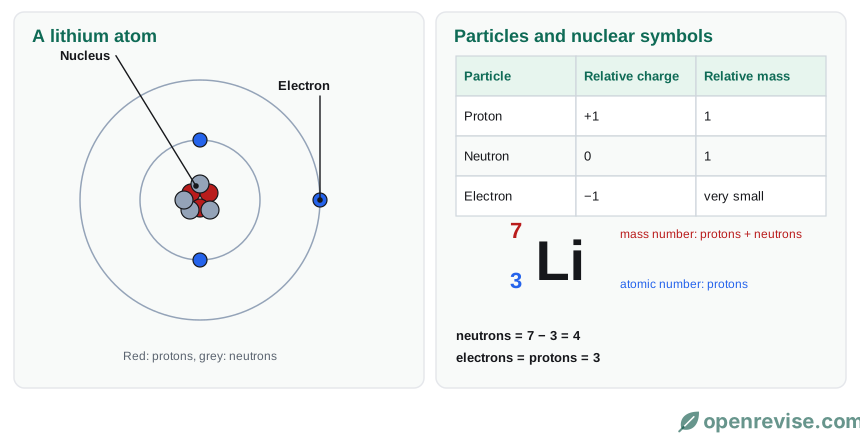
| Particle | Relative charge | Relative mass | Where it is |
|---|---|---|---|
| Proton | +1 | 1 | Nucleus |
| Neutron | 0 | 1 | Nucleus |
| Electron | −1 | Very small (about 1/2000) | Shells around the nucleus |
- An atom has no overall charge, because the number of electrons equals the number of protons.
- Almost all the mass is in the nucleus.
- All atoms of an element have the same number of protons, and this number is unique to that element. It is the atomic number, which places the element in the periodic table.
Working out the particles
For lithium-7 (mass number 7, atomic number 3):
- protons = atomic number = 3
- electrons = protons = 3 (in an atom)
- neutrons = mass number − atomic number = 7 − 3 = 4.
In an ion, the number of electrons is different: a 2+ ion has lost 2 electrons, and a 1− ion has gained 1 electron. For example, a sodium ion \mathrm{Na^+} has 11 protons and 10 electrons.
How big are atoms?
- Atoms have a radius of about 0.1 nm (1 × 10⁻¹⁰ m).
- The radius of the nucleus is about 1/10 000 of the radius of the atom (about 1 × 10-14 m).
- Small molecules are about 1 × 10⁻⁹ m across.
Test yourself on this lesson
6 exam questions · 12 marks · with mark schemes and model answers
Found a mistake?