1.6 Developing the model of the atom
How the model of the atom developed from Dalton's solid spheres to Thomson's plum pudding, Rutherford's nuclear model from the alpha scattering experiment, Bohr's electron shells and Chadwick's discovery of the neutron, and why models change with new evidence.
AQA
Edexcel
OCR
1 min read
Why models change
Key terms
- Model: a simplified way of showing or explaining something we cannot see directly.
- Plum pudding model: Thomson's model of the atom as a ball of positive charge with electrons embedded in it.
- Nuclear model: Rutherford's model of the atom with a tiny, dense, positive nucleus and electrons around it.
Scientific models change when new experimental evidence cannot be explained by the old model.
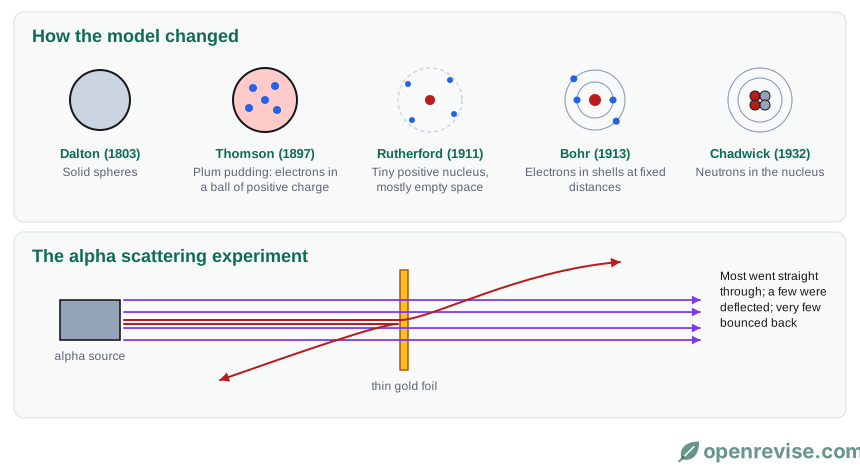
The story of the atom
- Before electrons were discovered, atoms were thought to be tiny spheres that could not be divided. John Dalton (early 1800s) described atoms as solid spheres, with different spheres for different elements.
- J.J. Thomson discovered the electron (1897). Atoms could therefore be divided. He proposed the plum pudding model: a ball of positive charge with negative electrons embedded in it.
- In the alpha particle scattering experiment (1909), Geiger and Marsden, working with Ernest Rutherford, fired positive alpha particles at thin gold foil:
- most passed straight through, so the atom is mostly empty space
- some were deflected, so the centre is positively charged
- a very few bounced back, so the mass is concentrated in a tiny nucleus. This led to the nuclear model (1911), which replaced the plum pudding model.
- Niels Bohr (1913) suggested that electrons orbit the nucleus at specific distances (shells or energy levels). His calculations agreed with experimental observations.
- Later experiments showed the positive charge is made of particles called protons.
- James Chadwick (1932) provided the evidence for neutrons in the nucleus.
Test yourself on this lesson
5 exam questions · 10 marks · with mark schemes and model answers
Found a mistake?