1.3 Hazard symbols and working safely
Edexcel: the hazard pictograms on chemical containers (flammable, oxidising, corrosive, toxic, harmful, health hazard, environmental hazard, explosive), what they warn about, and how to evaluate risks and choose precautions in practical work.
Edexcel
2 min read
Why hazard symbols are used
Key terms
- Hazard: something that could cause harm.
- Risk: the chance that a hazard will cause harm.
- Precaution: an action taken to reduce a risk.
Hazard symbols on containers of chemicals:
- show the dangers associated with the contents
- tell people about safe-working precautions when they use the chemicals in the lab or in industry.
They are recognised worldwide, so people can understand them whatever language they speak.
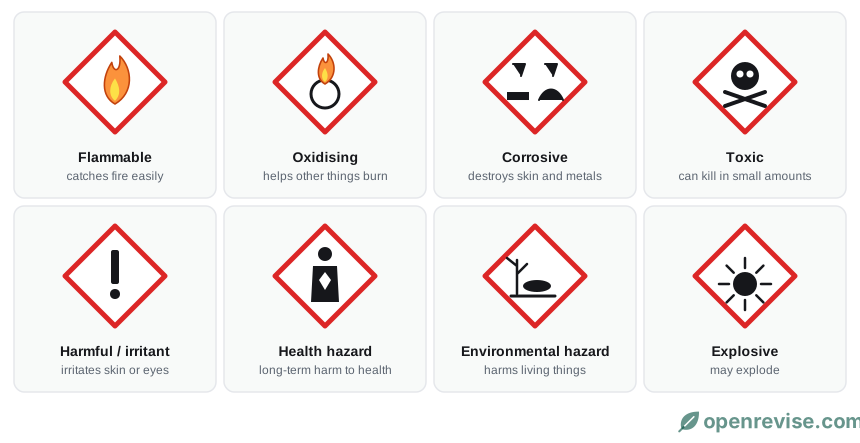
| Symbol | Meaning | Example | Precaution |
|---|---|---|---|
| Flammable | Catches fire easily | Ethanol | Keep away from flames |
| Oxidising | Provides oxygen, making other things burn more fiercely | Hydrogen peroxide | Keep away from flammable materials |
| Corrosive | Attacks and destroys living tissue, such as skin and eyes | Concentrated sulfuric acid, sodium hydroxide | Wear gloves and eye protection |
| Toxic | Can cause death if swallowed, breathed in or absorbed through skin | Chlorine, mercury | Use in a fume cupboard; wear gloves |
| Harmful / irritant | Can cause irritation, such as reddening or blistering of skin | Dilute acids, copper sulfate | Avoid contact with skin; wear eye protection |
| Health hazard | Can cause long-term health effects, such as cancer | Some solvents | Avoid breathing in; use in a fume cupboard |
| Environmental hazard | Harmful to living things in the environment | Mercury compounds | Dispose of safely, not down the sink |
Evaluating risks in a practical
For any practical, think about:
- the hazards: which chemicals and equipment could cause harm (hot apparatus, glass, chemicals)
- the risk: how likely harm is, and how serious it would be
- the precautions: for example wearing eye protection, using lower concentrations, heating with a water bath instead of a flame, working in a fume cupboard, keeping flammable liquids away from flames.
Test yourself on this lesson
5 exam questions · 8 marks · with mark schemes and model answers
Found a mistake?