1.4 Filtration and crystallisation
How filtration separates an insoluble solid from a liquid and how crystallisation obtains a soluble solid from a solution, with the apparatus and method for each and how to choose a separation technique.
Choosing a separation method
Key terms
- Filtration: separating an insoluble solid from a liquid using filter paper.
- Residue: the solid left in the filter paper.
- Filtrate: the liquid that passes through the filter paper.
- Crystallisation: getting a soluble solid from a solution by evaporating some of the solvent and letting crystals form.
Because the parts of a mixture are not chemically joined, they can be separated by physical processes. The method depends on their properties.
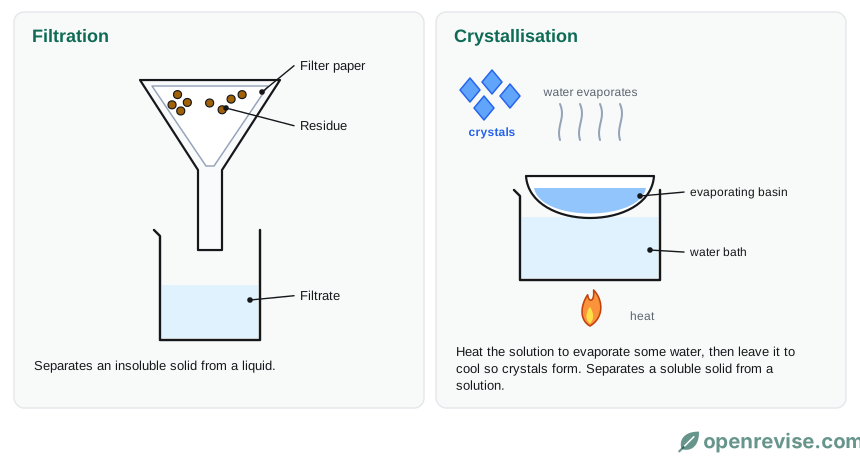
Filtration
Used to separate an insoluble solid from a liquid, such as sand from water, or excess copper oxide from copper sulfate solution.
- Fold a filter paper into a cone and put it in a filter funnel over a beaker or conical flask.
- Pour the mixture in. The liquid passes through the tiny holes in the paper as the filtrate.
- The solid particles are too big to pass through, so they stay as the residue.
Crystallisation
Used to get a soluble solid from a solution, such as salt from salt water or copper sulfate crystals.
- Pour the solution into an evaporating basin.
- Heat it gently, ideally over a water bath, to evaporate some of the water until crystals start to form at the edge (the solution is saturated).
- Leave it to cool: crystals form as the solubility falls.
- Filter off the crystals and dry them between filter papers or in a warm oven.
Heating gently, rather than boiling the solution dry, gives larger, purer crystals and does not decompose solids such as hydrated salts.
Example: rock salt
Rock salt is salt mixed with sand. Add water and stir to dissolve the salt, filter to remove the sand, then crystallise the salt from the filtrate.
Test yourself on this lesson
5 exam questions · 11 marks · with mark schemes and model answers
Found a mistake?