1.5 Simple and fractional distillation
How simple distillation separates a liquid from a solution (such as pure water from salt water) and how fractional distillation separates liquids with different boiling points (such as ethanol and water), with the apparatus and why each part is used.
Simple distillation
Key terms
- Distillation: separating a liquid from a mixture by evaporating it and then condensing the vapour.
- Distillate: the liquid collected after condensing.
- Condenser: a tube cooled by cold water, which turns vapour back into liquid.
- Fractional distillation: separating a mixture of liquids with different boiling points.
Simple distillation separates a liquid from a solution, for example pure water from sea water or ink.
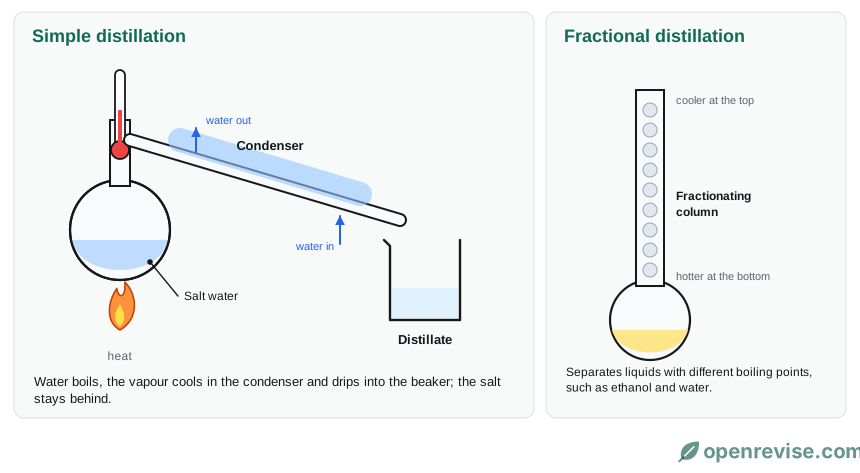
- Heat the solution in a flask. The solvent boils and turns to vapour; the dissolved solid does not.
- The vapour passes into the condenser, which is kept cold by water flowing through its outer jacket (in at the bottom, out at the top, so it stays full).
- The vapour condenses back to liquid and drips into a beaker as the distillate.
- The thermometer at the side arm shows the boiling point of the substance being collected.
The solid is left behind in the flask. This is how drinking water can be made from sea water in very dry countries, and Edexcel's core practical distils the water out of ink.
Fractional distillation
Fractional distillation separates liquids with different boiling points, such as ethanol (78 °C) and water (100 °C).
- Heat the mixture. Vapours of both liquids rise into the fractionating column, which is hot at the bottom and cooler at the top.
- The liquid with the lower boiling point reaches the top of the column first and passes into the condenser.
- Liquids with higher boiling points condense in the column and drip back down.
- When the temperature at the top rises, a different liquid (fraction) is being collected, so change the beaker.
Fractional distillation is used to separate crude oil into fractions and to separate the gases in liquid air.
Test yourself on this lesson
6 exam questions · 11 marks · with mark schemes and model answers
Found a mistake?