1.12 Group 0: the noble gases
Why the noble gases are unreactive and exist as single atoms, how their boiling points change down the group, how to predict properties from the trend, and how their uses depend on their properties.
AQA
Edexcel
OCR
2 min read
The noble gases
Key terms
- Noble gases: the elements in Group 0 (helium, neon, argon, krypton, xenon and radon).
- Inert: very unreactive; does not take part in chemical reactions easily.
- Monatomic: existing as single atoms rather than as molecules.
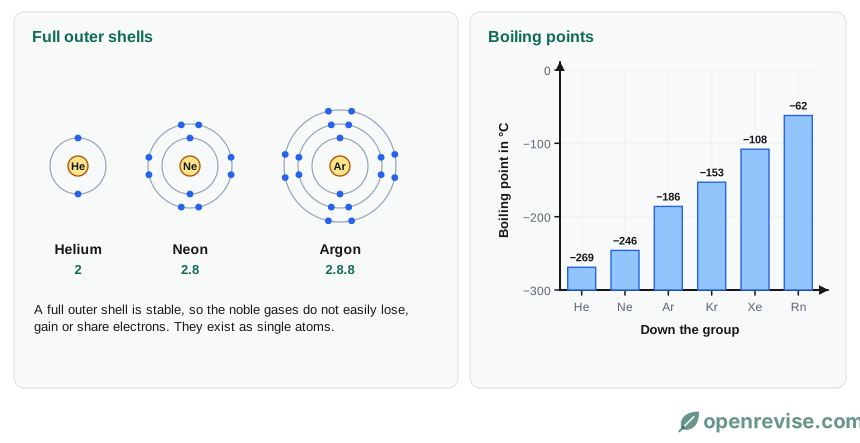
- Their atoms have a full outer shell of electrons: helium has 2, and the others have 8.
- This is a stable arrangement, so they do not easily lose, gain or share electrons. They are unreactive (inert).
- Because they do not bond, they exist as single atoms (they are monatomic), not as molecules like O2.
- They are all colourless gases at room temperature and are non-flammable.
Trends down the group
- Boiling points increase down the group, as the relative atomic mass increases. The atoms are larger with more electrons, so the forces between atoms are stronger and more energy is needed to separate them.
- Density increases down the group.
| Element | Relative atomic mass | Boiling point in °C |
|---|---|---|
| Helium | 4 | −269 |
| Neon | 20 | −246 |
| Argon | 40 | −186 |
| Krypton | 84 | −153 |
| Xenon | 131 | −108 |
| Radon | 222 | −62 |
Uses depend on properties
- Helium in balloons and airships: it is much less dense than air and, unlike hydrogen, it is non-flammable.
- Argon in filament lamps: it is inert, so the very hot metal filament does not react with it (in air, the filament would burn in oxygen).
- Argon as a shield gas in welding: it stops the hot metal reacting with oxygen.
- Neon in advertising signs: it glows when electricity passes through it and does not react.
Test yourself on this lesson
6 exam questions · 11 marks · with mark schemes and model answers
Found a mistake?