1.11 Mendeleev and the development of the periodic table
How early scientists ordered the elements by atomic weight, how Mendeleev left gaps and predicted the properties of undiscovered elements, and how the discovery of protons and isotopes explained his order.
Early attempts
Before protons, neutrons and electrons were discovered, scientists tried to classify the elements by putting them in order of their atomic weight (relative atomic mass).
- The early tables were incomplete, because many elements had not been discovered.
- If the strict order of atomic weight was followed, some elements were put in groups with elements that had very different properties.
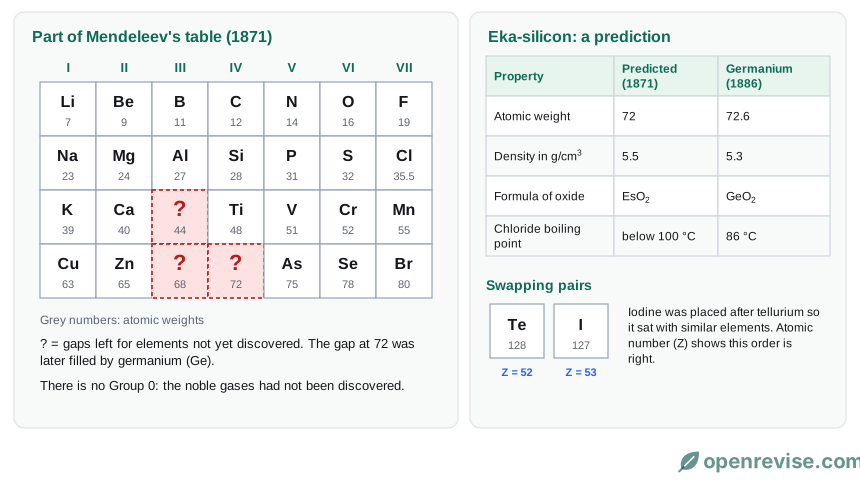
Mendeleev's table (1869)
Key terms
- Atomic weight: the old name for relative atomic mass, used to order the elements before atomic number was known.
Dmitri Mendeleev:
- put the elements roughly in order of atomic weight, but also used their properties and the properties of their compounds (such as the formulae of their oxides);
- left gaps for elements that he thought had not been discovered yet;
- swapped some pairs of elements (such as tellurium and iodine) so that each was in a group with similar elements;
- predicted the properties of the missing elements from the elements around each gap.
Evidence that he was right
When gallium (1875), scandium (1879) and germanium (1886) were discovered, they fitted the gaps and their properties matched his predictions closely. This convinced other scientists that his table was useful.
| Property | Predicted by Mendeleev | Germanium |
|---|---|---|
| Atomic weight | 72 | 72.6 |
| Density in g/cm3 | 5.5 | 5.3 |
| Formula of oxide | EsO2 | GeO2 |
The modern explanation
Mendeleev thought he had ordered the elements by atomic weight, but this was not always true. Tellurium (128) comes before iodine (127).
Once protons were discovered, the elements were ordered by atomic number: tellurium is 52 and iodine is 53, so Mendeleev's order was correct.
The atomic weights are out of order because of isotopes: tellurium has a higher proportion of heavier isotopes (more neutrons), so its relative atomic mass is higher even though it has fewer protons. Argon (40) and potassium (39) are another example.
The noble gases (Group 0) were added later, after they were discovered. They are unreactive, so they were hard to find.
Test yourself on this lesson
5 exam questions · 11 marks · with mark schemes and model answers
Found a mistake?