1.13 Group 1: the alkali metals
The properties of the alkali metals, their reactions with water, oxygen and chlorine with equations, and why reactivity increases down Group 1 in terms of the outer electron.
The alkali metals
Key terms
- Alkali metals: the elements in Group 1, such as lithium, sodium and potassium. They react with water to form alkaline solutions.
Their atoms all have one electron in the outer shell, so they react in similar ways.
Physical properties:
- soft: they can be cut with a knife
- shiny when freshly cut, but they quickly tarnish (go dull) as they react with oxygen in the air
- low density: lithium, sodium and potassium float on water
- low melting points, which decrease down the group
They are stored under oil to stop them reacting with oxygen and water vapour in the air.
Reactions with water
metal + water → metal hydroxide + hydrogen
2Na + 2H2O → 2NaOH + H2
The metal hydroxide dissolves to form an alkaline solution (universal indicator turns purple).
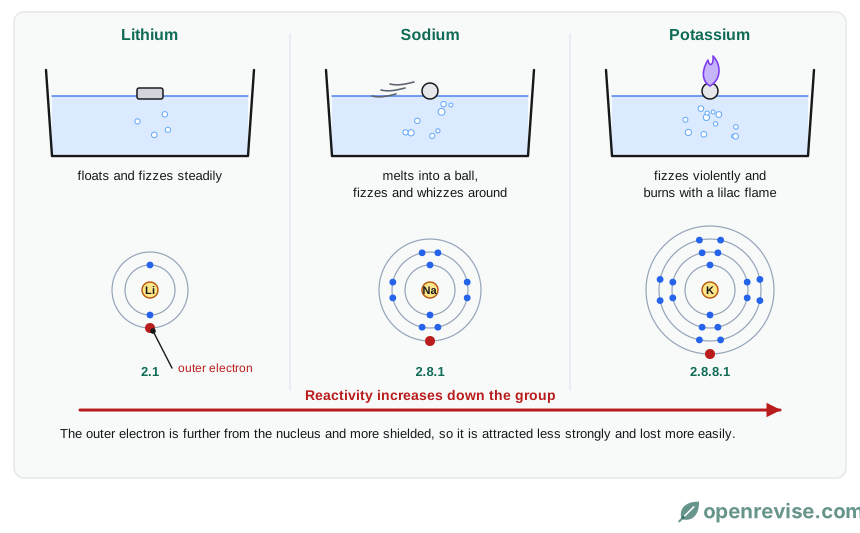
| Metal | What you see |
|---|---|
| Lithium | floats, fizzes steadily, slowly gets smaller |
| Sodium | floats, melts into a ball, fizzes quickly and whizzes around |
| Potassium | floats, melts, fizzes violently and burns with a lilac flame |
Reactions with oxygen and chlorine
- With oxygen they form metal oxides: 4Na + O2 → 2Na2O
- With chlorine they form metal chlorides, which are white solids: 2Na + Cl2 → 2NaCl
The products are ionic compounds containing 1+ metal ions, such as \mathrm{Na^+}. They are white solids that dissolve to give colourless solutions.
Why reactivity increases down the group
In every reaction, the atom loses its one outer electron to form a 1+ ion. Going down the group:
- The atoms have more shells, so the outer electron is further from the nucleus.
- There is more shielding by the inner electrons.
- So the attraction between the nucleus and the outer electron is weaker.
- The outer electron is lost more easily, so the metal is more reactive.
You can use this to predict that rubidium and caesium react even more violently, exploding in water.
Test yourself on this lesson
6 exam questions · 13 marks · with mark schemes and model answers
Found a mistake?