1.14 Group 7: the halogens
The colours, states and trends in physical properties of the halogens, the test for chlorine, their reactions with metals and hydrogen, and why reactivity decreases down Group 7.
The halogens
Key terms
- Halogens: the elements in Group 7, such as fluorine, chlorine, bromine and iodine. Their atoms have 7 outer electrons.
- Diatomic molecule: a molecule made of two atoms joined by a covalent bond, such as Cl2.
The halogens are non-metals. They exist as diatomic molecules: F2, Cl2, Br2 and I2. They are toxic, so they are handled in a fume cupboard.
| Halogen | Colour and state | Melting point in °C | Boiling point in °C |
|---|---|---|---|
| Fluorine | pale yellow gas | −220 | −188 |
| Chlorine | pale green gas | −101 | −34 |
| Bromine | red-brown liquid (orange vapour) | −7 | 59 |
| Iodine | dark grey solid (purple vapour) | 114 | 184 |
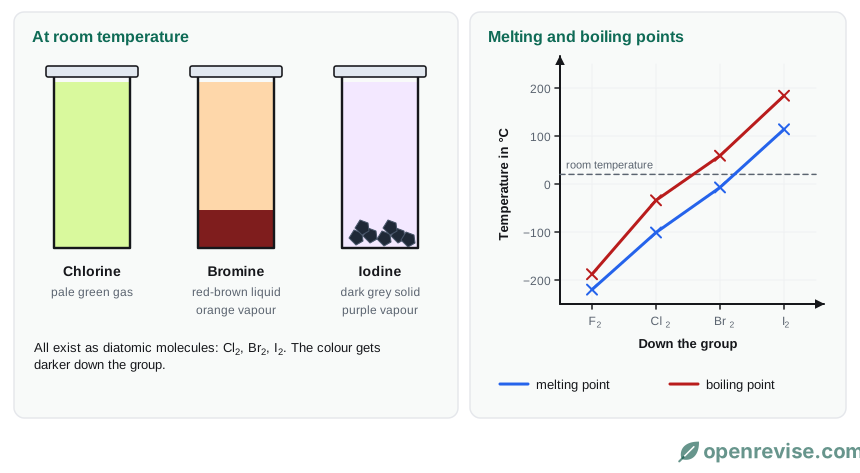
Trends in physical properties
Going down the group:
- melting and boiling points increase, because the molecules get larger (higher relative molecular mass), so the forces between molecules are stronger
- the colour gets darker
- the state changes from gas to liquid to solid
So you can predict that astatine, below iodine, is a dark solid with an even higher melting point.
Test for chlorine
Hold damp blue litmus paper in the gas. Chlorine turns it red and then bleaches it white.
Reactions
- With metals, halogens form metal halides (salts). These are ionic, with a 1− halide ion such as \mathrm{Cl^-}. 2Na + Cl2 → 2NaCl and 2Fe + 3Cl2 → 2FeCl3
- With hydrogen, halogens form hydrogen halides: H2 + Cl2 → 2HCl
- Hydrogen halides are gases that dissolve in water to form acidic solutions. Hydrogen chloride forms hydrochloric acid.
- With other non-metals, halogens form covalent compounds made of molecules.
Why reactivity decreases down the group
A halogen atom reacts by gaining one electron to complete its outer shell. Going down the group:
- The atoms have more shells, so the outer shell is further from the nucleus.
- There is more shielding by inner electrons.
- So there is a weaker attraction for an extra electron.
- An electron is gained less easily, so the halogen is less reactive.
Fluorine is the most reactive halogen.
Test yourself on this lesson
6 exam questions · 12 marks · with mark schemes and model answers
Found a mistake?