1.15 Halogen displacement reactions
How a more reactive halogen displaces a less reactive one from a solution of its salt, the colour changes and equations, how to explain the order of reactivity, and (Higher) ionic equations and redox.
Displacement reactions
Key terms
- Displacement reaction: a reaction in which a more reactive element takes the place of a less reactive element in a compound.
- Halide: a compound containing a halogen as a 1− ion, such as potassium bromide.
A more reactive halogen will displace a less reactive halogen from an aqueous solution of its salt.
Method: add a few drops of chlorine water, bromine water or iodine solution to solutions of potassium chloride, potassium bromide and potassium iodide (in a spotting tile or test tubes). A colour change shows that a reaction has happened. Wear eye protection and use a fume cupboard, as the halogens are toxic.
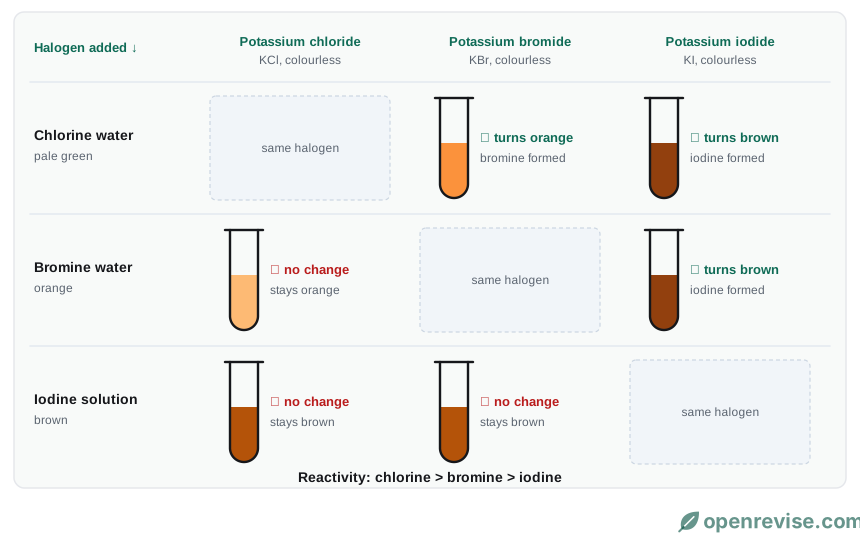
Results and equations
- Chlorine displaces bromine: Cl2 + 2KBr → 2KCl + Br2 (solution turns orange)
- Chlorine displaces iodine: Cl2 + 2KI → 2KCl + I2 (solution turns brown)
- Bromine displaces iodine: Br2 + 2KI → 2KBr + I2 (solution turns brown)
- Iodine cannot displace chlorine or bromine, and bromine cannot displace chlorine: no reaction.
So the order of reactivity is chlorine > bromine > iodine.
Explaining the order
The more reactive halogen gains electrons more easily. Chlorine atoms are smaller than bromine atoms, so their outer shell is closer to the nucleus and attracts an electron more strongly. Chlorine takes an electron from each bromide ion, forming chloride ions and bromine.
Higher: ionic equations and redox
The potassium ions do not change. They are spectator ions and are left out of the ionic equation:
Cl2 + 2\mathrm{Br^-} → 2\mathrm{Cl^-} + Br2
The half equations show what happens to the electrons:
- Cl2 + 2\mathrm{e^-} → 2\mathrm{Cl^-}: chlorine gains electrons, so it is reduced
- 2\mathrm{Br^-} → Br2 + 2\mathrm{e^-}: bromide ions lose electrons, so they are oxidised
Oxidation and reduction happen at the same time, so this is a redox reaction.
Test yourself on this lesson
6 exam questions · 13 marks · with mark schemes and model answers
Found a mistake?