1.16 Transition metals
Where the transition metals are, how their physical and chemical properties compare with Group 1 metals, and their typical properties: ions with different charges, coloured compounds and use as catalysts.
Where are they?
Key terms
- Transition metals: the block of metals in the middle of the periodic table, between Group 2 and Group 3, such as iron, copper and nickel.
- Catalyst: a substance that speeds up a reaction without being used up.
Most metals are transition metals. Typical examples are chromium, manganese, iron, cobalt, nickel and copper.
Compared with Group 1
| Property | Transition metals (e.g. iron) | Group 1 metals (e.g. sodium) |
|---|---|---|
| Melting point | high (iron: 1538 °C) | low (sodium: 98 °C) |
| Density | high (iron: 7.9 g/cm3) | low (sodium: 0.97 g/cm3) |
| Strength and hardness | hard and strong | soft, can be cut with a knife |
| Reactivity with water and oxygen | react slowly or not at all | react quickly |
| Ions | can form ions with different charges | always form 1+ ions |
| Compounds | often coloured | white, giving colourless solutions |
Their strength and high melting points make transition metals useful for building and tools (iron, as steel) and for wires and pipes (copper).
Typical properties
1. Ions with different charges. Iron forms \mathrm{Fe^{2+}} and \mathrm{Fe^{3+}} ions. Copper forms \mathrm{Cu^+} and \mathrm{Cu^{2+}}. Roman numerals in names show the charge: iron(II) oxide is FeO and iron(III) oxide is Fe2O3.
2. Coloured compounds. Many transition metal compounds are coloured. They are used to colour pottery glazes and glass.
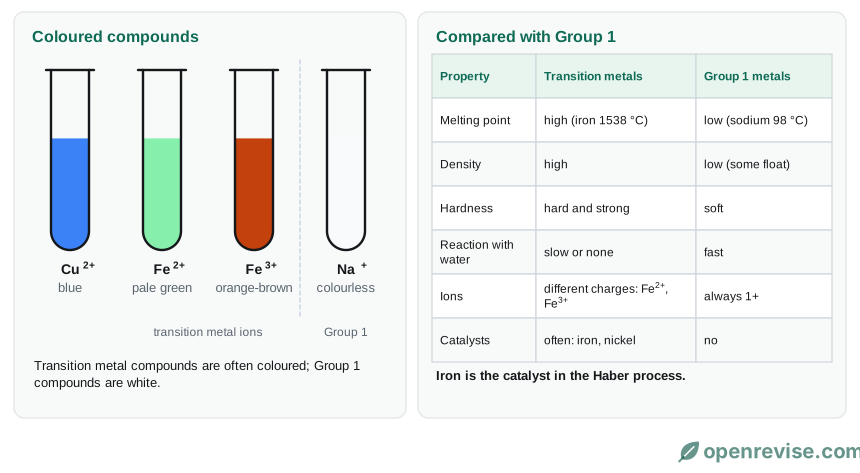
3. Catalysts. Transition metals and their compounds are often useful catalysts:
- iron in the Haber process for making ammonia
- nickel for hardening vegetable oils to make margarine
- manganese(IV) oxide for decomposing hydrogen peroxide
Test yourself on this lesson
6 exam questions · 10 marks · with mark schemes and model answers
Found a mistake?